The main difference between a knife and a dagger is that a knife is primarily designed for cutting, slicing, and everyday tasks, while a dagger is mainly designed for thrusting and piercing. Knives usually have a single-edged blade, whereas daggers typically feature a double-edged pointed blade. Although both are bladed tools, they differ in design, purpose, and historical use.
Imagine you are visiting an outdoor equipment store and notice two sharp tools on display: a knife and a dagger. At first glance, they may look similar because both have blades and handles. However, their purposes are quite different.
This is why many people search for knife vs dagger online. Understanding knife vs dagger helps collectors, history enthusiasts, outdoor adventurers, and students learn how these tools differ.
The confusion often arises because both are handheld blades used throughout history. However, when you examine their design, function, and usage, the distinction becomes clear. In this guide, we will explore knife vs dagger in simple terms, helping you understand which tool is designed for which purpose.
Knife vs Dagger at a Glance
| Feature | Knife | Dagger |
| Best For | Cutting and utility tasks | Piercing and thrusting |
| Blade Edge | Usually single-edged | Usually double-edged |
| Main Purpose | Everyday use | Combat and self-defense |
| Common Users | Chefs, campers, workers | Soldiers, collectors |
| Key Similarity | Both are handheld bladed tools | Both are handheld bladed tools |
What Is the Difference Between Knife and Dagger?
A knife is a versatile cutting tool used for daily tasks such as slicing food, cutting rope, or outdoor work. A dagger is a specialized weapon designed primarily for stabbing and piercing. While both have blades, the knife focuses on utility, whereas the dagger focuses on penetration.
Why Is This Difference Important?
Understanding the difference between a knife and a dagger helps learners understand history, tool design, and safety. Professionals such as historians, collectors, military experts, and outdoor enthusiasts benefit from knowing the distinction. It also helps consumers choose the right tool for a specific task instead of using the wrong blade.
Pronunciation
| Word | US Pronunciation | UK Pronunciation |
| Knife | nyfe | nyfe |
| Dagger | DAG-er | DAG-uh |
Now that we understand the basics, let’s explore the detailed differences between both.
Knife vs Dagger – 10 Key Differences
Purpose
Knife
- Designed for cutting and slicing.
- Example 1: Kitchen knife for vegetables.
- Example 2: Camping knife for rope.
- Real-world relevance: Common household tool.
Dagger
- Designed for thrusting and piercing.
- Example 1: Medieval combat dagger.
- Example 2: Ceremonial dagger.
- Real-world relevance: Historical weapon.
Blade Design
Knife
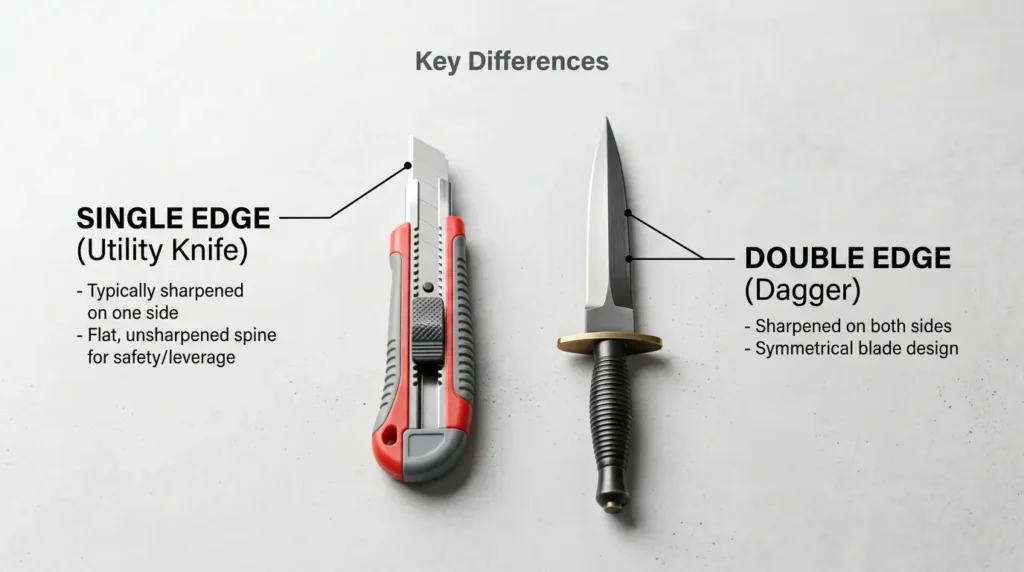
- Usually has one sharp edge.
- Example 1: Chef’s knife.
- Example 2: Pocket knife.
Dagger
- Usually has two sharp edges.
- Example 1: Stiletto dagger.
- Example 2: Medieval dagger.
Tip Shape
Knife
- Tip varies by purpose.
- Example 1: Rounded kitchen knife.
- Example 2: Drop-point hunting knife.
Dagger
- Sharp symmetrical point.
- Example 1: Combat dagger.
- Example 2: Ceremonial dagger.
Historical Role
Knife
- Used as a tool for thousands of years.
- Example 1: Food preparation.
- Example 2: Craftsmanship.
Dagger
- Mainly used as a weapon.
- Example 1: Ancient warfare.
- Example 2: Personal defense.
Everyday Usage
Knife
- Common in homes and workplaces.
- Example 1: Cooking.
- Example 2: Outdoor camping.
Dagger
- Rarely used in everyday life.
- Example 1: Collecting.
- Example 2: Historical displays.
Edge Configuration
Knife
- One cutting edge.
- Example 1: Utility knife.
- Example 2: Bread knife.
Dagger
- Two cutting edges.
- Example 1: Combat dagger.
- Example 2: Push dagger.
User Type
Knife
- Used by chefs, workers, and campers.
- Example 1: Professional chef.
- Example 2: Hiker.
Dagger
- Used by collectors and historians.
- Example 1: Museum curator.
- Example 2: Military collector.
Safety
Knife
- Easier to control for utility tasks.
- Example 1: Food cutting.
- Example 2: Wood carving.
Dagger
- Requires extra caution.
- Example 1: Display handling.
- Example 2: Historical demonstrations.
Legal Status
Knife
- Often legal with restrictions.
- Example 1: Kitchen knife ownership.
- Example 2: Utility knife use.
Dagger
- More heavily regulated in some regions.
- Example 1: Concealed carry laws.
- Example 2: Weapon restrictions.
Collectible Value
Knife
- Collected for craftsmanship.
- Example 1: Handmade knife.
- Example 2: Limited-edition knife.
Dagger
- Collected for historical significance.
- Example 1: Medieval dagger.
- Example 2: Military dagger.
Similarities Between Knife and Dagger
- Both are handheld bladed tools.
- Both have a blade and handle.
- Both have historical importance.
- Both can be collectible items.
- Both require safe handling.
Nature and Characteristics
Knife
Knives are practical, versatile, and designed for everyday utility. Their primary purpose is cutting and slicing.
Dagger
Daggers are specialized, symmetrical, and historically associated with combat, defense, and ceremonial use.
Why Do People Confuse Knife and Dagger?
People confuse them because both have blades and similar appearances. Movies, games, and artwork often use the terms interchangeably. In reality, their design and intended functions are different.
Difference and Similarity Table
| Feature | Knife | Dagger |
| Primary Function | Cutting | Piercing |
| Blade Edges | Usually one | Usually two |
| Everyday Use | Common | Rare |
| Historical Use | Tool | Weapon |
| Similarity | Handheld blade | Handheld blade |
Which Is Better?
Knife Is Better When…
A knife is better for daily activities such as cooking, camping, crafting, and general utility work. It is practical, versatile, and available in many designs. Most people benefit more from a knife because it serves useful everyday functions.
Dagger Is Better When…
A dagger is better for historical collections, ceremonial purposes, and studying military history. It appeals to collectors and enthusiasts who appreciate its unique design and historical significance.
Pros and Cons
Knife Pros
- Versatile
- Practical
- Widely available
Knife Cons
- Not specialized for piercing
Dagger Pros
- Strong piercing capability
- Historical significance
Dagger Cons
- Limited practical use
- Often subject to legal restrictions
Metaphors and Similes
- A knife is like a multitool for daily life.
- A dagger is like an arrow designed for precision.
- A knife works like a reliable helper.
- A dagger stands like a symbol of ancient warfare.
Connotative Meaning
Knife
Positive: Utility, craftsmanship, preparation
Negative: Danger, injury
Neutral: Cutting tool
Dagger
Positive: Courage, heritage
Negative: Conflict, betrayal
Neutral: Historical weapon
Idioms or Expressions
- “At daggers drawn” – meaning openly hostile.
- Example: The two rivals were at daggers drawn during the debate.
There are no widely used English idioms directly based on the word “knife” beyond common expressions involving cutting.
Works in Literature
- The Three Musketeers – Adventure – Alexandre Dumas – 1844
- Ivanhoe – Historical Fiction – Sir Walter Scott – 1819
- The Book of Knives – Poetry – Various Editions
Movies, TV Shows, or Documentaries
- Knives Out (2019, USA)
- The Dagger of Kamui (1985, Japan)
- The Last Duel (2021, USA)
Frequently Asked Questions
Is a dagger a type of knife?
Yes, a dagger can be considered a specialized type of knife designed mainly for piercing.
Why does a dagger have two edges?
The double-edged design improves thrusting and penetration.
Which is more common, a knife or a dagger?
A knife is far more common in everyday life.
Can a knife be used for self-defense?
Some knives can be used for self-defense, but their primary purpose is utility.
Are daggers legal everywhere?
No. Laws vary by country and region.
How Both Are Useful for Society
Knives support cooking, construction, camping, and countless daily activities. Daggers contribute to historical education, museum collections, and cultural heritage. Together, they help people understand tool evolution and human history.
Final Words
A knife is a practical utility tool, while a dagger is a specialized piercing blade with historical significance. Understanding their differences helps you choose the right tool and appreciate their unique roles.
Conclusion
The comparison of knife vs dagger reveals that although both are bladed tools, they serve different purposes. Knives are designed for cutting, slicing, and daily utility tasks, making them essential in homes and workplaces. Daggers, on the other hand, are primarily designed for piercing and have strong historical and ceremonial associations.
Understanding these differences helps students, collectors, and outdoor enthusiasts make informed decisions. Whether you are interested in practical tools or historical weapons, knowing the distinction between a knife and a dagger gives you a clearer appreciation of their design, purpose, and role in society.
Learn more related article:
Difference Between P790 and P770