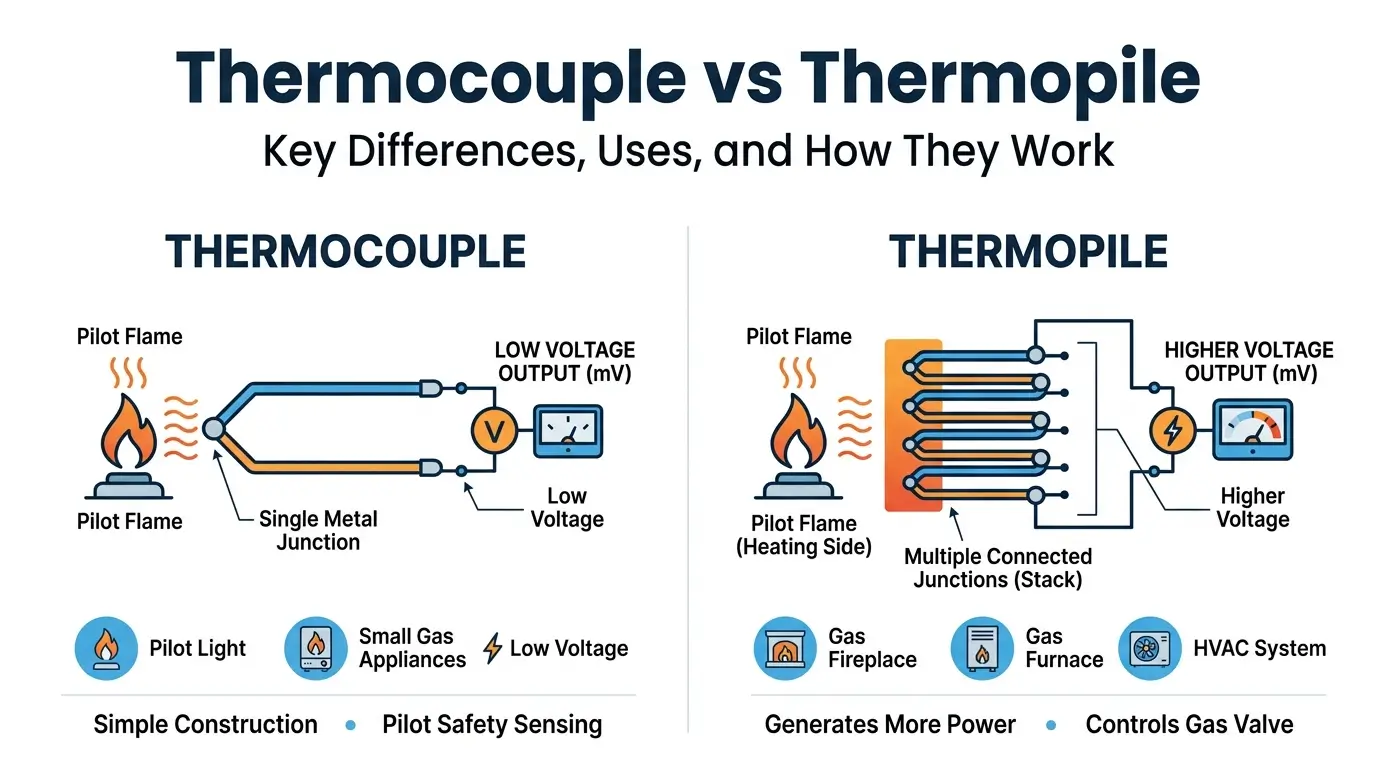
Thermocouple and thermopile devices both convert heat into electricity using the Seebeck Effect, but a thermocouple contains a single pair of dissimilar metals, while a thermopile consists of multiple thermocouples connected together. As a result, thermopiles generate higher voltage and are commonly used in gas fireplaces and heating controls, whereas thermocouples are primarily used for flame-safety detection.
Imagine turning on your gas fireplace on a cold winter evening, only to find that the pilot light refuses to stay lit. Many homeowners immediately suspect a faulty thermocouple or thermopile, but few understand the difference between these two important components.
The comparison of thermocouple vs thermopile often creates confusion because both devices generate electricity from heat and play critical roles in heating systems. While they may look similar and often work together in gas appliances, they serve different purposes and produce different amounts of voltage.
Understanding thermocouple vs thermopile can help homeowners troubleshoot heating issues, assist HVAC technicians in diagnosing problems, and improve overall knowledge of gas furnace and fireplace systems.
Thermocouple vs Thermopile at a Glance
| Feature | Thermocouple | Thermopile |
| Best Known For | Flame safety detection | Power generation for controls |
| Construction | Single thermocouple junction | Multiple thermocouples connected together |
| Voltage Output | Low voltage | Higher voltage |
| Common Use | Gas furnaces, water heaters | Gas fireplaces, millivolt systems |
| Main Difference | Detects flame presence | Produces enough power to operate controls |
| Key Similarity | Converts heat into electricity | Converts heat into electricity |
What Is the Difference Between Thermocouple and Thermopile?
The primary difference between a thermocouple and a thermopile is their construction and voltage output.
A thermocouple consists of one pair of dissimilar metals joined together. It produces a small electrical signal used mainly for flame detection and safety.
A thermopile contains multiple thermocouples connected in series. This design generates a higher voltage capable of powering gas valves, thermostats, and control circuits.
Why Is This Difference Important?
Understanding the difference helps homeowners and technicians diagnose heating problems more accurately.
For Homeowners
Knowing whether your appliance uses a thermocouple or thermopile can simplify troubleshooting and reduce repair costs.
For HVAC Technicians
Accurate identification speeds up repairs and ensures proper replacement parts are used.
For Engineers
Understanding voltage generation and thermal sensing helps in designing reliable heating systems.
Real-World Value
Many pilot-light failures and ignition problems can be traced to faulty thermocouples or thermopiles.
Pronunciation
| Term | US Pronunciation | UK Pronunciation |
| Thermocouple | THER-moh-cup-uhl | THER-muh-cup-uhl |
| Thermopile | THER-moh-pile | THER-muh-pile |
Now that we understand the basics, let’s explore the detailed differences between thermocouples and thermopiles.
Thermocouple vs Thermopile – 10 Key Differences
Definition
Thermocouple
A thermocouple is a temperature-sensing device made from two different metals joined together.
Examples:
- Water heater safety sensor
- Gas furnace pilot sensor
Real-World Relevance: Prevents gas leaks by detecting flame loss.
Thermopile
A thermopile is a collection of multiple thermocouples connected together.
Examples:
- Gas fireplace controls
- Millivolt heating systems
Real-World Relevance: Generates enough power to operate gas valves.
Working Principle
Thermocouple
Produces a small voltage when heated.
Examples:
- Pilot flame heats junction
- Safety signal sent to gas valve
Real-World Relevance: Maintains safe appliance operation.
Thermopile
Generates a larger voltage by combining outputs from many thermocouples.
Examples:
- Fireplace control systems
- Remote thermostat operation
Real-World Relevance: Powers control circuits without external electricity.
Construction
Thermocouple
Contains a single sensing junction.
Examples:
- Copper-based thermocouple
- Nickel alloy thermocouple
Real-World Relevance: Simple and inexpensive design.
Thermopile
Contains numerous thermocouples connected in series.
Examples:
- 20-junction thermopile
- Multi-cell thermal generator
Real-World Relevance: Higher energy output.
Number of Thermocouples
Thermocouple
Uses one thermocouple.
Examples:
- Pilot assembly sensor
- Furnace flame detector
Real-World Relevance: Suitable for basic sensing tasks.
Thermopile
Uses many thermocouples.
Examples:
- Fireplace generator assembly
- Millivolt power unit
Real-World Relevance: Suitable for powering components.
Voltage Output
Thermocouple
Typically produces 20–30 millivolts.
Examples:
- Water heater pilot sensor
- Furnace pilot sensor
Real-World Relevance: Adequate for flame detection.
Thermopile
Typically produces 250–750 millivolts.
Examples:
- Gas valve operation
- Thermostat power supply
Real-World Relevance: Supports system controls.
Thermocouple vs Thermopile – 10 Key Differences (Continued)
Sensitivity
Thermocouple
A thermocouple is less sensitive because it relies on a single sensing junction.
Examples:
- Detecting a pilot flame in a water heater
- Monitoring a furnace pilot light
Real-World Relevance: Works well for basic flame detection but produces limited electrical output.
Thermopile
A thermopile is more sensitive because multiple thermocouples combine their voltage output.
Examples:
- Operating a millivolt gas valve
- Powering a fireplace thermostat
Real-World Relevance: Better for applications requiring higher electrical signals.
Accuracy
Thermocouple
Provides reliable temperature measurement and flame detection.
Examples:
- Industrial temperature monitoring
- Furnace safety systems
Real-World Relevance: Widely trusted for accurate thermal sensing.
Thermopile
Provides good thermal measurement while generating usable power.
Examples:
- Infrared temperature sensors
- Gas fireplace controls
Real-World Relevance: Useful when both sensing and power generation are needed.
Applications
Thermocouple
Commonly used in safety systems and temperature measurement.
Examples:
- Gas furnaces
- Water heaters
Real-World Relevance: Essential for preventing unsafe gas flow.
Thermopile
Commonly used where higher voltage is needed.
Examples:
- Gas fireplaces
- Millivolt heating systems
Real-World Relevance: Allows certain systems to operate without household electricity.
Advantages
Thermocouple
Simple, durable, inexpensive, and highly reliable.
Examples:
- Low-cost furnace protection
- Water heater safety controls
Real-World Relevance: Easy replacement and maintenance.
Thermopile
Produces higher voltage and can power control systems.
Examples:
- Remote-controlled fireplaces
- Self-powered gas appliances
Real-World Relevance: Provides greater functionality.
Limitations
Thermocouple
Produces very little voltage.
Examples:
- Cannot power large control circuits
- Limited electrical output
Real-World Relevance: Mostly restricted to sensing functions.
Thermopile
More expensive and slightly more complex.
Examples:
- Higher replacement cost
- More components can fail
Real-World Relevance: Increased capability comes with increased cost.
Similarities Between Thermocouple and Thermopile
Although they have important differences, thermocouples and thermopiles share several characteristics:
- Both use the Seebeck Effect.
- Both convert heat into electrical energy.
- Both are found in HVAC and heating systems.
- Both contribute to safe appliance operation.
- Both depend on temperature differences to function.
- Both are commonly used in gas-powered equipment.
How a Thermocouple Works
A thermocouple operates when two dissimilar metals are joined together and heated by a flame. The temperature difference between the heated junction and the cooler end generates a small electrical voltage.
In a gas furnace or water heater, this voltage keeps the gas valve open. If the pilot light goes out, voltage production stops, causing the gas valve to close automatically and preventing gas leaks.
Common Uses
- Gas furnaces
- Water heaters
- Industrial temperature sensors
- Ovens and boilers
How a Thermopile Works
A thermopile works on the same principle as a thermocouple but contains multiple thermocouples connected in series.
Because the voltages add together, the thermopile produces significantly more electrical power. This increased output can operate a gas valve, thermostat, or control circuit.
Common Uses
- Gas fireplaces
- Millivolt systems
- Infrared sensors
- Self-powered heating controls
Thermocouple vs Thermopile in Gas Furnaces
In gas furnaces, thermocouples are commonly used as flame-safety devices.
Thermocouple Role
- Detects pilot flame presence
- Prevents gas leaks
- Shuts off gas when flame is lost
Thermopile Role
- Less common in standard furnaces
- Provides higher electrical output when needed
- Supports millivolt control systems
For most traditional furnaces, the thermocouple remains the primary safety component.
Thermocouple vs Thermopile in Fireplaces
Gas fireplaces frequently use thermopiles because they require more voltage to operate controls.
Thermocouple Function
- Verifies pilot flame presence
- Provides safety shutdown protection
Thermopile Function
- Generates millivolt power
- Operates gas valves
- Powers thermostats and remote controls
This is why many modern fireplaces contain both a thermocouple and a thermopile.
Common Failure Symptoms
Thermocouple Failure Signs
- Pilot light will not stay lit
- Frequent system shutdowns
- Gas valve closes unexpectedly
- Weak or unstable flame detection
Thermopile Failure Signs
- Fireplace will not turn on
- Low millivolt readings
- Thermostat fails to operate
- Gas valve receives insufficient power
Testing and Troubleshooting
Testing a Thermocouple
Tools Needed:
- Multimeter
- Basic hand tools
Steps:
- Disconnect the thermocouple.
- Heat the sensing tip.
- Measure millivolt output.
- Compare readings with manufacturer specifications.
A healthy thermocouple usually produces between 20 and 30 millivolts.
Testing a Thermopile
Tools Needed:
- Digital multimeter
- Manufacturer specifications
Steps:
- Keep the pilot flame burning.
- Measure thermopile output.
- Compare voltage readings with expected values.
Most healthy thermopiles generate between 250 and 750 millivolts.
| Factor | Thermocouple | Thermopile |
| Replacement Cost | Lower | Higher |
| Installation Cost | Lower | Moderate |
| Maintenance | Minimal | Moderate |
| Voltage Output | Low | High |
| Long-Term Value | Good | Excellent for control systems |
Thermocouple vs Thermopile Cost
Can You Replace a Thermocouple with a Thermopile?
In most cases, a thermocouple cannot simply be replaced with a thermopile because they serve different purposes and produce different voltage outputs.
When Replacement Is Possible
- If the appliance manufacturer specifically supports both components.
- In certain millivolt fireplace systems designed for thermopile operation.
- When upgrading compatible control systems.
When Replacement Is Not Possible
- Standard gas furnaces designed only for thermocouples.
- Appliances requiring specific flame-safety certifications.
- Systems with incompatible gas valves or wiring.
When to Call a Professional
If you’re unsure about compatibility, consult an HVAC technician. Using the wrong component can prevent proper operation and create safety issues.
Thermocouple vs Thermopile Troubleshooting Chart
| Symptom | Possible Thermocouple Issue | Possible Thermopile Issue |
| Pilot light won’t stay lit | Weak thermocouple signal | Possible but less common |
| Fireplace won’t start | Usually not the cause | Low thermopile output |
| Gas valve won’t remain open | Faulty thermocouple | Insufficient thermopile voltage |
| Low millivolt reading | Damaged thermocouple | Weak thermopile |
| Remote control not working | Usually unrelated | Thermopile not generating enough power |
| Frequent shutdowns | Poor flame sensing | Inconsistent voltage generation |
Difference and Similarity Table
| Feature | Thermocouple | Thermopile |
| Definition | Single thermal junction | Multiple thermocouples connected together |
| Construction | Two dissimilar metals | Multiple thermocouple junctions |
| Voltage Output | 20–30 mV | 250–750 mV |
| Primary Function | Flame safety detection | Power generation |
| Accuracy | High for sensing | High for control applications |
| Applications | Furnaces, water heaters | Fireplaces, millivolt systems |
| Cost | Lower | Higher |
| Maintenance | Simple | Moderate |
| Advantages | Reliable and inexpensive | Higher voltage output |
| Limitations | Limited electrical power | Higher replacement cost |
Similarities
| Feature | Both Devices |
| Use Heat | Yes |
| Generate Electricity | Yes |
| Use Seebeck Effect | Yes |
| HVAC Applications | Yes |
| Improve Safety | Yes |
Which Is Better?
When a Thermocouple Is Better
A thermocouple is the better choice when simple flame detection and safety monitoring are the primary requirements. It is inexpensive, highly reliable, easy to replace, and commonly used in gas furnaces, water heaters, and industrial equipment. Because it focuses on detecting whether a flame is present, it remains one of the most trusted safety devices in heating systems. For homeowners looking for a straightforward and cost-effective solution, a thermocouple is often ideal.
When a Thermopile Is Better
A thermopile is better when higher voltage output is required to power controls, thermostats, or gas valves. It is commonly found in gas fireplaces and millivolt systems where external electrical power may not be available. Although it costs more than a thermocouple, its ability to generate greater electrical output makes it valuable for advanced heating controls and remote-operated fireplace systems.
Pros and Cons
Thermocouple Pros
- Low cost
- Simple design
- Reliable operation
- Easy replacement
- Excellent safety performance
Thermocouple Cons
- Produces limited voltage
- Cannot power complex controls
- May wear out from prolonged heat exposure
Thermopile Pros
- Higher voltage generation
- Powers thermostats and gas valves
- Supports remote controls
- Useful in millivolt systems
Thermopile Cons
- Higher cost
- More complex design
- Replacement may require professional assistance
Frequently Asked Questions
Is a thermopile the same as a thermocouple?
No. A thermocouple contains one pair of dissimilar metals, while a thermopile contains multiple thermocouples connected together.
Which produces more voltage?
A thermopile produces significantly more voltage than a thermocouple because it combines the output of multiple thermocouples.
Can a thermopile replace a thermocouple?
Usually no. Replacement depends on appliance design and manufacturer specifications.
How do I know which one has failed?
A thermocouple failure often causes the pilot light to go out, while a thermopile failure commonly causes low millivolt output and control-system problems.
Which is used in gas fireplaces?
Many gas fireplaces use both. The thermocouple provides safety monitoring, while the thermopile powers controls and gas valves.
How Both Help Heating Systems
Safety
Both devices help prevent dangerous gas leaks by ensuring proper flame operation.
Temperature Sensing
Thermocouples provide accurate thermal detection, while thermopiles monitor heat while generating useful electrical power.
Energy Efficiency
Properly functioning thermocouples and thermopiles improve overall heating-system efficiency.
Reliable Operation
These components help furnaces, fireplaces, and other heating systems operate safely and consistently.
Final Words
The key difference between a thermocouple and a thermopile is that a thermocouple primarily detects flame presence, while a thermopile generates higher voltage to power controls and gas valves. Both are essential components in modern HVAC and heating systems.
Conclusion
Understanding the difference between thermocouple and thermopile devices can make troubleshooting heating systems much easier. Although both use the Seebeck Effect to convert heat into electricity, they serve different purposes.
Thermocouples are primarily used for flame-safety detection, while thermopiles generate higher voltage to operate gas valves, thermostats, and fireplace controls. Whether you’re a homeowner, HVAC technician, or engineering student, knowing how these components work can help you diagnose problems, choose replacement parts, and maintain safe heating-system operation.
The next time your furnace or fireplace experiences ignition issues, you’ll have a much better understanding of which component may be responsible.
Learn more article:
IPS vs IDS: Understanding the Key Differences in Cybersecurity