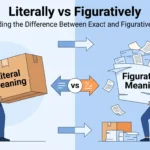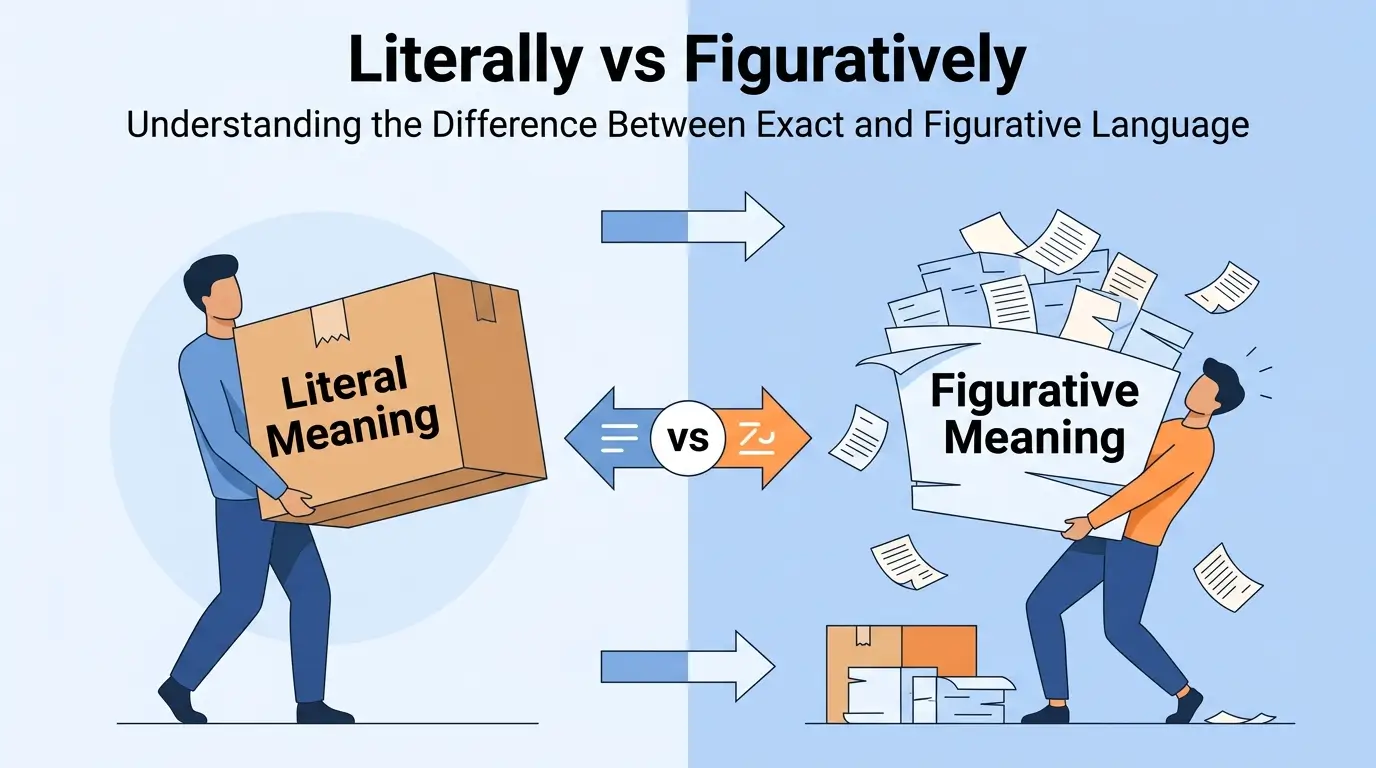
The difference between literally and figuratively is that literally means something happened exactly as stated, while figuratively means the words are not meant to be taken in their exact sense and are used for comparison, emphasis, or imagery. For example, “I literally ran five miles” is factual, while “I figuratively climbed a mountain of paperwork” is symbolic.
Imagine hearing someone say, “I literally died laughing.” Did they actually die? Of course not. This common expression shows why many people get confused about literally vs figuratively. These two words are often used in everyday conversations, books, social media posts, and professional writing, yet they have very different meanings.
Understanding literally vs figuratively can improve your grammar, writing clarity, and communication skills. While one word focuses on facts and exact meanings, the other adds creativity and imagery
Many English learners and even native speakers misuse these terms, leading to misunderstandings. In this guide, you will learn the key differences, practical examples, common mistakes, and when to use each word correctly.
Literally vs Figuratively at a Glance
| Feature | Literally | Figuratively |
| Meaning | Exactly as stated | Not literally true; symbolic |
| Purpose | To express facts | To create imagery or emphasis |
| Accuracy | Precise and factual | Creative and non-literal |
| Common Use | News, instructions, facts | Stories, speeches, creative writing |
| Similarity | Both help communicate ideas | Both help communicate ideas |
What Is the Difference Between Literally and Figuratively?
The main difference is simple:
- Literally means exactly what the words say.
- Figuratively means the words are used symbolically or creatively rather than factually.
Example
Literally:
“The glass literally broke when it fell.”
Figuratively:
“My heart figuratively broke when I heard the news.”
In the first sentence, the glass actually broke. In the second, the heart did not physically break; it represents emotional pain.
Why Is This Difference Important?
Understanding the difference matters because language can easily become confusing when these words are misused.
For Students
Students need accurate grammar for essays, exams, and academic writing.
For Writers
Writers use figurative language to make content engaging while using literal language for clarity.
For Professionals
Business communication often requires precise wording to avoid misunderstandings.
Real-World Communication
Knowing when to use each term helps people express themselves clearly and effectively.
Pronunciation
| Word | US Pronunciation | UK Pronunciation |
| Literally | LIT-er-uh-lee | LIT-er-uh-lee |
| Figuratively | FIG-yuh-ruh-tiv-lee | FIG-yuh-ruh-tiv-lee |
Now that we understand the basics, let’s explore the detailed differences between these commonly confused words.
Literally vs Figuratively – 10 Key Differences
Meaning
Literally
Means exactly what is stated.
Examples:
- I literally finished the race.
- The bottle literally shattered.
Real-world relevance:
Used when accuracy is important.
Figuratively
Means something symbolically.
Examples:
- I figuratively carried the whole team.
- She has a heart of gold.
Real-world relevance:
Adds creativity and emotional impact.
Usage
Literally
Used in factual statements.
Examples:
- The meeting lasted two hours.
- He literally arrived at noon.
Real-world relevance:
Common in journalism and reporting.
Figuratively
Used in descriptive language.
Examples:
- Time flew by.
- The classroom was a zoo.
Real-world relevance:
Popular in storytelling.
Purpose
Literally
To communicate exact truth.
Examples:
- The package weighs 10 pounds.
- The store closed at 9 PM.
Figuratively
To paint a vivid picture.
Examples:
- Her smile lit up the room.
- His words cut like a knife.
Context
Literally
Fits formal and factual contexts.
Examples:
- Scientific reports.
- News articles.
Figuratively
Fits creative and emotional contexts.
Examples:
- Novels.
- Poetry.
Degree of Accuracy
Literally
100% factual.
Examples:
- The temperature is 30°C.
- The train arrived late.
Figuratively
Not factually exact.
Examples:
- I’m drowning in work.
- He exploded with anger.
Emotional Impact
Literally
Focuses on information.
Examples:
- The exam lasted three hours.
- The road is closed.
Figuratively
Focuses on emotion.
Examples:
- Her voice was music to my ears.
- The city never sleeps.
Writing Style
Literally
Direct and straightforward.
Examples:
- User manuals.
- Academic papers.
Figuratively
Colorful and expressive.
Examples:
- Fiction writing.
- Motivational speeches.
Everyday Speech
Literally
Used to emphasize reality.
Examples:
- I literally saw it happen.
- She literally called me yesterday.
Figuratively
Used to exaggerate or compare.
Examples:
- I’m on top of the world.
- He is a walking encyclopedia.
Common Mistakes
Literally
Often misused for exaggeration.
Incorrect:
- I literally exploded with excitement.
Correct:
- I was extremely excited.
Figuratively
Sometimes mistaken for facts.
Example:
- “The company is drowning in debt” does not mean it is underwater.
Examples in Sentences
Literally
- The cat literally climbed the tree.
- We literally finished before noon.
Figuratively
- The cat was a tiger in the competition.
- We climbed a mountain of work.
Similarities Between Literally and Figuratively
- Both are adverbs.
- Both help communicate ideas.
- Both appear in speech and writing.
- Both add meaning to sentences.
- Both improve communication when used correctly.
Common Examples of Literally
- I literally forgot my keys at home.
- The phone literally stopped working.
- We literally walked five miles.
- The glass literally cracked.
- He literally owns three cars.
- The door literally slammed shut.
Common Examples of Figuratively
- I’m drowning in homework.
- She has a heart of stone.
- The classroom was a zoo.
- He is a shining star.
- The news hit me like a truck.
- Time flies when you’re having fun.
Types of Figurative Language
Metaphor
A direct comparison.
Example:
- Time is money.
Simile
A comparison using “like” or “as.”
Example:
- Busy as a bee.
Hyperbole
Extreme exaggeration.
Example:
- I’ve told you a million times.
Personification
Giving human qualities to non-human things.
Example:
- The wind whispered through the trees.
Idiom
A phrase whose meaning differs from the literal words.
Example:
- Break the ice.
Why Do People Confuse Literally and Figuratively?
Several reasons contribute to the confusion:
- Informal speech often misuses “literally.”
- Social media encourages exaggeration.
- Figurative expressions are common in everyday language.
- People use “literally” for emphasis rather than accuracy.
Literally vs Figuratively in Social Media and Modern Usage
Modern conversations often use literally as an intensifier.
Example:
- “I literally can’t stop laughing.”
Technically, this may not be literal. However, modern usage has become so widespread that many dictionaries now acknowledge this informal meaning.
This evolving usage is one reason the debate around literally vs figuratively continues today.
Difference and Similarity Table
| Feature | Literally | Figuratively |
| Meaning | Exact | Symbolic |
| Purpose | Accuracy | Imagery |
| Context | Facts | Creativity |
| Emotion | Low | High |
| Writing Style | Formal | Expressive |
| Truthfulness | Direct | Indirect |
| Similarity | Both communicate ideas | Both communicate ideas |
Which Is Better to Use?
When Literally Is Better
Literally is better when accuracy matters. Academic writing, news reporting, legal documents, instructions, and factual communication require literal language. It helps readers understand exactly what happened without confusion.
When Figuratively Is Better
Figuratively is better when you want to create vivid images, emotions, or creative expression. Authors, speakers, marketers, and storytellers often use figurative language to engage audiences and make messages memorable.
Common Mistakes to Avoid
- Using “literally” when you mean “figuratively.”
- Taking figurative expressions as factual statements.
- Mixing factual and symbolic meanings in the same sentence.
- Overusing “literally” for emphasis.
Role in Writing and Communication
Academic Writing
Literal language ensures precision.
Creative Writing
Figurative language creates imagery.
Journalism
Literal wording improves accuracy.
Everyday Conversation
Both forms help people communicate effectively.
Frequently Asked Questions
What does literally mean?
It means exactly as stated without exaggeration.
What does figuratively mean?
It means using words symbolically rather than literally.
Can literally be used for exaggeration?
In informal speech, yes, although traditional grammar discourages it.
Is figurative language false?
No. It communicates ideas symbolically rather than factually.
Which is more common in literature?
Figuratively is more common because it creates imagery and emotion.
How Both Improve Communication
- Literally improves clarity.
- Figuratively improves creativity.
- Both strengthen expression.
- Both help engage audiences.
- Both serve important communication purposes.
Final Words
The difference between literally vs figuratively comes down to truth versus imagery. One describes reality exactly, while the other uses language creatively to express ideas and emotions.
Conclusion
Understanding literally vs figuratively is essential for clear and effective communication. Literally refers to something that is exactly true, while figuratively refers to symbolic or imaginative language. Although modern speech sometimes blurs the line between the two, knowing their traditional meanings helps avoid confusion and improves both writing and speaking skills.
Whether you’re crafting an academic paper, telling a story, or posting on social media, choosing the right word can make your message more accurate and impactful. The next time you hear someone say they “literally died laughing,” you’ll know exactly what’s going on.
Learn more related article:
Bought vs Brought: Easy Differences, Meanings, and Examples