The main difference between contractions and cramps is that contractions are rhythmic tightening and relaxing of the uterine muscles, often associated with labor, while cramps are muscle pains that can occur due to menstruation, digestion, dehydration, or pregnancy. Contractions usually become regular and stronger over time, whereas cramps are often irregular and temporary.
Imagine feeling a sudden pain in your lower abdomen and wondering whether it is a simple cramp or the beginning of labor. This situation is common, especially during pregnancy. Many people struggle to understand the difference between contractions and cramps because both can cause discomfort in the abdominal area.
The confusion surrounding contractions vs cramps often leads to unnecessary worry or, in some cases, delayed medical attention. While contractions and cramps may feel similar at first, they have different causes, patterns, and meanings.
Understanding these differences can help pregnant individuals, caregivers, and healthcare professionals recognize what is happening in the body and determine whether medical care is needed. In this guide, we will explore the key differences between contractions and cramps, their causes, symptoms, and when to seek help.
Contractions vs Cramps at a Glance
| Feature | Contractions | Cramps |
| Best Known For | Labor and childbirth | Muscle or abdominal pain |
| Main Cause | Uterine muscle tightening | Various physical conditions |
| Pattern | Usually regular | Often irregular |
| Intensity | Increases over time | May remain constant |
| Pregnancy Connection | Strongly linked | May or may not be pregnancy-related |
| Similarity | Both cause abdominal discomfort | Both can involve muscle pain |
What Is the Difference Between Contractions and Cramps?
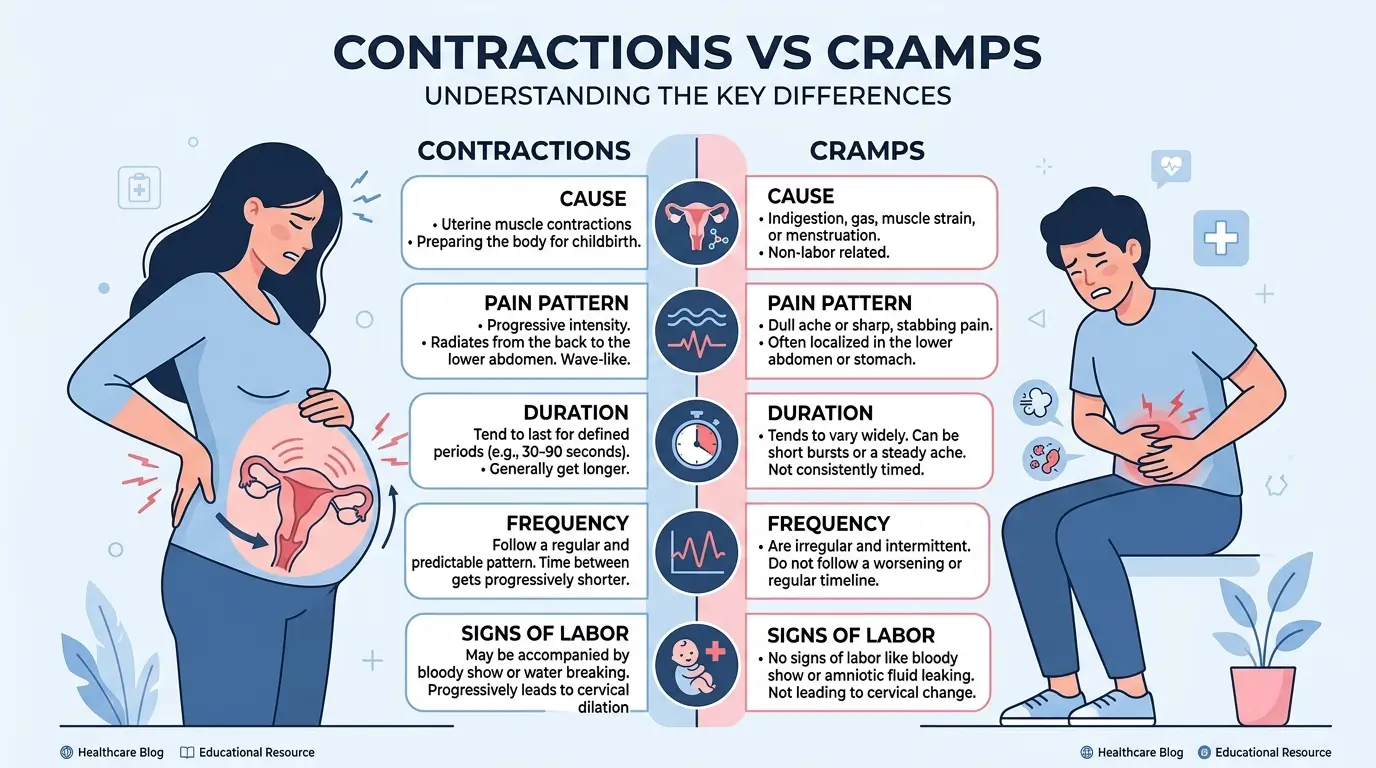
Contractions are rhythmic tightenings of the uterine muscles that help prepare the body for childbirth. Cramps are general muscle pains that can occur for many reasons, including menstruation, digestion, exercise, dehydration, or pregnancy.
The key distinction is that contractions often follow a predictable pattern and may become stronger and closer together over time, while cramps are usually less organized and may come and go without a specific rhythm.
Why Is This Difference Important?
Importance for Patients
Knowing the difference can reduce anxiety and help people respond appropriately to symptoms.
Importance for Caregivers
Caregivers can better support pregnant individuals and recognize when medical attention may be needed.
Importance for Healthcare Professionals
Accurate symptom descriptions help healthcare providers make informed decisions.
Real-World Relevance
Understanding these symptoms can help prevent unnecessary hospital visits or dangerous delays in seeking care.
Pronunciation
| Word | US Pronunciation | UK Pronunciation |
| Contractions | kuhn-TRAK-shunz | kuhn-TRAK-shuhnz |
| Cramps | KRAMPS | KRAMPS |
Now that we understand the basics, let’s explore the detailed differences between contractions and cramps.
Types of Contractions
Braxton Hicks Contractions
Often called “practice contractions,” these are usually irregular and do not lead to labor.
Early Labor Contractions
These contractions become more regular and help prepare the cervix for childbirth.
Active Labor Contractions
These are stronger, longer, and closer together. They usually indicate that labor is progressing.
Common Causes of Cramps
Menstrual Cramps
Caused by uterine contractions during menstruation.
Digestive Cramps
May result from gas, indigestion, or gastrointestinal disorders.
Muscle Cramps
Can occur due to dehydration, exercise, or electrolyte imbalances.
Pregnancy-Related Cramps
May occur as the uterus expands and ligaments stretch.
Contractions vs Cramps – 10 Key Differences
1. Definition
Contractions
Contractions are rhythmic tightening and relaxing movements of the uterine muscles.
Examples:
- Early labor contractions.
- Active labor contractions.
Real-world relevance:
They play a crucial role in childbirth.
Cramps
Cramps are sudden or persistent muscle pains that can occur in different parts of the body.
Examples:
- Menstrual cramps.
- Leg cramps after exercise.
Real-world relevance:
They are common symptoms experienced by people of all ages.
2. Cause
Contractions
Usually caused by the uterus preparing for labor or responding to pregnancy-related changes.
Examples:
- Labor onset.
- Braxton Hicks contractions.
Real-world relevance:
They help healthcare providers assess labor progression.
Cramps
Can result from muscle strain, dehydration, digestion issues, menstruation, or pregnancy.
Examples:
- Stomach cramps after eating.
- Muscle cramps during exercise.
Real-world relevance:
They may indicate minor discomfort or underlying health conditions.
3. Pain Pattern
Contractions
Typically follow a regular pattern and often become more frequent.
Examples:
- Every 10 minutes.
- Every 5 minutes during active labor.
Real-world relevance:
Regular timing is a major sign of labor.
Cramps
Usually occur irregularly.
Examples:
- Random abdominal cramps.
- Occasional muscle spasms.
Real-world relevance:
Their unpredictability often distinguishes them from contractions.
4. Location of Pain
Contractions
Often begin in the lower back and move toward the abdomen.
Examples:
- Lower back discomfort.
- Tightness across the abdomen.
Real-world relevance:
Pain location helps identify labor-related symptoms.
Cramps
Can occur in various body areas.
Examples:
- Legs.
- Abdomen.
Real-world relevance:
Location often depends on the underlying cause.
5. Intensity
Contractions
Usually become stronger over time.
Examples:
- Mild early labor discomfort.
- Intense active labor pain.
Real-world relevance:
Increasing intensity often signals labor progression.
Here is Part 2 of the article.
6. Duration
Contractions
Contractions typically last between 30 and 90 seconds.
Examples:
- Early labor contractions lasting 30 seconds.
- Active labor contractions lasting up to 90 seconds.
Real-world relevance:
Tracking duration helps determine whether labor is progressing.
Cramps
Cramps can last from a few seconds to several hours.
Examples:
- Brief leg cramps.
- Menstrual cramps lasting several hours.
Real-world relevance:
Duration often depends on the underlying cause.
7. Frequency
Contractions
Contractions often occur at regular intervals.
Examples:
- Every 15 minutes.
- Every 3 minutes during active labor.
Real-world relevance:
Increasing frequency is a major indicator of labor.
Cramps
Cramps usually occur irregularly.
Examples:
- Random stomach cramps.
- Occasional muscle spasms.
Real-world relevance:
Irregular timing helps distinguish cramps from labor contractions.
8. Pregnancy Connection
Contractions
Closely linked to pregnancy and childbirth.
Examples:
- Braxton Hicks contractions.
- Labor contractions.
Real-world relevance:
Can signal that labor is approaching.
Cramps
May occur during pregnancy but are not always related to labor.
Examples:
- Round ligament pain.
- Mild uterine stretching discomfort.
Real-world relevance:
Many pregnancy-related cramps are normal.
9. Signs of Labor
Contractions
Often indicate labor when they become regular, stronger, and closer together.
Examples:
- Contractions every five minutes.
- Contractions accompanied by cervical changes.
Real-world relevance:
One of the most important labor indicators.
Cramps
Rarely indicate labor by themselves.
Examples:
- Mild abdominal discomfort.
- Digestive cramping.
Real-world relevance:
Usually require additional symptoms before labor is suspected.
10. When to Seek Medical Care
Contractions
Medical attention may be needed when contractions become regular or occur prematurely.
Examples:
- Contractions before 37 weeks.
- Contractions every five minutes for one hour.
Real-world relevance:
Early evaluation can prevent complications.
Cramps
Medical care may be necessary if cramps are severe or persistent.
Examples:
- Severe abdominal pain.
- Cramps accompanied by fever.
Real-world relevance:
May indicate an underlying medical condition.
Similarities Between Contractions and Cramps
Although they are different, contractions and cramps share several characteristics:
- Both can cause abdominal discomfort.
- Both involve muscle activity.
- Both may vary in intensity.
- Both can occur during pregnancy.
- Both may require medical evaluation in certain situations.
- Both can affect daily activities and comfort.
Contractions vs Cramps During Pregnancy
Pregnancy can make distinguishing between contractions and cramps difficult. Mild cramping is common as the uterus expands and ligaments stretch. Contractions, however, tend to become more organized and rhythmic.
Braxton Hicks contractions are often mistaken for cramps because they can create abdominal tightness. Unlike true labor contractions, they usually disappear with rest, hydration, or a change in position.
When Are Contractions a Sign of Labor?
Contractions may indicate labor when they:
- Become regular.
- Increase in strength.
- Last longer over time.
- Occur closer together.
- Continue despite rest.
- Are accompanied by cervical dilation.
A common guideline is the 5-1-1 rule:
- Every 5 minutes.
- Lasting 1 minute each.
- For at least 1 hour.
Warning Signs That Need Medical Attention
Seek immediate medical advice if you experience:
- Severe abdominal pain.
- Heavy vaginal bleeding.
- Contractions before 37 weeks of pregnancy.
- Reduced fetal movement.
- High fever.
- Sudden swelling or severe headaches.
- Leakage of amniotic fluid.
Why Do People Confuse Contractions and Cramps?
Several factors contribute to confusion:
- Both occur in the abdominal area.
- Both can cause pain and pressure.
- Early contractions may feel like menstrual cramps.
- Pregnancy-related cramps can resemble labor symptoms.
- Symptom intensity varies from person to person.
Because every pregnancy is different, distinguishing between the two can be challenging without medical guidance.
Difference and Similarity Table
| Feature | Contractions | Cramps |
| Definition | Uterine muscle tightening | General muscle pain |
| Pattern | Regular | Usually irregular |
| Frequency | Predictable | Unpredictable |
| Duration | 30–90 seconds | Seconds to hours |
| Intensity | Often increases | May remain stable |
| Labor Sign | Often yes | Usually no |
| Pregnancy Related | Common | Possible |
| Cause | Uterine activity | Various causes |
| Treatment | Depends on labor stage | Depends on cause |
| Medical Importance | High during pregnancy | Varies by condition |
Which Is More Important?
When Contractions Matter Most
Contractions become especially important during pregnancy because they can indicate labor progression. Healthcare providers monitor contraction timing, duration, and intensity to determine whether childbirth is approaching. Recognizing true contractions can help expectant parents prepare for delivery and seek medical care at the right time.
When Cramps Matter Most
Cramps are important because they can signal a wide range of health conditions. While many cramps are harmless, severe or persistent cramping may indicate digestive disorders, reproductive health issues, dehydration, infections, or other medical concerns. Understanding the cause helps ensure appropriate treatment.
Pros and Limitations of Understanding Contractions and Cramps
Benefits
- Helps identify labor signs.
- Reduces unnecessary anxiety.
- Encourages timely medical care.
- Improves communication with healthcare providers.
Limitations
- Symptoms can overlap.
- Pain perception varies.
- Medical evaluation may still be required.
- Self-diagnosis is not always accurate.
Role in Healthcare and Pregnancy Care
Healthcare professionals regularly assess contractions and cramps when evaluating pregnant patients. Understanding symptom patterns helps determine whether a patient is experiencing normal pregnancy discomfort, false labor, or active labor.
Accurate symptom reporting can improve maternal and fetal outcomes.
How Healthcare Professionals Differentiate Them
Healthcare providers often consider:
- Timing of symptoms.
- Frequency patterns.
- Pain intensity.
- Pregnancy stage.
- Cervical changes.
- Additional symptoms.
These factors help distinguish normal cramps from true labor contractions.
Frequently Asked Questions
Are contractions more painful than cramps?
Usually yes. Labor contractions often become stronger and more intense than typical cramps.
Can early labor feel like menstrual cramps?
Yes. Early labor contractions often resemble strong menstrual cramps.
Do Braxton Hicks contractions hurt?
They may cause discomfort or tightening, but they are usually less painful than true labor contractions.
How can I tell if contractions are real?
Real contractions become regular, stronger, longer, and closer together over time.
When should I call my doctor about contractions?
Contact your healthcare provider if contractions are regular, painful, occur before 37 weeks, or are accompanied by concerning symptoms.
How Both Affect Quality of Life
Understanding contractions and cramps can improve quality of life by reducing uncertainty and helping individuals respond appropriately to symptoms. This knowledge supports better healthcare decisions, safer pregnancies, and improved communication between patients and medical professionals.
Final Words
Contractions and cramps may feel similar, but they have different causes, patterns, and meanings. Recognizing their unique characteristics can help you respond appropriately and seek care when necessary.
Conclusion
Understanding the difference between contractions and cramps is important for anyone experiencing abdominal discomfort, especially during pregnancy. Contractions are rhythmic uterine muscle tightenings that often signal labor, while cramps are more general muscle pains caused by a variety of factors.
The key differences include pattern, frequency, duration, intensity, and relationship to pregnancy. While many cramps are harmless, regular and increasingly intense contractions may require medical attention. By learning to recognize these symptoms, individuals can make informed decisions, reduce anxiet
Lean more about:
ADLs vs IADLs: Understanding the Key Difference