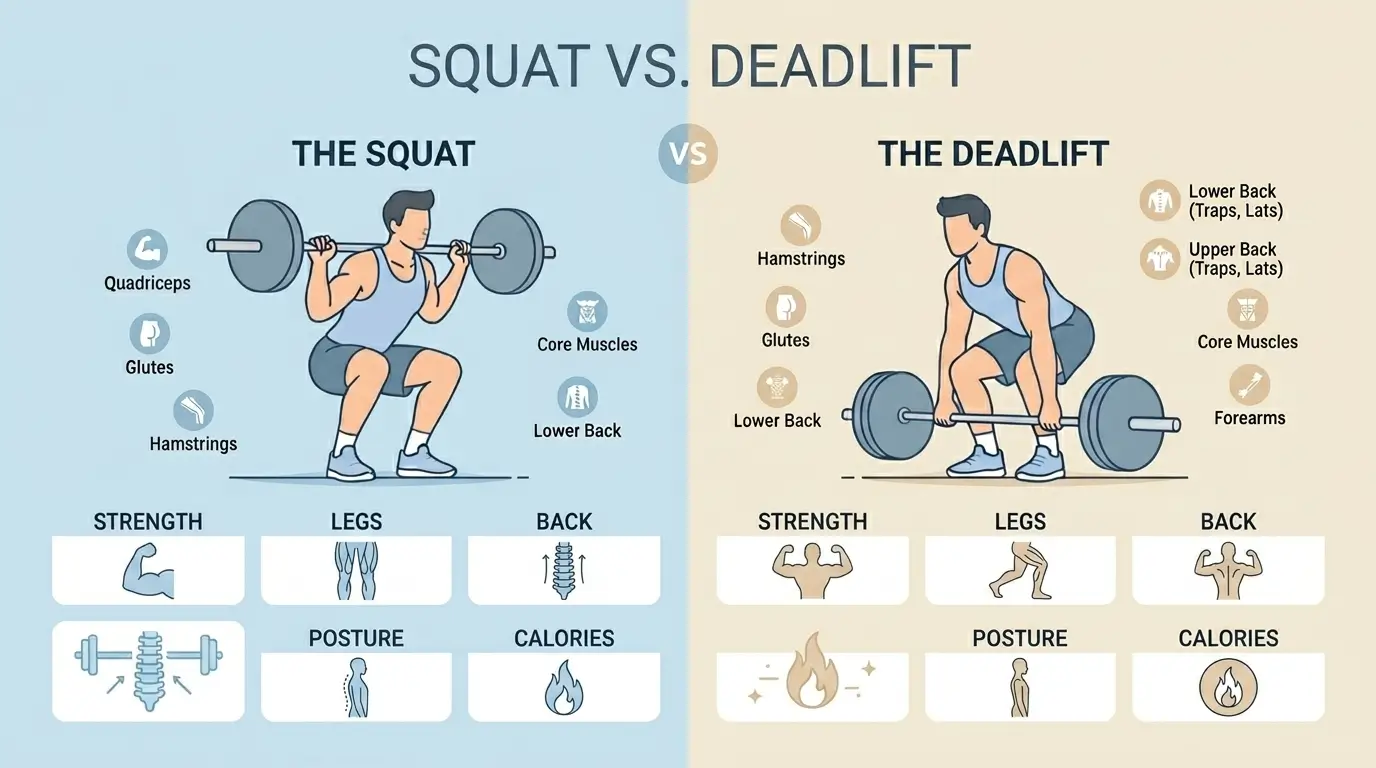
Squat and deadlift are both powerful strength-training exercises, but they target the body differently. Squats focus more on the quadriceps, glutes, and lower body balance, while deadlifts mainly train the hamstrings, glutes, back, and overall pulling strength. Neither exercise is “better” for everyone. The right choice depends on your fitness goals, body type, and training style.
If you spend time in a gym, watch fitness videos, or follow workout plans online, you have probably heard the debate about squat vs deadlift. Both exercises are famous in strength training, bodybuilding, and sports fitness. But many beginners still feel confused about which one is better, safer, or more effective.
Some people believe squats are the king of all exercises because they build powerful legs and improve athletic performance. Others argue that deadlifts train more muscles and develop total-body strength faster. Since both workouts use heavy weights and similar muscle groups, many people struggle to understand the real difference.
The confusion also comes from fitness advice online. Social media trainers often compare squat and deadlift without clearly explaining their unique benefits. As a result, beginners may choose the wrong exercise or perform it incorrectly.
This guide clears up the confusion in simple language. You will learn the meaning, history, differences, benefits, common mistakes, and real-life uses of squat and deadlift. By the end, you will know exactly which exercise fits your fitness goals.
Squat vs Deadlift – Quick Answer
Squat and deadlift are different strength exercises.
Squat
A squat involves lowering your body by bending the knees and hips while keeping the weight on your shoulders or body.
Example:
He improved leg strength with heavy squats.
Deadlift
A deadlift involves lifting weight from the floor using your hips, legs, and back.
Example:
She increased overall strength through deadlifts.
Main Difference
| Exercise | Main Focus | Primary Muscles |
| Squat | Lower-body pushing strength | Quads, glutes, core |
| Deadlift | Pulling and total-body strength | Hamstrings, back, glutes |
The Origin of Squat vs Deadlift
The word “squat” comes from an old Scandinavian term meaning “to sit down” or “crouch.” Humans have naturally squatted for thousands of years while resting, lifting, or working.
“Deadlift” comes from weightlifting culture. “Dead” refers to lifting a weight that starts motionless on the ground. “Lift” simply means raising it upward.
Both exercises became popular in modern strength sports during the 19th and 20th centuries. Today, they are essential in bodybuilding, powerlifting, CrossFit, and athletic training.
Unlike spelling debates in English grammar, squat and deadlift are not spelling variations. They are completely different exercises with different purposes.
British English vs American English Spelling
There is no spelling difference between British and American English.
| Exercise | British English | American English |
| Squat | squat | squat |
| Deadlift | deadlift | deadlift |
The meaning and spelling remain the same worldwide.
Which Exercise Should You Choose?
The best exercise depends on your goals.
Choose Squats If You Want:
- Bigger and stronger legs
- Better balance and mobility
- Improved athletic movement
- Stronger quadriceps and glutes
Choose Deadlifts If You Want:
- Full-body strength
- Stronger back and hamstrings
- Better pulling power
- Improved posture and grip strength
Best Option
Most trainers recommend doing both exercises because they complement each other.
For beginners:
- Start with lighter weights
- Focus on form first
- Learn movement patterns safely
Common Mistakes with Squat vs Deadlift
Many people confuse the exercises or perform them incorrectly.
Squat Mistakes
❌ Knees collapsing inward
✅ Keep knees aligned with feet
❌ Rounding the lower back
✅ Maintain a neutral spine
❌ Squatting too shallow
✅ Lower hips properly
Deadlift Mistakes
❌ Pulling with the arms
✅ Drive through hips and legs
❌ Rounded back position
✅ Keep chest up and spine straight
❌ Jerking the bar suddenly
✅ Lift smoothly and controlled
Important Tip
Poor form increases injury risk in both exercises.
Squat vs Deadlift in Everyday Examples
Emails
Our trainer recommends squats for leg development.
News
Athletes use deadlifts to improve explosive power.
Social Media
Leg day is incomplete without squats.
Formal Writing
Deadlifts contribute significantly to posterior chain strength.
Gym Conversations
He can squat 200 pounds but deadlift 300 pounds.
Squat vs Deadlift – Google Trends & Usage Data
Search interest for squat vs deadlift has grown rapidly over the past decade. Fitness culture, social media, and online coaching increased global awareness of strength training.
Countries with High Search Interest
- United States
- Canada
- United Kingdom
- Australia
- India
Common Search Intent
People usually search:
- Which exercise burns more calories?
- Which builds muscle faster?
- Which is safer for beginners?
- Squat vs deadlift for fat loss
- Squat vs deadlift for athletes
Google Trends shows squats are more popular among beginners, while deadlifts are heavily searched by strength athletes and gym enthusiasts.
Comparison Table: Squat vs Deadlift
| Feature | Squat | Deadlift |
| Movement Type | Push | Pull |
| Starting Position | Standing | Floor |
| Main Muscles | Quads, glutes | Back, hamstrings |
| Core Activation | High | Very high |
| Grip Strength Needed | Low | High |
| Athletic Benefit | Jumping, balance | Power, posture |
| Beginner Friendly | Yes | Moderate |
| Calorie Burn | High | Very high |
Benefits of Squats
Builds Lower-Body Strength
Squats target the legs and glutes effectively.
Improves Mobility
Deep squats improve hip and ankle flexibility.
Supports Athletic Performance
Running, jumping, and sports movements improve through squats.
Strengthens Core Stability
The core works constantly during squats.
Benefits of Deadlifts
Develops Full-Body Strength
Deadlifts train multiple muscle groups at once.
Improves Posture
They strengthen the back and spinal muscles.
Enhances Grip Strength
Holding heavy weight improves hand and forearm power.
Increases Functional Strength
Deadlifts mimic real-life lifting movements.
FAQs About Squat vs Deadlift
1. Which exercise is better for beginners?
Squats are usually easier for beginners to learn safely.
2. Do deadlifts build bigger backs?
Yes. Deadlifts strongly target the back muscles.
3. Which burns more calories?
Deadlifts often burn slightly more calories because they use more muscles.
4. Can I do both on the same day?
Yes, but training volume should be controlled carefully.
5. Which exercise is safer?
Both are safe with proper form and reasonable weight.
6. Are squats enough for leg growth?
Squats are excellent for leg development, but additional exercises help.
7. Do athletes need both exercises?
Most athletes benefit from both movements.
Conclusion
The debate around squat vs deadlift continues because both exercises are extremely effective. Squats focus more on lower-body pushing strength, balance, and leg development. Deadlifts focus more on pulling strength, back development, and total-body power. Neither exercise is automatically better than the other.
Your fitness goals should guide your choice. If you want stronger legs and athletic movement, squats may suit you better. If you want full-body strength and powerful posterior-chain development, deadlifts are excellent. Most fitness experts recommend including both exercises in a balanced program.
There is no spelling difference across British and American English. The real difference lies in movement, muscle focus, and training purpose. Understanding these differences helps you train smarter and avoid common gym mistakes.
In the end, the best exercise is the one performed with proper form, consistency, and a clear goal. Both squats and deadlifts can transform strength, fitness, and overall health when used correctly.
learn more related post :
Difference Between Sermorelin and Ipamorelin