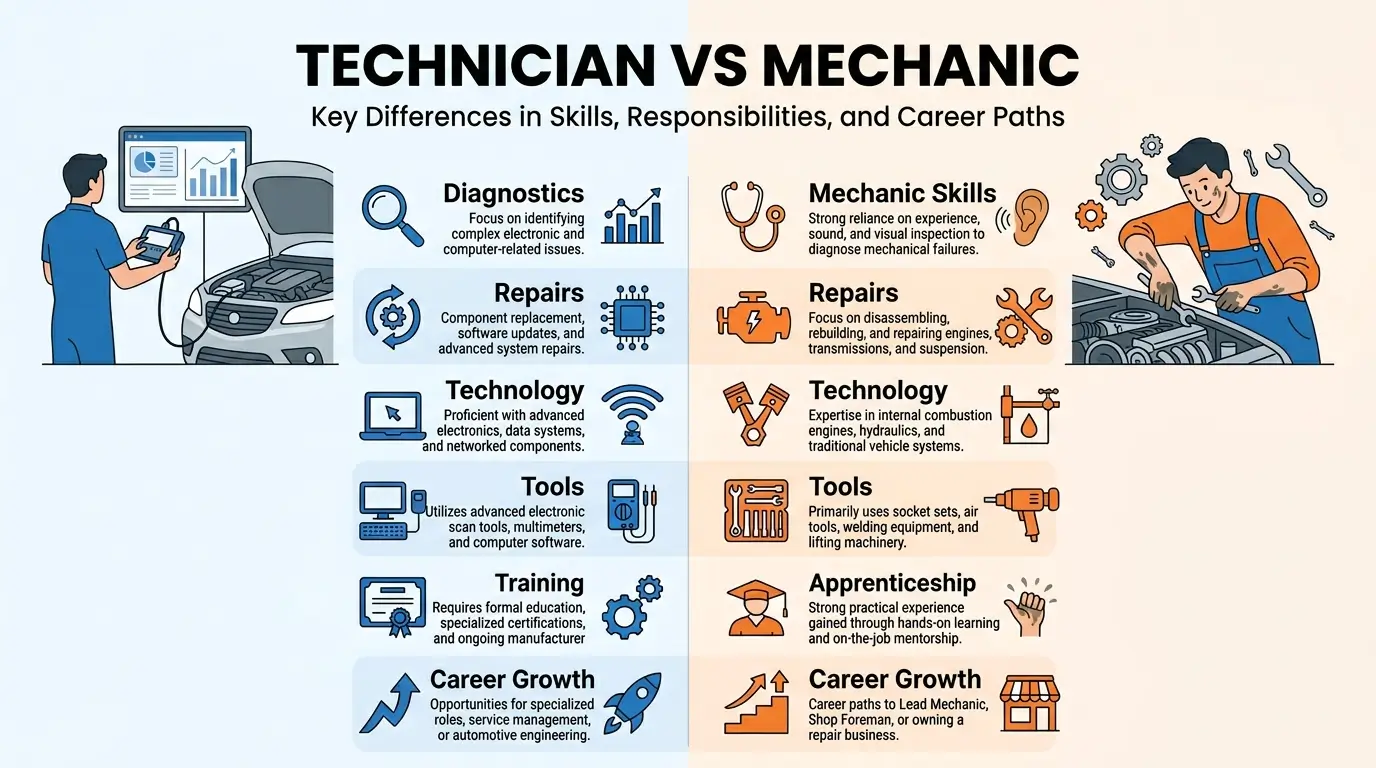
A technician and a mechanic both work on vehicles, machinery, and equipment, but a technician primarily diagnoses problems using advanced tools and computerized systems, while a mechanic focuses on repairing and maintaining mechanical components. Technicians often specialize in diagnostics, whereas mechanics perform hands-on repairs and replacements.
Imagine your car’s check engine light suddenly turns on. You take it to a repair shop, and one person connects a diagnostic scanner to identify the problem while another replaces the faulty part. This common situation highlights the difference between a technician and a mechanic.
The debate of technician vs mechanic often confuses students, job seekers, and vehicle owners because both professions work on similar equipment and often share workplaces. However, their responsibilities, skills, and career paths can differ significantly.
Understanding the difference between technician vs mechanic can help you choose the right career, hire the right professional, or better understand how modern repair industries operate. Let’s explore what sets these two important professions apart.
Technician vs Mechanic at a Glance
| Feature | Technician | Mechanic |
| Best Known For | Diagnostics and testing | Repairs and maintenance |
| Primary Focus | Identifying problems | Fixing problems |
| Technology Use | High | Moderate |
| Hands-On Repairs | Some | Extensive |
| Common Industries | Automotive, HVAC, IT, Manufacturing | Automotive, Industrial Equipment |
| Key Similarity | Both maintain and repair equipment | Both maintain and repair equipment |
What Is the Difference Between a Technician and a Mechanic?
The main difference is that a technician specializes in diagnosing and analyzing problems using technical knowledge and diagnostic tools, while a mechanic specializes in repairing, maintaining, and replacing physical components.
In modern industries, technicians often work with computerized systems and advanced technology, whereas mechanics focus more on hands-on mechanical repairs.
Why Is This Difference Important?
Understanding this distinction benefits several groups:
For Students
Students can choose educational programs that align with their interests, whether they prefer diagnostics or physical repairs.
For Employers
Businesses can hire the right professionals for specific roles and improve workplace efficiency.
For Customers
Knowing the difference helps customers find the right expert for their repair needs.
For Industry Professionals
Understanding role differences can support career planning and specialization opportunities.
Pronunciation
| Word | US Pronunciation | UK Pronunciation |
| Technician | tek-NISH-un | tek-NISH-un |
| Mechanic | muh-KAN-ik | muh-KAN-ik |
Now that we understand the basics, let’s examine the detailed differences between these professions.
Technician vs Mechanic – 10 Key Differences
Definition
Technician
A technician is a trained professional who diagnoses, analyzes, and services technical systems.
Examples:
- Automotive technician
- HVAC technician
Real-World Relevance: Essential for identifying complex technical issues.
Mechanic
A mechanic repairs and maintains machines, vehicles, and equipment.
Examples:
- Auto mechanic
- Diesel mechanic
Real-World Relevance: Keeps machinery operating safely and efficiently.
Education Requirements
Technician
Technicians often complete specialized technical programs and certifications.
Examples:
- Automotive technology degree
- HVAC certification
Real-World Relevance: Technical education supports advanced diagnostics.
Mechanic
Mechanics may enter the field through vocational training or apprenticeships.
Examples:
- Trade school training
- On-the-job learning
Real-World Relevance: Practical experience is highly valued.
Training
Technician
Training emphasizes diagnostics, electronics, and software systems.
Examples:
- Computer diagnostics
- Electronic control systems
Real-World Relevance: Modern equipment requires technical expertise.
Mechanic
Training focuses on repair techniques and equipment maintenance.
Examples:
- Engine rebuilding
- Brake repairs
Real-World Relevance: Strong mechanical skills remain essential.
Skills Required
Technician
Requires analytical thinking and problem-solving abilities.
Examples:
- Reading diagnostic codes
- Interpreting technical data
Real-World Relevance: Helps identify issues quickly and accurately.
Mechanic
Requires mechanical aptitude and hands-on repair skills.
Examples:
- Replacing components
- Using repair tools
Real-World Relevance: Ensures equipment functions properly.
Job Responsibilities
Technician
Focuses on diagnosing and evaluating system performance.
Examples:
- Running diagnostic tests
- Inspecting electronic systems
Real-World Relevance: Identifies root causes of problems.
Mechanic
Focuses on fixing and maintaining equipment.
Examples:
- Replacing parts
- Performing repairs
Real-World Relevance: Restores equipment to working condition.
Technician vs Mechanic – 10 Key Differences (Continued)
Tools Used
Technician
Technicians often use advanced diagnostic equipment and software.
Examples:
- OBD-II diagnostic scanners
- Digital multimeters
Real-World Relevance: Helps identify hidden problems quickly.
Mechanic
Mechanics primarily use physical repair and maintenance tools.
Examples:
- Wrenches and sockets
- Hydraulic lifts
Real-World Relevance: Essential for performing repairs and replacements.
Technology Involvement
Technician
Works extensively with computerized systems and electronics.
Examples:
- Vehicle control modules
- Diagnostic software
Real-World Relevance: Modern vehicles and machines depend heavily on technology.
Mechanic
Works mainly with mechanical systems and physical components.
Examples:
- Engines
- Suspension systems
Real-World Relevance: Mechanical repairs remain necessary despite technological advances.
Work Environment
Technician
Often works in diagnostic centers, dealerships, laboratories, or specialized service facilities.
Examples:
- Automotive dealerships
- HVAC service companies
Real-World Relevance: Frequently handles advanced equipment.
Mechanic
Typically works in repair shops, garages, factories, or maintenance facilities.
Examples:
- Auto repair shops
- Industrial maintenance departments
Real-World Relevance: Requires extensive hands-on work.
Salary Potential
Technician
Often earns higher wages due to specialized technical knowledge.
Examples:
- Automotive diagnostic technician
- Industrial electronics technician
Real-World Relevance: Specialized certifications can increase earnings.
Mechanic
Income varies based on experience, specialization, and location.
Examples:
- General auto mechanic
- Diesel mechanic
Real-World Relevance: Skilled mechanics remain in high demand.
Career Growth Opportunities
Technician
Can advance into specialized technical or management roles.
Examples:
- Master technician
- Technical trainer
Real-World Relevance: Technology-focused careers offer strong growth potential.
Mechanic
Can progress into senior repair, supervisory, or business ownership positions.
Examples:
- Shop foreman
- Garage owner
Real-World Relevance: Experience can lead to leadership opportunities.
Similarities Between Technician and Mechanic
Although their duties differ, technicians and mechanics share many similarities:
- Both maintain and repair equipment.
- Both require technical knowledge.
- Both use specialized tools.
- Both solve operational problems.
- Both are important in the automotive and industrial sectors.
- Both need ongoing training as technology evolves.
What Is a Technician?
A technician is a professional who specializes in diagnosing, testing, maintaining, and sometimes repairing technical systems.
Common Industries
- Automotive
- HVAC
- Information Technology
- Manufacturing
- Telecommunications
Typical Duties
- Diagnosing faults
- Running performance tests
- Using computerized equipment
- Interpreting technical data
- Performing preventive maintenance
What Is a Mechanic?
A mechanic is a skilled tradesperson who repairs, maintains, and rebuilds machinery, vehicles, and equipment.
Common Industries
- Automotive
- Aviation
- Agriculture
- Construction
- Manufacturing
Typical Duties
- Replacing damaged parts
- Repairing engines
- Maintaining equipment
- Performing inspections
- Troubleshooting mechanical failures
Technician vs Mechanic in the Automotive Industry
The automotive industry provides one of the best examples of how these roles differ.
Technician Responsibilities
- Diagnose check-engine lights
- Analyze computer data
- Program electronic systems
- Test sensors and modules
Mechanic Responsibilities
- Replace brake components
- Repair engines
- Install new parts
- Perform routine maintenance
In modern repair shops, technicians and mechanics often work together to solve vehicle problems efficiently.
Technician vs Mechanic Salary Comparison
| Factor | Technician | Mechanic |
| Entry-Level Pay | Moderate | Moderate |
| Specialized Skills | Higher demand | Moderate demand |
| Certification Impact | High | Moderate |
| Advancement Potential | High | High |
| Earning Potential | Often higher in technical fields | Strong with experience |
Education and Certification Requirements
Technician
Common qualifications include:
- Technical college diploma
- Associate degree
- Industry certifications
- Manufacturer training programs
Mechanic
Common qualifications include:
- Trade school training
- Apprenticeships
- Vocational programs
- Industry certifications
Popular Certifications
- ASE Certification
- HVAC Certifications
- Manufacturer-Specific Certifications
Tools and Equipment Used
Technician Tools
- Diagnostic scanners
- Oscilloscopes
- Digital multimeters
- Programming devices
- Specialized software
Mechanic Tools
- Wrenches
- Ratchets
- Torque tools
- Jacks and lifts
- Engine repair equipment
Career Path and Advancement Opportunities
Technician Career Path
Entry-Level Technician → Certified Technician → Senior Technician → Master Technician → Technical Manager
Mechanic Career Path
Apprentice Mechanic → Journeyman Mechanic → Senior Mechanic → Shop Supervisor → Business Owner
Technician vs Mechanic Troubleshooting Chart
| Situation | Technician’s Role | Mechanic’s Role |
| Check Engine Light | Diagnose electronic faults using scanners | Repair or replace faulty parts |
| Electrical Problems | Test sensors, circuits, and modules | Repair damaged wiring or components |
| Engine Misfire | Analyze diagnostic codes | Replace spark plugs, injectors, or coils |
| Brake Warning Light | Identify sensor or control issues | Repair brake pads, rotors, or calipers |
| HVAC System Issue | Test electronic controls | Repair mechanical HVAC components |
| Transmission Problems | Analyze transmission data | Rebuild or repair transmission parts |
Difference and Similarity Table
| Feature | Technician | Mechanic |
| Primary Role | Diagnoses and tests systems | Repairs and maintains equipment |
| Main Focus | Technical analysis | Hands-on repair |
| Technology Usage | High | Moderate |
| Diagnostic Equipment | Frequently used | Occasionally used |
| Repair Work | Limited to moderate | Extensive |
| Education | Technical programs | Vocational training |
| Certifications | Often required | Helpful but not always required |
| Work Environment | Labs, dealerships, service centers | Garages, workshops, repair facilities |
| Career Growth | Technical specialist, manager | Senior mechanic, supervisor, owner |
| Salary Potential | Often higher with specialization | Competitive with experience |
Similarities
| Similarity | Description |
| Problem Solving | Both identify and resolve equipment issues |
| Technical Knowledge | Both require industry expertise |
| Safety Standards | Both follow safety procedures |
| Continuous Learning | Both adapt to new technology |
| Industry Importance | Both keep systems operating efficiently |
Which Is Better?
When a Technician Is Better
A technician is the better choice when the problem involves electronic systems, software, sensors, or advanced diagnostics. Modern vehicles and equipment rely heavily on computers and digital controls that require specialized testing tools. Technicians can quickly identify hidden issues by analyzing fault codes and system data. If accuracy, diagnostics, and technology are priorities, a technician is usually the most effective professional for the job.
When a Mechanic Is Better
A mechanic is the better choice when physical repairs or maintenance are needed. Mechanics excel at replacing damaged parts, rebuilding engines, servicing brakes, and performing routine maintenance. Their hands-on expertise makes them essential for keeping vehicles and machinery operating safely. If the issue requires tools, repairs, and practical mechanical skills, a mechanic is often the ideal professional.
Pros and Cons
Technician Pros
- Strong diagnostic skills
- Works with advanced technology
- Higher specialization opportunities
- Strong career growth potential
- Often earns higher salaries
Technician Cons
- Requires continuous training
- Technology changes rapidly
- Certifications can be expensive
- Complex troubleshooting can be challenging
Mechanic Pros
- Strong practical skills
- High demand across industries
- Opportunities for self-employment
- Less reliance on software
- Rewarding hands-on work
Mechanic Cons
- Physically demanding
- Exposure to dirt, grease, and noise
- Heavy lifting may be required
- Some repairs can be time-consuming
Frequently Asked Questions
Is a technician the same as a mechanic?
No. A technician primarily focuses on diagnostics and technical analysis, while a mechanic focuses on repairing and maintaining equipment.
Who earns more, a technician or a mechanic?
Technicians often earn more when they specialize in diagnostics and advanced technologies, although experienced mechanics can also earn competitive salaries.
Can a mechanic become a technician?
Yes. Many mechanics gain certifications and technical training to move into technician roles.
Do technicians repair equipment?
Yes. Many technicians perform repairs, but their primary responsibility is usually diagnosis and troubleshooting.
Which career has a better future?
Both careers have strong prospects, but technicians may benefit more from increasing automation and technology in modern industries.
How Both Support Modern Industries
Automotive Industry
Technicians diagnose vehicle problems, while mechanics repair and maintain vehicles. Together they ensure safe and reliable transportation.
Manufacturing Industry
Both professionals help maintain machinery, reduce downtime, and improve productivity.
HVAC Industry
Technicians troubleshoot control systems and electronics, while mechanics repair mechanical components and equipment.
Transportation Sector
Their combined expertise keeps trucks, buses, trains, and industrial vehicles operating efficiently.
Economic Contribution
Without technicians and mechanics, many businesses would struggle to maintain operations, resulting in higher costs and reduced productivity.
Final Words
The technician vs mechanic comparison is not about which profession is better overall. Instead, it is about understanding their different strengths. Technicians specialize in diagnostics and technology, while mechanics specialize in repairs and maintenance. Together, they form the backbone of many modern industries.
Conclusion
Understanding the difference between a technician and a mechanic helps students, job seekers, employers, and customers make informed decisions. Technicians focus on diagnostics, electronics, and advanced systems, while mechanics focus on hands-on repairs and maintenance. As vehicles and machinery become more technologically advanced, both professions continue to evolve and remain highly valuable. Whether you choose a career as a technician or a mechanic, both paths offer rewarding opportunities, stable employment, and the chance to play a vital role in keeping modern systems running smoothly.
Learn more related post:
Thermocouple vs Thermopile: Key Differences ?