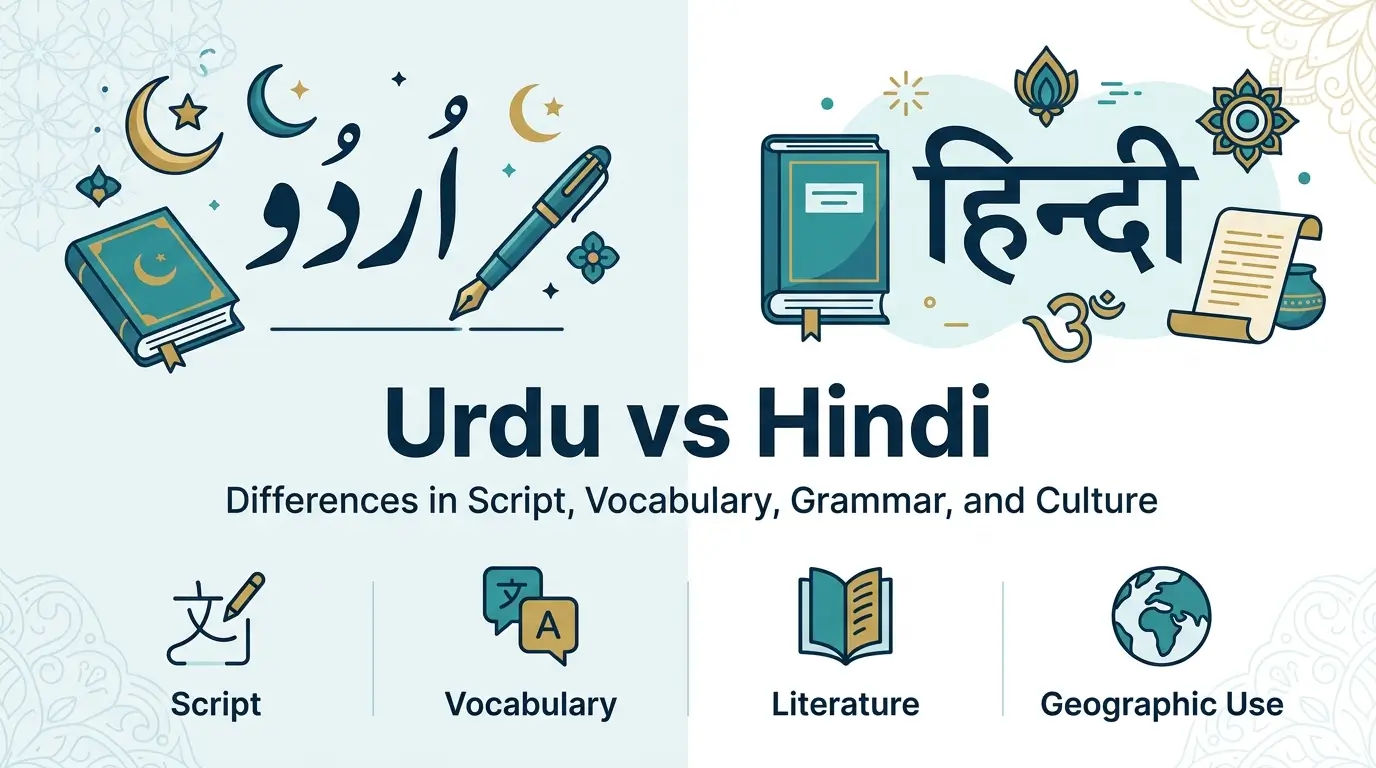
Urdu and Hindi are closely related languages that share much of their grammar and everyday spoken vocabulary. The biggest difference lies in their writing systems and formal vocabulary. Urdu uses the Perso-Arabic Nastaliq script and draws heavily from Persian and Arabic, while Hindi uses the Devanagari script and incorporates more Sanskrit-based vocabulary.
Imagine watching a Bollywood movie and hearing dialogues that sound familiar whether you are from Pakistan or India. Many people are surprised to learn that Urdu and Hindi are distinct languages despite sounding very similar in everyday conversation. This is why the comparison of Urdu vs Hindi is so common among language learners, travelers, students, and cultural enthusiasts.
Urdu and Hindi both evolved from the Hindustani language and share similar grammar, sentence structure, and thousands of everyday words. However, differences emerge in their scripts, literary traditions, and formal vocabulary. Understanding these distinctions helps learners communicate more effectively and appreciate the rich cultural heritage of South Asia.
Urdu vs Hindi at a Glance
| Feature | Urdu | Hindi |
| Meaning | National language of Pakistan | One of the official languages of India |
| Script | Nastaliq (Perso-Arabic) | Devanagari |
| Main Vocabulary Sources | Persian, Arabic, Turkish | Sanskrit, Prakrit |
| Writing Direction | Right to Left | Left to Right |
| Spoken Similarity | Very High | Very High |
| Main Countries | Pakistan, India | India, Nepal |
What Is Urdu?
Urdu is an Indo-Aryan language written primarily in the Nastaliq script and strongly influenced by Persian and Arabic.
What Is Hindi?
Hindi is an Indo-Aryan language written in Devanagari and influenced largely by Sanskrit.
Main Difference
The primary difference is script and formal vocabulary.
Key Similarity
Both share a common grammatical foundation and are often mutually understandable in conversation.
Where They Are Spoken
Urdu is primarily spoken in Pakistan and parts of India, while Hindi is mainly spoken throughout India and by Indian communities worldwide.
What Is the Difference Between Urdu and Hindi?
The difference between Urdu and Hindi is primarily found in their writing systems and formal vocabulary. Spoken Urdu and Hindi are often mutually intelligible, meaning speakers can understand each other in daily conversation. However, Urdu uses Persian-Arabic script and Persianized vocabulary, while Hindi uses Devanagari script and Sanskrit-derived vocabulary.
Why Is This Difference Important?
For Students
Understanding both languages improves linguistic awareness and cultural knowledge.
For Travelers
Knowing the distinctions helps travelers communicate effectively in Pakistan and India.
For Language Learners
Choosing the right language depends on personal, academic, or professional goals.
Cultural Significance
Each language represents unique literary and historical traditions.
Communication Value
Recognizing differences prevents misunderstandings in formal communication and writing.
Pronunciation
| Word | US Pronunciation | UK Pronunciation |
| Urdu | OOR-doo | OOR-doo |
| Hindi | HIN-dee | HIN-dee |
As fascinating as their similarities are, the real differences become clearer when we examine their history, script, vocabulary, and cultural development.
Urdu vs Hindi – 10 Key Differences
Definition
Urdu
Urdu is the national language of Pakistan and one of the recognized languages of India.
Examples:
- Urdu newspapers in Pakistan.
- Urdu poetry collections.
Real-World Relevance: Widely used in education, media, and literature.
Hindi
Hindi is one of India’s official languages and one of the world’s most spoken languages.
Examples:
- Hindi textbooks.
- Hindi news channels.
Real-World Relevance: Important for communication across much of India.
Origin
Urdu
Developed through interaction among Persian, Turkish, Arabic, and local Indian languages.
Examples:
- Mughal court language influences.
- Persian literary traditions.
Real-World Relevance: Reflects centuries of cultural exchange.
Hindi
Developed primarily from Sanskrit through Prakrit and Apabhramsha stages.
Examples:
- Classical Sanskrit influence.
- Modern Hindi literature.
Real-World Relevance: Represents a major branch of India’s linguistic heritage.
Writing System (Script)
Urdu
Uses the Nastaliq script.
Examples:
- کتاب (Book)
- زبان (Language)
Real-World Relevance: Essential for reading Urdu literature and media.
Hindi
Uses the Devanagari script.
Examples:
- किताब (Book)
- भाषा (Language)
Real-World Relevance: Used in schools, government, and publishing across India.
Vocabulary
Urdu
Includes many Persian and Arabic loanwords.
Examples:
- Muhabbat
- Khayal
Real-World Relevance: Gives Urdu its distinct literary style.
Hindi
Contains many Sanskrit-derived terms.
Examples:
- Prem
- Vichar
Real-World Relevance: Common in formal Hindi communication.
Pronunciation
Urdu
Often preserves Persian and Arabic sounds.
Examples:
- Gh
- Kh
Real-World Relevance: Important for accurate pronunciation.
Hindi
Uses sounds more closely related to Sanskrit phonetics.
Examples:
- Dh
- Bh
Real-World Relevance: Common in formal Hindi speech.
Grammar
Urdu
Grammar is largely identical to Hindi.
Examples:
- Main ja raha hoon.
- Woh ghar gaya.
Real-World Relevance: Makes spoken communication easier.
Hindi
Shares nearly the same grammar system.
Examples:
- Main ja raha hoon.
- Woh ghar gaya.
Real-World Relevance: Enables mutual understanding.
Literary Tradition
Urdu
Known for ghazals and classical poetry.
Examples:
- Poetry by Mirza Ghalib
- Works by Allama Iqbal
Real-World Relevance: Influences South Asian literature.
Hindi
Rich tradition of prose, poetry, and devotional works.
Examples:
- Writings of Munshi Premchand
- Modern Hindi novels.
Real-World Relevance: Shapes modern Indian literature.
Geographic Distribution
Urdu
Predominantly spoken in Pakistan and parts of India.
Examples:
- Karachi
- Lucknow
Real-World Relevance: Important for regional communication.
Hindi
Spoken across northern and central India.
Examples:
- Delhi
- Uttar Pradesh
Real-World Relevance: One of the most widely spoken languages globally.
Official Status
Urdu
National language of Pakistan.
Examples:
- Government communication.
- Educational institutions.
Real-World Relevance: Central to Pakistani identity.
Hindi
Official language of India alongside English.
Examples:
- Government documents.
- Public services.
Real-World Relevance: Vital for administration and education.
Mutual Intelligibility
Urdu
Generally understands spoken Hindi.
Examples:
- Movies.
- Television programs.
Real-World Relevance: Facilitates cross-border communication.
Hindi
Generally understands spoken Urdu.
Examples:
- Songs.
- Everyday conversations.
Real-World Relevance: Supports cultural exchange.
Similarities Between Urdu and Hindi
- Both evolved from Hindustani.
- Both belong to the Indo-Aryan language family.
- Both share similar grammar.
- Both use Subject-Object-Verb sentence structure.
- Both have a large common vocabulary.
- Speakers often understand one another in conversation.
What Is Urdu?
History of Urdu
Urdu developed during the medieval period through interaction among Persian, Turkish, Arabic, and local Indian languages.
Urdu Script
Urdu uses the elegant Nastaliq script written from right to left.
Urdu Literature
Urdu literature is renowned for poetry, ghazals, and philosophical writings.
Modern Usage of Urdu
Today, Urdu is used in education, media, literature, and government throughout Pakistan and among diaspora communities worldwide.
What Is Hindi?
History of Hindi
Hindi evolved from Sanskrit through several linguistic stages, including Prakrit and Apabhramsha. Over centuries, it developed into the modern standardized language used across much of India today. Hindi became increasingly important during the 19th and 20th centuries as a language of education, literature, and national identity.
Devanagari Script
Hindi is written in the Devanagari script, one of the world’s oldest and most systematic writing systems.
Characteristics include:
- Written from left to right
- Phonetic spelling system
- Derived from ancient Brahmi script
- Widely used in educational institutions
Example:
- भाषा (Language)
- मित्र (Friend)
- पुस्तक (Book)
Hindi Literature
Hindi literature has a rich tradition that includes devotional poetry, novels, short stories, and modern literary works.
Notable contributors include:
- Munshi Premchand
- Harivansh Rai Bachchan
- Mahadevi Varma
Hindi literature continues to influence modern Indian culture and education.
Modern Usage of Hindi
Today, Hindi is used in:
- Government administration
- Education
- Television and cinema
- Digital media
- Business communication
It is one of the most widely spoken languages in the world.
Urdu vs Hindi Script Comparison
Urdu Nastaliq Script
The Urdu writing system uses the Perso-Arabic Nastaliq script.
Features:
- Written from right to left
- Connected letters
- Strong Persian and Arabic influence
- Artistic and calligraphic appearance
Examples:
| English | Urdu |
| Book | کتاب |
| Friend | دوست |
| School | اسکول |
| Language | زبان |
Hindi Devanagari Script
Hindi uses the Devanagari script.
Features:
- Written from left to right
- Characters connected by a horizontal line
- Highly phonetic
- Easier for beginners to pronounce from text
Examples:
| English | Hindi |
| Book | किताब |
| Friend | दोस्त |
| School | स्कूल |
| Language | भाषा |
Key Script Difference
Although many spoken words sound identical, the scripts are completely different. A fluent Urdu reader may not automatically read Hindi script, and vice versa.
Urdu vs Hindi Vocabulary
Urdu Vocabulary Sources
Urdu vocabulary is heavily influenced by:
- Persian Language
- Arabic Language
- Turkish Language
Examples:
| Meaning | Urdu Word |
| Love | Muhabbat |
| Thought | Khayal |
| Knowledge | Ilm |
| Respect | Ehteram |
Hindi Vocabulary Sources
Hindi vocabulary is primarily influenced by:
- Sanskrit
- Prakrit
- Modern borrowings from English
Examples:
| Meaning | Hindi Word |
| Love | Prem |
| Thought | Vichar |
| Knowledge | Gyan |
| Respect | Samman |
Shared Everyday Words
Many common words remain almost identical.
| English | Urdu | Hindi |
| Water | Pani | Pani |
| House | Ghar | Ghar |
| Friend | Dost | Dost |
| Food | Khana | Khana |
| Market | Bazaar | Bazaar |
This shared vocabulary is one reason spoken Urdu and Hindi are often mutually understandable.
Urdu vs Hindi Grammar
Sentence Structure
Both languages generally follow:
Subject + Object + Verb
Example:
- Main kitab parhta hoon.
- Main kitaab padhta hoon.
The sentence structure remains almost identical.
Verb Forms
Both languages use similar verb conjugation systems.
Examples:
- I am going.
- Main ja raha hoon.
- She is reading.
- Woh parh rahi hai.
Pronouns
Most personal pronouns are nearly identical.
| English | Urdu | Hindi |
| I | Main | Main |
| You | Tum | Tum |
| We | Hum | Hum |
| They | Woh | Ve/Woh |
Similarities and Minor Differences
While grammar is remarkably similar, differences appear in:
- Formal vocabulary
- Literary style
- Specialized terminology
- Official government language
For everyday conversation, however, speakers generally communicate with little difficulty.
Urdu vs Hindi Around the World
Urdu-Speaking Regions
Urdu is widely spoken in:
- Pakistan
- Northern India
- United Arab Emirates
- Saudi Arabia
- United Kingdom
- United States
Hindi-Speaking Regions
Hindi is primarily spoken in:
- India
- Nepal
- Mauritius
- Fiji
- Suriname
- Trinidad and Tobago
Diaspora Communities
Large South Asian communities around the world continue to use both languages at home, in media, and in cultural events.
Global Influence
Both languages have gained international recognition through:
- Movies
- Music
- Social media
- Literature
- International migration
Can Urdu Speakers Understand Hindi?
In most everyday situations, yes.
Spoken Communication
Urdu and Hindi speakers can usually understand one another during casual conversations because the spoken forms share much of their vocabulary and grammar.
Written Communication
Understanding drops significantly when reading because the scripts are entirely different.
Media Influence
Movies, television, and online content have increased mutual understanding between speakers.
Common Challenges
Difficulties arise when:
- Highly Sanskritized Hindi is used.
- Highly Persianized Urdu is used.
- Technical or academic vocabulary appears.
Even then, many basic conversations remain understandable.
Urdu vs Hindi in Movies, TV, and Media
Bollywood
One of the biggest reasons Urdu and Hindi sound so similar is the influence of Bollywood. Many film dialogues and songs use a blend of both languages, often called Hindustani.
Examples:
- Romantic songs frequently contain Urdu poetic expressions.
- Everyday dialogue typically uses simple Hindi-Urdu vocabulary.
This mixed language helps movies reach audiences across South Asia and beyond.
Television
Television dramas in Pakistan primarily use Urdu, while Indian television mostly uses Hindi. However, viewers from both countries can often understand each other’s programs with little difficulty.
Digital Media
Social media, YouTube, podcasts, and streaming platforms have further blurred the distinction between spoken Urdu and Hindi.
Many creators intentionally use vocabulary understood by both audiences.
Popular Culture
Urdu contributes heavily to:
- Poetry
- Ghazals
- Literary expression
Hindi contributes heavily to:
- Mainstream entertainment
- Education
- Mass media communication
Together, they shape much of South Asian popular culture.
Why Do People Confuse Urdu and Hindi?
Several factors make the two languages appear almost identical.
Similar Spoken Language
Most daily conversations use common vocabulary that sounds nearly the same.
Shared Cultural History
Both languages developed from Hindustani and evolved in the same geographical region.
Media Influence
Movies, songs, television, and online content frequently mix Urdu and Hindi expressions.
Common Vocabulary
Words such as:
- Pani (water)
- Khana (food)
- Dost (friend)
- Ghar (house)
are widely understood by speakers of both languages.
Historical Connection Through Hindustani
Before modern standardization, both languages existed as different literary forms of a shared spoken language.
Difference and Similarity Table
| Feature | Urdu | Hindi |
| Origin | Hindustani with Persian-Arabic influence | Hindustani with Sanskrit influence |
| Script | Nastaliq (Perso-Arabic) | Devanagari |
| Writing Direction | Right to Left | Left to Right |
| Vocabulary Source | Persian, Arabic, Turkish | Sanskrit, Prakrit |
| Grammar | Very Similar | Very Similar |
| Pronunciation | Slight Persian influence | Slight Sanskrit influence |
| Official Status | National language of Pakistan | Official language of India |
| Literature | Famous for poetry and ghazals | Famous for novels and modern literature |
| Mutual Intelligibility | High in speech | High in speech |
| Written Understanding | Limited for Hindi readers | Limited for Urdu readers |
Key Similarities
| Similarity | Description |
| Shared Roots | Both evolved from Hindustani |
| Grammar | Nearly identical |
| Sentence Structure | Subject-Object-Verb |
| Everyday Vocabulary | Large overlap |
| Spoken Communication | Often mutually understandable |
Which Is Easier to Learn?
Urdu Is Easier When…
Urdu may be easier if you are interested in South Asian poetry, Islamic literature, or already know Arabic or Persian script. Learners familiar with right-to-left writing systems often adapt quickly to Urdu’s Nastaliq script. Urdu is also valuable for understanding Pakistani culture, literature, and media.
Hindi Is Easier When…
Hindi may be easier if you plan to travel, study, or work in India. Learning resources for Hindi are widely available worldwide. Since Hindi uses the phonetic Devanagari script, many beginners find pronunciation easier to learn directly from written text.
Pros and Cons
Urdu Pros
- Rich poetic tradition
- Beautiful calligraphic script
- Strong literary heritage
- Widely understood in Pakistan
Urdu Cons
- Nastaliq script can be challenging for beginners
- Fewer global learning resources than Hindi
- Some formal vocabulary is highly Persianized
Hindi Pros
- Large number of speakers
- Extensive educational resources
- Easier access to Indian media
- Phonetic writing system
Hindi Cons
- Formal Hindi can become heavily Sanskritized
- Some learners find Devanagari difficult initially
- Regional dialect variations can be significant
Famous Writers and Poets
Urdu Writers and Poets
Notable Urdu literary figures include:
- Mirza Ghalib
- Allama Iqbal
- Faiz Ahmed Faiz
- Saadat Hasan Manto
Their works continue to influence literature worldwide.
Hindi Writers and Poets
Important Hindi literary figures include:
- Munshi Premchand
- Harivansh Rai Bachchan
- Mahadevi Varma
- Ramdhari Singh Dinkar
These authors helped shape modern Hindi literature.
Frequently Asked Questions
Is Urdu the same as Hindi?
No. Urdu and Hindi are separate standardized languages. They share grammar and much spoken vocabulary but differ mainly in script and higher-level vocabulary.
Can Hindi speakers understand Urdu?
Yes. Most Hindi speakers can understand everyday spoken Urdu, especially through exposure to films and media.
Which came first, Urdu or Hindi?
Both evolved from earlier forms of Hindustani over centuries. Modern standardized Urdu and Hindi developed during the 18th and 19th centuries.
Why do Urdu and Hindi sound similar?
They share common roots in Hindustani and have nearly identical grammatical structures.
Which language is easier to learn?
It depends on your goals. Hindi often has more learning resources, while Urdu may be easier for those familiar with Arabic or Persian scripts.
How Both Languages Enrich South Asian Culture
Literature
Both languages have produced world-class novels, poetry, and literary works.
Poetry
Urdu is famous for ghazals and nazms, while Hindi has a strong tradition of devotional and modern poetry.
Cinema
Together, they form the linguistic foundation of much South Asian entertainment.
Education
Both languages play important roles in schools, universities, and research institutions.
Cultural Identity
Urdu and Hindi help preserve the diverse heritage of South Asia while connecting millions of speakers worldwide.
Final Words
Urdu and Hindi are like close linguistic cousins—sharing grammar and everyday speech while maintaining distinct scripts, literary traditions, and cultural influences.
Conclusion
The debate of Urdu vs Hindi often comes down to script and vocabulary rather than spoken communication. Both languages evolved from the same Hindustani foundation, which explains why speakers can often understand one another in everyday conversation. Urdu reflects strong Persian and Arabic influences and uses the elegant Nastaliq script, while Hindi draws more heavily from Sanskrit and uses the Devanagari script.
Whether you choose to learn Urdu or Hindi depends on your personal, academic, professional, or cultural goals. Understanding their similarities and differences not only improves language skills but also provides deeper insight into the history, literature, and culture of South Asia. Exploring both languages can open doors to a rich and fascinating linguistic world.
Learn more topic:
Difference Between Modernism and Postmodernism: guide 2026