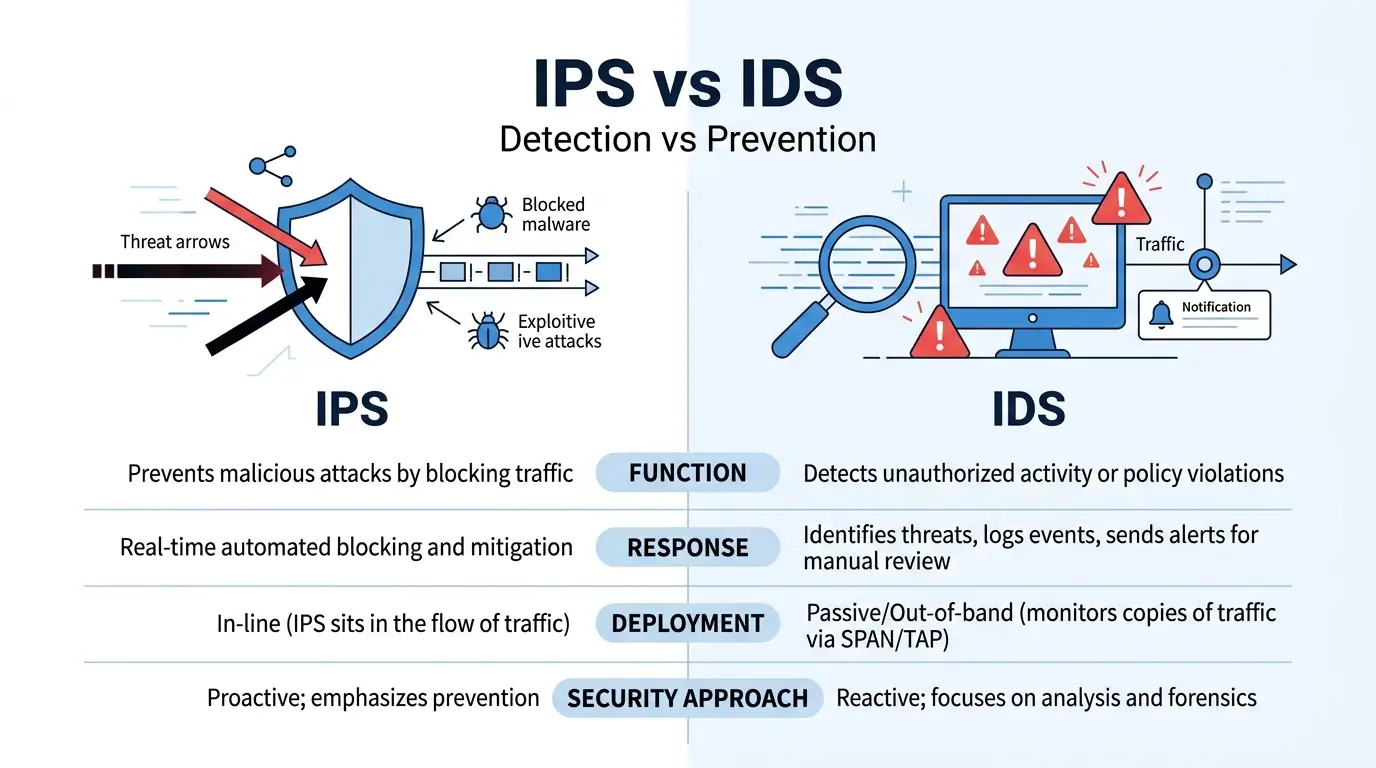
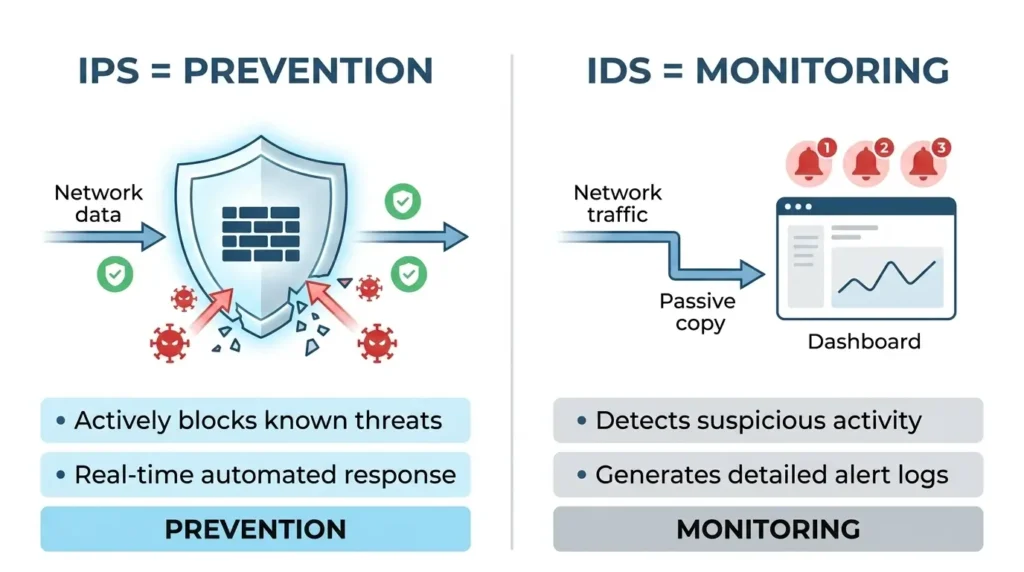
The main difference between IPS (Intrusion Prevention System) and IDS (Intrusion Detection System) is that an IDS detects suspicious network activity and alerts administrators, while an IPS actively blocks or prevents threats in real time. IDS focuses on monitoring and detection, whereas IPS combines detection with automated protection.
Imagine you manage a company network and suddenly receive a warning about unusual activity. Would you prefer a system that simply alerts you or one that automatically stops the attack? This question highlights the difference between IPS vs IDS.
In cybersecurity, IPS and IDS are two essential security technologies designed to protect networks from cyber threats. Because both systems monitor network traffic and identify suspicious behavior, many people confuse them. However, their roles are quite different.
Understanding IPS vs IDS helps IT professionals, students, business owners, and cybersecurity enthusiasts choose the right security solution. While both systems strengthen network defense, knowing when and how each operates can significantly improve protection against malware, hackers, and unauthorized access.
IPS vs IDS at a Glance
| Feature | IPS | IDS |
| Full Form | Intrusion Prevention System | Intrusion Detection System |
| Best Known For | Blocking threats automatically | Detecting threats and sending alerts |
| Main Function | Prevention and protection | Detection and monitoring |
| Traffic Handling | Active | Passive |
| Response | Automatic action | Alert only |
| Key Similarity | Both monitor network traffic and identify suspicious activity |
What Is the Difference Between IPS and IDS?
An IDS monitors network traffic and alerts security teams when suspicious activity is detected. It acts like a surveillance camera that watches and reports incidents.
An IPS goes one step further. It not only detects threats but also blocks malicious traffic automatically. It acts like a security guard who identifies and immediately stops intruders.
In simple terms:
- IDS = Detect and Alert
- IPS = Detect, Alert, and Prevent
Why Is This Difference Important?
For Students
Students studying cybersecurity must understand how different security technologies protect networks. IPS and IDS are fundamental concepts in network security courses and certification programs.
For IT Professionals
Security teams use these systems to reduce cyber risks, improve incident response, and strengthen organizational defenses.
For Businesses
Companies rely on IPS and IDS to protect sensitive information, customer data, and business operations from cyberattacks.
Real-World Relevance
As cyber threats continue to evolve, organizations increasingly deploy both technologies as part of a layered security strategy.
Pronunciation
| Term | US Pronunciation | UK Pronunciation |
| IPS | eye-pee-ess | eye-pee-ess |
| IDS | eye-dee-ess | eye-dee-ess |
Now that we understand the basics, let’s explore the detailed differences between IPS and IDS.
IPS vs IDS – 10 Key Differences
Definition
IPS
An Intrusion Prevention System is a security tool that detects and actively blocks malicious activity.
Examples:
- Blocking malware downloads.
- Stopping unauthorized access attempts.
Real-World Relevance: Helps prevent security incidents before damage occurs.
IDS
An Intrusion Detection System identifies suspicious activity and sends alerts.
Examples:
- Detecting unusual login attempts.
- Identifying suspicious network scans.
Real-World Relevance: Provides visibility into potential threats.
Purpose
IPS
Designed to prevent attacks automatically.
Examples:
- Blocking malicious IP addresses.
- Preventing exploit attempts.
Real-World Relevance: Reduces security response time.
IDS
Designed to monitor and report suspicious activity.
Examples:
- Alerting administrators about malware activity.
- Reporting unauthorized access attempts.
Real-World Relevance: Improves threat awareness.
Detection Method
IPS
Uses signatures, anomaly detection, and behavioral analysis to identify threats and immediately act.
Examples:
- Recognizing known malware patterns.
- Detecting abnormal traffic spikes.
Real-World Relevance: Enhances proactive security.
IDS
Uses similar detection methods but focuses on generating alerts.
Examples:
- Identifying suspicious packets.
- Detecting unusual user behavior.
Real-World Relevance: Supports security investigations.
Response Capability
IPS
Automatically blocks malicious traffic.
Examples:
- Dropping harmful packets.
- Terminating suspicious connections.
Real-World Relevance: Prevents attacks from progressing.
IDS
Only sends notifications.
Examples:
- Email alerts.
- Dashboard warnings.
Real-World Relevance: Requires human intervention.
Network Placement
IPS
Typically deployed inline with network traffic.
Examples:
- Between firewall and internal network.
- At network gateways.
Real-World Relevance: Enables immediate threat blocking.
IDS
Usually deployed out-of-band.
Examples:
- Monitoring mirrored traffic.
- Observing network activity passively.
Real-World Relevance: Minimizes impact on network performance.
Performance Impact
IPS
Because an IPS sits directly in the traffic path and actively analyzes packets, it can slightly affect network performance.
Examples:
- Inspecting incoming web traffic.
- Analyzing encrypted communication streams.
Real-World Relevance: Organizations must balance security and performance when deploying IPS solutions.
IDS
An IDS operates passively and generally has little impact on network speed.
Examples:
- Monitoring mirrored traffic.
- Observing user activity logs.
Real-World Relevance: Ideal for environments where performance is critical.
False Positives
IPS
False positives can be more problematic because the system may block legitimate traffic.
Examples:
- Blocking a valid business application.
- Interrupting authorized user sessions.
Real-World Relevance: Requires careful tuning and monitoring.
IDS
False positives generate alerts but usually do not interrupt operations.
Examples:
- Flagging legitimate traffic as suspicious.
- Generating unnecessary notifications.
Real-World Relevance: Security teams can review alerts before taking action.
Prevention vs Monitoring
IPS
Focuses primarily on prevention.
Examples:
- Blocking ransomware communication.
- Preventing brute-force login attempts.
Real-World Relevance: Acts as an active defense mechanism.
IDS
Focuses primarily on monitoring and visibility.
Examples:
- Tracking suspicious activity.
- Monitoring network behavior.
Real-World Relevance: Helps identify emerging threats.
Best Use Cases
IPS
Best for organizations requiring real-time protection.
Examples:
- Financial institutions.
- E-commerce platforms.
Real-World Relevance: Protects critical systems from immediate threats.
IDS
Best for organizations prioritizing threat visibility and investigation.
Examples:
- Security Operations Centers (SOCs).
- Research environments.
Real-World Relevance: Supports forensic analysis and compliance monitoring.
Security Approach
IPS
Uses a proactive approach by stopping threats before damage occurs.
Examples:
- Blocking malicious downloads.
- Preventing exploit execution.
Real-World Relevance: Reduces the likelihood of successful attacks.
IDS
Uses a reactive approach by identifying and reporting threats.
Examples:
- Logging suspicious network activity.
- Sending incident alerts.
Real-World Relevance: Helps security teams investigate attacks.
Similarities Between IPS and IDS
Although IPS and IDS serve different purposes, they share several similarities:
- Both monitor network traffic.
- Both identify suspicious behavior.
- Both use signature-based detection.
- Both support anomaly-based detection.
- Both improve cybersecurity posture.
- Both help organizations detect threats.
- Both are commonly deployed alongside firewalls.
How IDS Works
An Intrusion Detection System continuously monitors network traffic and system activity.
Signature-Based Detection
Detects known attack patterns.
Example: Identifying a known malware signature.
Anomaly-Based Detection
Detects unusual behavior compared to normal activity.
Example: Sudden spikes in outbound traffic.
Alert Generation
When suspicious activity is found, the IDS notifies administrators.
Example: Sending email or dashboard alerts.
How IPS Works
An Intrusion Prevention System analyzes network traffic in real time and takes action when threats are detected.
Traffic Inspection
Examines packets for malicious content.
Threat Blocking
Stops suspicious traffic before it reaches systems.
Automatic Response
Can block IP addresses, terminate sessions, or drop malicious packets.
Types of IDS
Network-Based IDS (NIDS)
Monitors traffic across an entire network.
Benefits:
- Broad visibility.
- Centralized monitoring.
Host-Based IDS (HIDS)
Monitors activity on individual devices.
Benefits:
- Detailed host-level analysis.
- Detection of local attacks.
Types of IPS
Network-Based IPS (NIPS)
Protects an entire network segment.
Host-Based IPS (HIPS)
Protects individual devices and endpoints.
Wireless IPS (WIPS)
Monitors and secures wireless networks.
Network Behavior Analysis IPS (NBA)
Identifies unusual traffic patterns and behaviors.
IDS vs IPS in Cybersecurity
Modern cybersecurity strategies often combine both technologies.
IDS Provides
- Visibility
- Monitoring
- Incident detection
- Threat intelligence
IPS Provides
- Active defense
- Automatic prevention
- Real-time protection
- Reduced attack success rates
Using both creates multiple layers of security and improves overall protection.
Can IDS and IPS Work Together?
Yes. In fact, many organizations deploy both IDS and IPS as part of a layered cybersecurity strategy.
An IDS acts as a monitoring and alerting system, helping security teams identify suspicious activities and investigate threats. An IPS acts as a protective barrier that automatically blocks malicious traffic before it can cause harm.
Benefits of Using Both
- Improved threat detection
- Faster incident response
- Better network visibility
- Stronger security posture
- Reduced risk of successful attacks
Enterprise Example
A bank may use an IDS to monitor suspicious login attempts while an IPS automatically blocks known attack patterns targeting customer accounts.
Difference and Similarity Table
| Feature | IPS | IDS |
| Full Form | Intrusion Prevention System | Intrusion Detection System |
| Main Function | Prevents attacks | Detects attacks |
| Response | Automatic | Alert Only |
| Traffic Position | Inline | Passive |
| Security Approach | Proactive | Reactive |
| Performance Impact | Moderate | Low |
| False Positives | Can block legitimate traffic | Generates alerts only |
| Monitoring | Yes | Yes |
| Threat Detection | Yes | Yes |
| Threat Prevention | Yes | No |
| Best For | Active protection | Threat visibility |
Which Is Better?
IPS Is Better When…
An IPS is better when real-time threat prevention is a priority. Organizations that handle sensitive customer data, financial transactions, or critical infrastructure often benefit from IPS deployment. Because it automatically blocks malicious traffic, an IPS reduces the risk of successful attacks and minimizes response time. Businesses that require continuous protection against ransomware, malware, and intrusion attempts typically choose IPS as a key component of their security strategy.
IDS Is Better When…
An IDS is better when organizations need detailed visibility into network activity and threat monitoring. Security teams often use IDS solutions to investigate incidents, identify attack patterns, and improve threat intelligence. Since IDS does not block traffic automatically, it reduces the risk of interrupting legitimate business operations. It is especially useful in research environments, security operations centers, and organizations with dedicated cybersecurity teams.
Advantages and Disadvantages
IPS Advantages
- Blocks threats automatically
- Provides real-time protection
- Reduces manual intervention
- Stops attacks before damage occurs
IPS Disadvantages
- May create false positives
- Can affect network performance
- Requires regular tuning
- Usually more complex to manage
IDS Advantages
- Excellent visibility into network activity
- Minimal performance impact
- Supports threat investigations
- Easier deployment in many environments
IDS Disadvantages
- Cannot stop attacks automatically
- Requires human response
- Alert fatigue may occur
- Threats may succeed before action is taken
Real-World Use Cases
Small Businesses
Small businesses often use IDS solutions to monitor network activity and identify suspicious behavior without investing heavily in advanced infrastructure.
Enterprises
Large organizations frequently deploy both IDS and IPS technologies to achieve comprehensive protection and visibility.
Cloud Environments
Cloud providers use IPS solutions to protect workloads from known threats while IDS systems monitor unusual behavior.
Government Networks
Government agencies often combine IDS and IPS with firewalls, endpoint security tools, and threat intelligence platforms to secure sensitive information.
Frequently Asked Questions
What is the main difference between IDS and IPS?
IDS detects and alerts, while IPS detects and actively blocks threats.
Is IPS more secure than IDS?
IPS generally provides stronger protection because it can prevent attacks automatically, but both technologies are valuable.
Can IDS prevent cyberattacks?
No. IDS identifies suspicious activity and generates alerts but does not block attacks.
Should organizations use both IDS and IPS?
Yes. Using both creates a layered security approach that improves detection and prevention capabilities.
Is IPS placed before or after a firewall?
IPS is commonly deployed behind or alongside a firewall to inspect traffic entering the network.
How Both Improve Cybersecurity
Threat Detection
Both systems help identify malicious activities before they become major incidents.
Risk Reduction
They reduce the likelihood of successful cyberattacks.
Compliance Support
Many regulatory frameworks require continuous monitoring and threat management.
Security Awareness
Both provide valuable insights into network behavior and potential vulnerabilities.
Final Words
The IPS vs IDS debate is not about choosing one over the other. IDS focuses on visibility and threat detection, while IPS focuses on prevention and active defense. Together, they form a powerful cybersecurity combination.
Conclusion
Understanding the difference between IPS and IDS is essential for building an effective cybersecurity strategy. An IDS monitors network traffic and alerts administrators to suspicious activity, while an IPS goes a step further by automatically blocking potential threats. Although each technology has unique strengths, they work best when used together. Organizations that combine detection, monitoring, and prevention create a stronger defense against modern cyber threats. Whether you are a student, IT professional, or business owner, knowing how IPS and IDS function can help you make smarter security decisions and better protect valuable digital assets.
Learn more article:
Nova vs Lox: What’s the Difference Between These
ADLs vs IADLs: Understanding the Key Differences