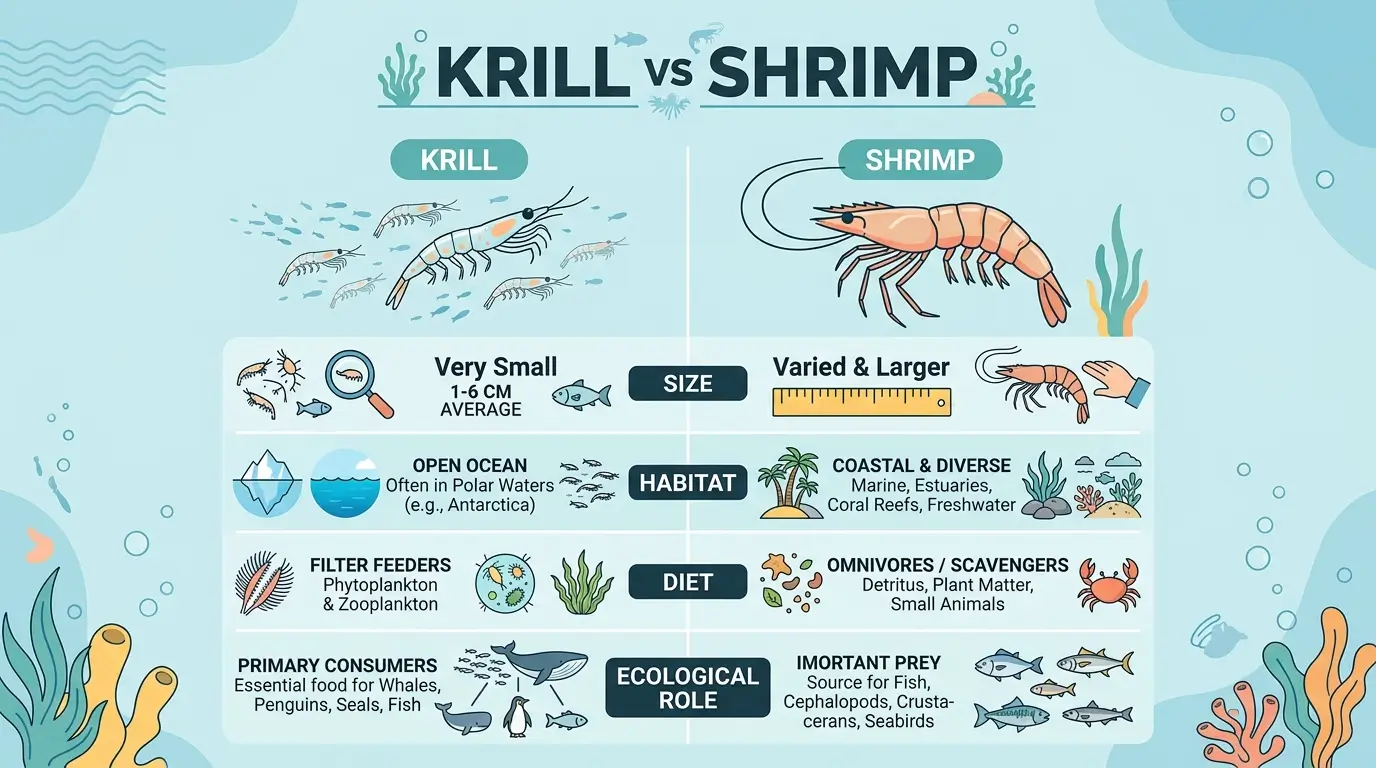
The main difference between krill and shrimp is that krill are small, plankton-like crustaceans that serve as a vital food source for marine animals, while shrimp are generally larger crustaceans commonly consumed by humans. Although they look similar, they differ in classification, habitat, diet, size, and ecological importance.
Imagine watching a nature documentary where a giant whale swims through a cloud of tiny sea creatures. Many people assume those creatures are shrimp, but they are often krill.
This common misunderstanding is one reason why many people search for krill vs shrimp online. While both are small crustaceans that live in water, they play very different roles in marine ecosystems.
Understanding krill vs shrimp is important for students, seafood lovers, researchers, and anyone interested in ocean life. At first glance, they may appear almost identical, but differences in their size, habitat, behavior, and ecological function make them unique.
In this guide, we will explore the complete krill vs shrimp comparison and discover why these fascinating creatures are so important to life in the oceans.
Krill vs Shrimp at a Glance
| Feature | Krill | Shrimp |
| Best Known For | Feeding whales and marine animals | Human food and commercial fishing |
| Habitat | Mostly cold oceans | Oceans, rivers, lakes, and estuaries |
| Size | Usually smaller | Usually larger |
| Diet | Phytoplankton and zooplankton | Plants, algae, and small animals |
| Main Role | Ecosystem foundation species | Food source and seafood industry |
| Key Similarity | Both are aquatic crustaceans | Both are aquatic crustaceans |
What Is the Difference Between Krill and Shrimp?
Krill and shrimp are both crustaceans, but they belong to different groups and serve different purposes in nature. Krill are small, shrimp-like animals that primarily feed on plankton and support marine food webs. Shrimp are generally larger, live in a wider range of habitats, and are widely harvested for human consumption.
Why Is This Difference Important?
Understanding the difference between krill and shrimp helps students learn marine biology more accurately. Researchers use this knowledge to study ocean ecosystems and food chains. Krill support many of the world’s largest marine animals, while shrimp contribute significantly to global fisheries and food production. Knowing how they differ helps us better understand biodiversity and ocean conservation.
Pronunciation
| Word | US Pronunciation | UK Pronunciation |
| Krill | kril | kril |
| Shrimp | shrimp | shrimp |
Now that we understand the basics, let’s take a closer look at the scientific and ecological differences between krill and shrimp.
Scientific Classification
| Classification | Krill | Shrimp |
| Kingdom | Animalia | Animalia |
| Phylum | Arthropoda | Arthropoda |
| Class | Malacostraca | Malacostraca |
| Order | Euphausiacea | Decapoda |
| Family | Various families | Various families |
krill vs shrimp
1. Classification
Krill
- Belong to the order Euphausiacea.
- Example 1: Antarctic krill.
- Example 2: Northern krill.
- Real-world relevance: Essential members of marine food chains.
Shrimp
- Belong mainly to the order Decapoda.
- Example 1: White shrimp.
- Example 2: Tiger shrimp.
- Real-world relevance: Important seafood species worldwide.
2. Size
Krill
- Krill are usually much smaller than shrimp.
- Most krill grow between 1 and 6 centimeters long.
- Example 1: Antarctic krill typically reach about 6 cm.
- Example 2: Northern krill are often smaller than 4 cm.
- Real-world relevance: Their small size makes them easy prey for whales and fish.
Shrimp
- Shrimp are generally larger and more varied in size.
- Some species grow over 20 centimeters long.
- Example 1: Tiger shrimp can exceed 30 cm.
- Example 2: White shrimp commonly reach 15–20 cm.
- Real-world relevance: Their larger size makes them valuable in commercial fisheries.
3. Physical Appearance
Krill
- Krill have transparent bodies and visible internal organs.
- Many species can glow through bioluminescence.
- Example 1: Antarctic krill have large black eyes.
- Example 2: Some krill emit light to avoid predators.
- Real-world relevance: Transparency helps them survive in open oceans.
Shrimp
- Shrimp have a more solid body structure and varied colors.
- They may appear pink, brown, gray, or red.
- Example 1: Pink shrimp are common in warm waters.
- Example 2: Ghost shrimp are nearly transparent.
- Real-world relevance: Their appearance often depends on habitat.
4. Habitat
Krill
- Krill mainly live in oceans, especially cold waters.
- Large populations are found around Antarctica.
- Example 1: Antarctic Ocean.
- Example 2: North Pacific Ocean.
- Real-world relevance: Krill thrive in nutrient-rich marine environments.
Shrimp
- Shrimp live in both saltwater and freshwater habitats.
- They can survive in rivers, lakes, estuaries, and oceans.
- Example 1: Freshwater shrimp in streams.
- Example 2: Marine shrimp in coastal waters.
- Real-world relevance: Their adaptability allows them to live worldwide.
5. Geographic Distribution
Krill
- Krill are concentrated in colder marine regions.
- They are especially abundant in polar oceans.
- Example 1: Southern Ocean.
- Example 2: Arctic waters.
- Real-world relevance: Their distribution influences whale migration routes.
Shrimp
- Shrimp are found across nearly every continent.
- They inhabit tropical, temperate, and cold waters.
- Example 1: Gulf of Mexico shrimp.
- Example 2: Asian tiger shrimp.
- Real-world relevance: Their global presence supports major fishing industries.
6. Diet
Krill
- Krill mainly feed on phytoplankton and microscopic organisms.
- They act as primary consumers in marine ecosystems.
- Example 1: Diatoms.
- Example 2: Microscopic algae.
- Real-world relevance: They transfer energy from plankton to larger animals.
Shrimp
- Shrimp are omnivores and scavengers.
- They eat algae, plants, and small animals.
- Example 1: Small worms.
- Example 2: Organic debris.
- Real-world relevance: They help keep aquatic environments clean.
7. Lifespan
Krill
- Krill generally live longer than many people expect.
- Some species can survive for several years.
- Example 1: Antarctic krill may live 5–10 years.
- Example 2: Northern krill often live several years.
- Real-world relevance: Long lifespans support stable populations.
Shrimp
- Most shrimp have shorter lifespans.
- Many species live between 1 and 6 years.
- Example 1: White shrimp often live about 2 years.
- Example 2: Freshwater shrimp may live 1–3 years.
- Real-world relevance: Short life cycles support rapid population turnover.
8. Reproduction
Krill
- Krill release eggs directly into the water.
- Fertilized eggs develop into larvae.
- Example 1: Antarctic krill spawning.
- Example 2: Seasonal breeding migrations.
- Real-world relevance: Large reproductive numbers help maintain populations.
Shrimp
- Shrimp often carry eggs on their bodies until hatching.
- Reproductive methods vary among species.
- Example 1: Female shrimp carrying eggs under the abdomen.
- Example 2: Freshwater shrimp brood care.
- Real-world relevance: Different strategies improve survival rates.
9. Behavior
Krill
- Krill form enormous swarms containing millions of individuals.
- They migrate vertically through the water column.
- Example 1: Night-time surface feeding.
- Example 2: Deep-water daytime sheltering.
- Real-world relevance: Swarming protects them from predators.
Shrimp
- Shrimp are usually less social than krill.
- Many species live alone or in small groups.
- Example 1: Bottom-dwelling shrimp.
- Example 2: Reef shrimp communities.
- Real-world relevance: Their behavior depends heavily on habitat.
10. Ecological Role
Krill
- Krill are among the most important animals in marine food webs.
- Many large marine species depend on them.
- Example 1: Baleen whales feed heavily on krill.
- Example 2: Penguins consume krill regularly.
- Real-world relevance: Without krill, many ocean ecosystems would struggle.
Shrimp
- Shrimp contribute to nutrient recycling and food chains.
- They are prey for many fish and birds.
- Example 1: Coastal fish feeding on shrimp.
- Example 2: Shorebirds consuming shrimp.
- Real-world relevance: They support both ecosystems and fisheries.
Similarities Between Krill and Shrimp
- Both are crustaceans.
- Both have segmented bodies.
- Both possess exoskeletons.
- Both live in aquatic environments.
- Both serve as food for larger animals.
- Both play important ecological roles.
- Both molt as they grow.
- Both belong to the phylum Arthropoda.
Physical Characteristics
Krill
- Small, transparent, shrimp-like crustaceans.
- Large compound eyes.
- Often capable of bioluminescence.
- Usually range from 1–6 cm in length.
- Delicate body structure adapted for open-ocean life.
Shrimp
- More robust body structure.
- Available in various colors and sizes.
- Long antennae and strong swimming legs.
- Usually larger than krill.
- Adapted to freshwater and marine habitats.
Habitat and Distribution
Krill
Krill primarily inhabit oceans, especially cold and nutrient-rich waters. The largest populations are found around Antarctica, where they form massive swarms that support marine ecosystems.
Shrimp
Shrimp have a much wider distribution. They are found in oceans, rivers, lakes, estuaries, and coastal regions across the globe. Their adaptability allows them to thrive in diverse environments.
Diet and Feeding Habits
Krill
Krill mainly feed on:
- Phytoplankton
- Microscopic algae
- Zooplankton
Their feeding behavior makes them a crucial link between primary producers and larger marine animals.
Shrimp
Shrimp consume:
- Algae
- Small aquatic animals
- Organic matter
- Decaying plants
Their scavenging habits help maintain cleaner aquatic ecosystems.
Nature and Behavior
Krill
- Highly social creatures.
- Form huge swarms.
- Migrate vertically through the water column.
- Depend on group behavior for protection.
Shrimp
- Often solitary or found in small groups.
- More adaptable to different habitats.
- Display diverse behaviors depending on species.
- Some species are territorial.
Role in the Ecosystem
Krill
Krill are considered one of the most important species in marine ecosystems.
They provide food for:
- Whales
- Penguins
- Seals
- Fish
- Seabirds
Without krill, many Antarctic food chains would collapse.
Shrimp
Shrimp contribute by:
- Recycling nutrients
- Cleaning aquatic environments
- Serving as prey for fish and birds
- Supporting aquatic biodiversity
They help maintain ecological balance in both freshwater and marine systems.
Conservation Status
Krill
Most krill populations remain abundant, but climate change and warming oceans may threaten their long-term survival by reducing sea ice habitats.
Shrimp
Many shrimp species remain stable, but some populations face challenges from:
- Overfishing
- Habitat destruction
- Water pollution
- Coastal development
Sustainable management is important for future populations.
Why Do People Confuse Krill and Shrimp?
People often confuse krill and shrimp because:
- Both have similar body shapes.
- Both are small aquatic crustaceans.
- Their names are frequently used interchangeably in casual conversations.
- Photos of krill often resemble tiny shrimp.
- Many people are unfamiliar with marine biology classifications.
Despite these similarities, krill and shrimp belong to different orders and play different roles in nature.
Difference and Similarity Table
| Feature | Krill | Shrimp |
| Classification | Euphausiacea | Decapoda |
| Average Size | Smaller | Larger |
| Habitat | Mainly oceans | Oceans and freshwater |
| Distribution | Mostly cold seas | Worldwide |
| Diet | Plankton | Omnivorous |
| Lifespan | Up to 10 years | Usually shorter |
| Social Behavior | Large swarms | Solitary or small groups |
| Human Consumption | Limited | Common |
| Ecological Importance | Foundation species | Important food-chain member |
| Similarity | Both crustaceans | Both crustaceans |
Which Is Better?
Krill Is Better When…
Krill is more important when discussing marine ecosystems and environmental balance. It serves as a primary food source for many of the world’s largest animals, including whales and penguins. Scientists studying ocean food chains often focus on krill because entire ecosystems depend on its abundance. If the goal is understanding ecological importance and biodiversity, krill stands out as the more significant organism.
Shrimp Is Better When…
Shrimp is generally better when considering human use, food production, and commercial value. It is one of the most widely consumed seafood products in the world and supports millions of jobs through fishing and aquaculture industries. For nutrition, culinary purposes, and economic impact, shrimp plays a far greater role in everyday human life than krill.
Pros and Cons
Krill Pros
- Vital food source for marine life.
- Supports ocean ecosystems.
- Rich in omega-3 fatty acids.
- Important for scientific research.
Krill Cons
- Sensitive to climate change.
- Limited direct human consumption.
- Dependent on stable ocean conditions.
Shrimp Pros
- Valuable food source.
- Major economic importance.
- Widely available worldwide.
- High in protein.
Shrimp Cons
- Overfishing concerns.
- Aquaculture may affect habitats.
- Some fisheries face sustainability issues.
Human Uses and Importance
Krill
- Used in omega-3 supplements.
- Studied in marine biology research.
- Supports ecotourism through whale populations.
- Important in environmental monitoring.
Shrimp
- Consumed globally as seafood.
- Supports commercial fisheries.
- Provides employment opportunities.
- Contributes significantly to international trade.
Fun Facts
- Antarctic krill are among the most abundant animals on Earth.
- Some krill can glow in the dark.
- A blue whale can eat several tons of krill in a single day.
- Shrimp have existed for millions of years.
- Some shrimp species can produce loud snapping sounds.
- Cleaner shrimp remove parasites from fish.
- Krill help transfer carbon from the ocean surface to deeper waters.
- There are thousands of shrimp species worldwide.
Frequently Asked Questions
Is krill a type of shrimp?
No. Krill and shrimp are different types of crustaceans belonging to different orders.
Which is larger, krill or shrimp?
Most shrimp species are larger than krill.
Do humans eat krill?
Yes, but far less commonly than shrimp. Krill is mainly used in supplements.
Why are krill important?
Krill are a major food source for whales, seals, penguins, and many fish species.
Are shrimp and krill closely related?
Yes. Both are crustaceans, but they belong to different biological groups.
How Both Are Useful for Nature and Society
Krill and shrimp provide tremendous value to both ecosystems and humans. Krill supports marine food webs and helps maintain healthy ocean environments. Shrimp contributes to food security, economic growth, and aquatic biodiversity. Together, these crustaceans play essential roles in sustaining life below water and supporting scientific understanding of marine ecosystems.
Final Words
Although krill and shrimp may look similar, they differ significantly in classification, habitat, behavior, and ecological importance. Krill is the foundation of many marine food chains, while shrimp plays a larger role in human nutrition and commerce.
Conclusion
The comparison of krill vs shrimp reveals that appearance can be misleading. While both are aquatic crustaceans, krill primarily support marine ecosystems by feeding countless ocean animals, whereas shrimp are better known for their commercial and culinary value.
Differences in size, habitat, diet, behavior, and ecological function make each unique. Understanding these distinctions helps students, seafood enthusiasts, and nature lovers appreciate the complexity of aquatic life.
Whether you are studying marine biology or simply curious about ocean creatures, knowing the difference between krill and shrimp provides a deeper understanding of how aquatic ecosystems work.
Learn more:
ifference Between Sermorelin and Ipamorelin