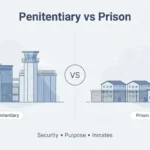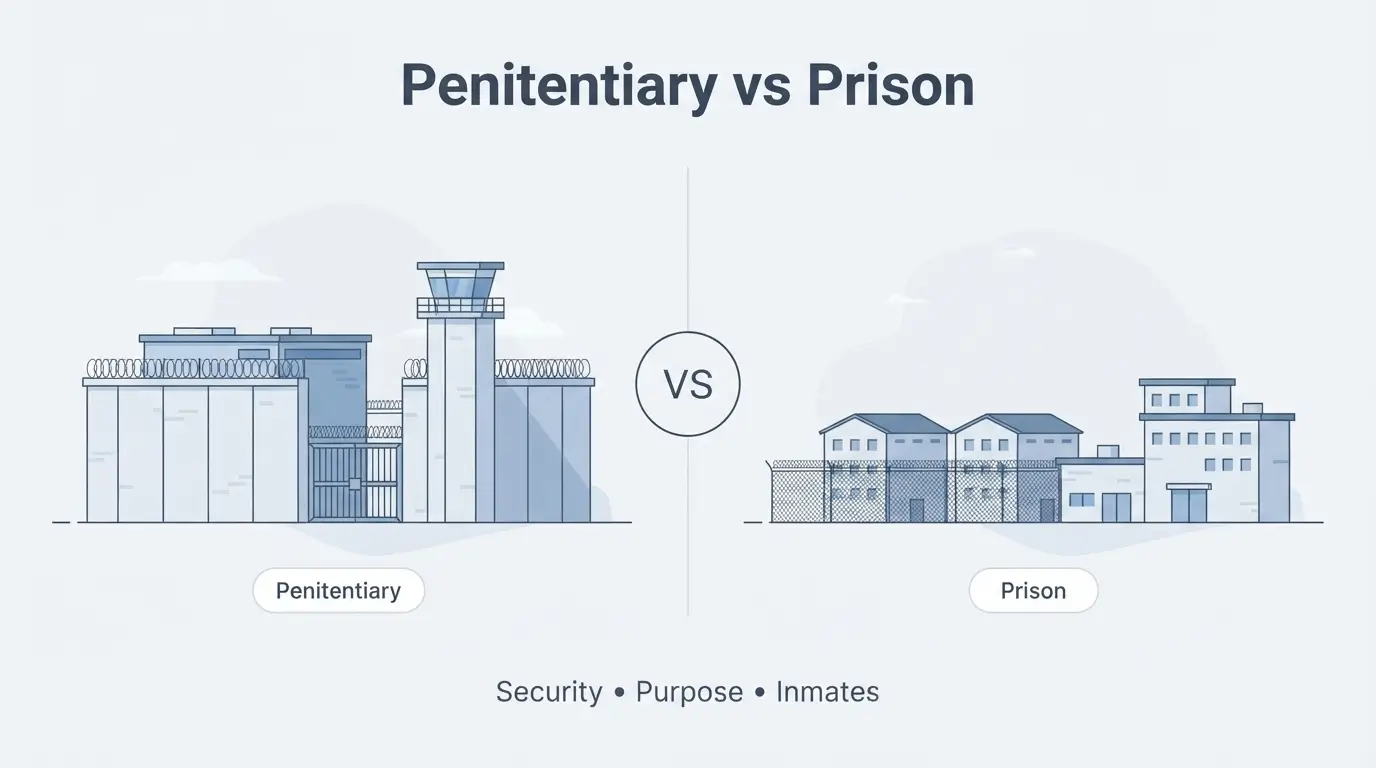
A penitentiary is a type of prison that typically houses inmates serving long sentences for serious crimes, often in higher-security facilities. A prison is a broader term for any correctional institution that confines convicted offenders. In everyday language, all penitentiaries are prisons, but not all prisons are penitentiaries.
Imagine reading a news headline that says someone was sent to a penitentiary, while another article says a person was transferred to a prison. At first glance, the two words seem to mean exactly the same thing. In everyday conversation, people often use them interchangeably. However, in legal and correctional systems, there are important differences.
Understanding penitentiary vs prison is useful for students, journalists, legal professionals, and anyone interested in the criminal justice system. While both are correctional facilities designed to house convicted offenders, they may differ in purpose, security level, inmate population, and legal terminology depending on the country.
This guide explains the difference between a penitentiary and a prison, explores how each facility operates, and answers common questions such as whether every prison is a penitentiary and who is typically sent to these institutions.
Penitentiary vs Prison at a Glance
| Feature | Penitentiary | Prison |
| Meaning | A high-security correctional institution, often for serious offenders | A general correctional facility for convicted offenders |
| Purpose | Long-term incarceration and rehabilitation | Housing convicted offenders of varying security levels |
| Typical Security | Medium to Maximum | Minimum, Medium, Maximum, or Supermax |
| Typical Inmates | Serious felony offenders serving long sentences | Offenders serving various sentence lengths |
| Operated By | Usually federal or state correctional authorities | Federal, state, provincial, or national authorities |
| Rehabilitation | Extensive programs depending on facility | Available in many correctional institutions |
What Is a Penitentiary?
A penitentiary is a correctional institution that usually houses inmates convicted of serious crimes and serving lengthy sentences. Many penitentiaries operate with medium or maximum security.
What Is a Prison?
A prison is a broader term for any correctional facility where convicted offenders serve their sentences. It includes facilities with different security levels and inmate populations.
Main Difference
A penitentiary is generally a specific type of prison designed for more serious offenders, while prison is the broader category covering many types of correctional institutions.
Key Similarity
Both confine convicted offenders, protect public safety, and provide opportunities for rehabilitation.
What Is the Difference Between a Penitentiary and a Prison?
The biggest difference between a penitentiary and a prison is scope.
A prison refers to nearly any correctional institution where convicted individuals serve criminal sentences.
A penitentiary usually refers to a prison designed for offenders convicted of more serious crimes, often serving longer sentences under stricter security conditions.
Think of it this way:
- Every penitentiary is a prison.
- Not every prison is a penitentiary.
This distinction is especially common in the United States and Canada, although terminology varies worldwide.
Why Is This Difference Important?
Understanding these terms improves legal accuracy and prevents confusion.
Importance for Criminal Justice
Law enforcement officers, correctional professionals, and attorneys use precise terminology when discussing sentencing and incarceration.
Importance for Legal Terminology
Legal documents often distinguish between different correctional facilities. Knowing the correct term improves legal understanding.
Importance for Court Reporting
Journalists covering criminal cases should accurately describe where offenders are sentenced.
Importance for Public Understanding
Knowing the difference helps readers better understand criminal justice news and government policies.
Pronunciation
| Word | US Pronunciation | UK Pronunciation |
| Penitentiary | pen-i-TEN-shuh-ree | pen-i-TEN-shuh-ree |
| Prison | PRIZ-ən | PRIZ-ən |
Understanding the basic definitions is only the beginning. Let’s take a closer look at each facility individually before comparing them in detail.
What Is a Penitentiary?
A penitentiary is one of the most secure types of correctional institutions within many criminal justice systems. Although people often use the word interchangeably with “prison,” a penitentiary traditionally refers to a facility designed for offenders convicted of serious crimes and serving long-term sentences.
The word itself comes from penitence, reflecting the early belief that offenders should reflect on their actions, reform their behavior, and return to society as better citizens.
Definition of a Penitentiary
A penitentiary is a correctional institution that houses convicted felons, typically those serving long sentences for serious criminal offenses.
Characteristics include:
- Long-term incarceration
- Higher security
- Serious criminal convictions
- Structured rehabilitation programs
- Strict inmate supervision
Examples
- A person convicted of armed robbery receives a 20-year sentence in a federal penitentiary.
- An offender serving life imprisonment may be housed in a maximum-security penitentiary.
Real-World Relevance
News reports involving federal convictions often mention penitentiaries because many high-risk offenders serve their sentences in these facilities.
Purpose of a Penitentiary
The primary purpose of a penitentiary is to safely incarcerate offenders who have committed serious crimes while providing opportunities for rehabilitation.
Major objectives include:
- Protecting public safety
- Preventing escapes
- Rehabilitating offenders
- Providing educational opportunities
- Reducing repeat offenses (recidivism)
Many penitentiaries also offer:
- Vocational training
- Drug treatment
- Mental health counseling
- Educational courses
- Reentry preparation
These programs aim to prepare eligible inmates for eventual release while maintaining institutional security.
Security Level of a Penitentiary
Most penitentiaries operate under medium or maximum security, although the exact classification depends on the country’s correctional system.
Common security features include:
- Multiple perimeter fences
- Surveillance cameras
- Armed correctional officers
- Controlled inmate movement
- Electronic security systems
- Regular inmate counts
- Restricted visitation procedures
Some of the highest-security penitentiaries, often called Supermax facilities, house offenders considered extremely dangerous or escape risks.
Examples
- A federal maximum-security penitentiary housing violent offenders.
- A Supermax institution designed for inmates requiring the strictest supervision.
Why Security Matters
Higher security protects correctional staff, inmates, and the public while reducing opportunities for violence or escape.
Types of Inmates in a Penitentiary
Penitentiaries generally house offenders convicted of serious felony offenses.
Common inmate categories include:
- Violent offenders
- Organized crime members
- Drug trafficking leaders
- Armed robbery offenders
- Murder convictions
- Repeat felony offenders
- Long-term federal inmates
Sentence lengths often exceed several years, with many inmates serving decades or life sentences.
Rehabilitation Programs in a Penitentiary
Modern penitentiaries focus on more than punishment. Rehabilitation has become an important part of correctional philosophy.
Programs commonly include:
Educational Programs
- High school equivalency
- College courses
- Literacy classes
Vocational Training
- Carpentry
- Welding
- Plumbing
- Computer skills
Behavioral Programs
- Anger management
- Substance abuse treatment
- Cognitive behavioral therapy
Mental Health Services
Licensed professionals provide counseling and psychiatric care for eligible inmates.
Reentry Planning
Many institutions prepare inmates for successful reintegration through:
- Employment readiness
- Financial literacy
- Housing assistance
- Community resource referrals
What Is a Prison?
A prison is a correctional facility where people convicted of crimes serve court-ordered sentences. Unlike the more specific term “penitentiary,” prison is a broad category that includes institutions with varying security levels, inmate populations, and correctional goals.
Prisons exist in nearly every country and are operated by federal, state, provincial, or national governments, depending on the legal system.
Definition of a Prison
A prison is a government-operated correctional institution used to confine individuals convicted of criminal offenses after sentencing.
Prisons may house inmates serving:
- Short-term sentences
- Long-term sentences
- Felony convictions
- Certain misdemeanor sentences (depending on jurisdiction)
Examples
- A state prison housing offenders serving five-year sentences.
- A minimum-security prison for nonviolent offenders nearing release.
Real-World Relevance
Most people use the word “prison” because it applies to a wide variety of correctional institutions rather than one specific type.
Purpose of a Prison
The purpose of a prison extends beyond incarceration. Modern correctional systems aim to balance punishment, public safety, and rehabilitation.
Key objectives include:
- Protecting society
- Enforcing criminal sentences
- Deterring future crime
- Rehabilitating offenders
- Preparing inmates for successful reentry into society
Different prisons emphasize these goals to varying degrees based on their security level and inmate population.
Security Levels of a Prison
Unlike penitentiaries, prisons may operate at several security levels.
These commonly include:
Minimum Security
Designed for low-risk, nonviolent offenders with minimal supervision.
Medium Security
Provides increased monitoring, secure housing, and controlled movement.
Maximum Security
Used for dangerous offenders requiring strict supervision and enhanced security measures.
Supermax Facilities
Reserved for inmates who present extreme security risks or have histories of violence or escape attempts.
Types of Inmates in a Prison
Because prison is a broad term, prisons house many different types of offenders depending on their security classification and sentence length.
Common inmate groups include:
- Nonviolent offenders
- Violent offenders
- First-time offenders
- Repeat offenders
- State inmates
- Federal inmates
- White-collar criminals
- Drug offenders
Unlike a penitentiary, not every prison is designed for the most dangerous criminals. Some minimum-security prisons house inmates who are nearing release or have committed less serious offenses.
Examples
- A person convicted of tax fraud may serve time in a minimum-security federal prison.
- An offender convicted of burglary may serve a sentence in a medium-security state prison.
Real-World Relevance
Understanding the inmate population helps explain why prisons have different security levels and rehabilitation programs.
Rehabilitation Programs in a Prison
Most modern prisons aim to reduce repeat offending through rehabilitation.
Common prison programs include:
Educational Programs
- GED and high school equivalency
- College courses
- Literacy education
Vocational Training
- Carpentry
- Electrical work
- Welding
- Computer skills
Behavioral Programs
- Substance abuse treatment
- Anger management
- Parenting classes
Mental Health Services
Many prisons provide counseling, psychological care, and crisis intervention.
Reentry Programs
Prisons often prepare inmates for release by offering:
- Job readiness
- Resume writing
- Financial education
- Community support referrals
Penitentiary vs Prison – 10 Key Differences
Definition of Penitentiary vs Prison
Penitentiary
A penitentiary is a specialized correctional institution primarily intended for offenders convicted of serious crimes who usually receive long prison sentences.
Examples
- Federal penitentiary for armed robbery.
- Maximum-security penitentiary for violent offenders.
Real-World Relevance
The word usually suggests stricter security and more serious offenders.
Prison
A prison is a general correctional facility used to house convicted offenders of different security classifications.
Examples
- State prison.
- Federal prison.
Real-World Relevance
It is the broader legal term used worldwide.
Purpose of Penitentiary vs Prison
Purpose of a Penitentiary
The primary goal is to safely confine serious offenders while maintaining high security and offering rehabilitation opportunities.
Examples
- Housing life-sentence inmates.
- Managing violent criminals.
Purpose of a Prison
A prison accommodates convicted offenders with different sentence lengths and rehabilitation needs.
Examples
- Housing medium-risk offenders.
- Preparing inmates for reentry.
Security Level of Penitentiary vs Prison
Security Level of a Penitentiary
Penitentiaries generally operate with medium or maximum security.
Common features include:
- Armed correctional officers
- Multiple fences
- Surveillance systems
- Restricted inmate movement
Security Level of a Prison
Prisons can be:
- Minimum Security
- Medium Security
- Maximum Security
- Supermax
Security depends on inmate risk rather than the name of the facility.
Type of Offenders in Penitentiary vs Prison
Penitentiary
Typically houses:
- Murder convictions
- Armed robbery offenders
- Organized crime members
- Repeat violent offenders
Prison
May house:
- Drug offenders
- Property crime offenders
- White-collar criminals
- Violent offenders
- Nonviolent offenders
Sentence Length in Penitentiary vs Prison
Penitentiary
Most inmates serve long-term sentences.
Examples include:
- 15 years
- 25 years
- Life imprisonment
Prison
Sentence lengths vary greatly.
Examples include:
- 18 months
- 5 years
- 10 years
- Longer sentences
Government Authority of Penitentiary vs Prison
Penitentiary
Often operated by federal correctional agencies or state departments of corrections.
Examples include:
- Federal Bureau of Prisons
- Provincial correctional authorities
Prison
May be operated by:
- Federal government
- State government
- Provincial government
- National correctional agencies
Rehabilitation Programs in Penitentiary vs Prison
Rehabilitation Programs in a Penitentiary
Programs often focus on long-term behavioral improvement.
Examples include:
- College education
- Vocational certification
- Psychological counseling
Rehabilitation Programs in a Prison
Programs vary according to inmate needs and facility resources.
Examples include:
- Drug treatment
- Job training
- Educational classes
Daily Life in Penitentiary vs Prison
Daily Life in a Penitentiary
Daily schedules are highly structured.
Activities include:
- Security counts
- Assigned work
- Education
- Recreation
- Counseling
Movement is carefully monitored.
Daily Life in a Prison
Daily routines vary depending on security level.
Some inmates have greater movement, educational opportunities, and work assignments than others.
Facilities in Penitentiary vs Prison
Penitentiary
Often includes:
- Secure housing units
- Intensive surveillance
- High-security control rooms
- Medical clinics
- Vocational workshops
Prison
Facilities vary widely and may include:
- Dormitories
- Recreation yards
- Libraries
- Classrooms
- Medical centers
Public Usage of Penitentiary vs Prison
Penitentiary
Mostly used in legal documents and official correctional terminology.
Prison
Commonly used in everyday conversation, news reporting, and media.
For most people, “prison” is the preferred general term.
Similarities Between Penitentiary and Prison
Although they differ in scope, penitentiaries and prisons share many characteristics.
Both:
- House convicted offenders.
- Operate under government authority.
- Protect public safety.
- Employ correctional officers.
- Provide rehabilitation opportunities.
- Offer education and vocational training.
- Maintain strict security procedures.
- Support inmate reentry programs.
Penitentiary vs Prison vs Jail
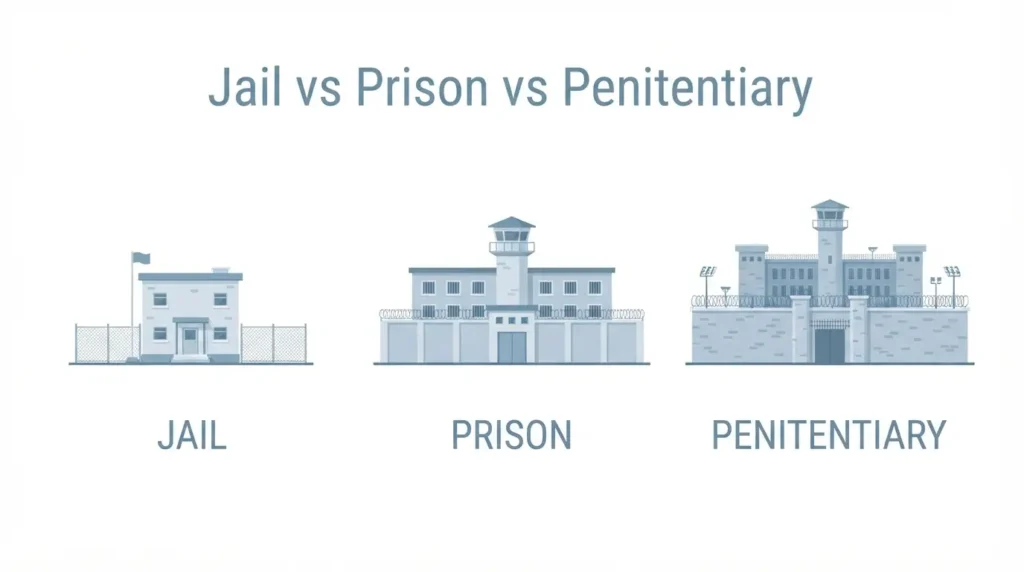
Many people also confuse jails with prisons and penitentiaries.
| Feature | Jail | Prison | Penitentiary |
| Holds | Awaiting trial or short sentences | Convicted offenders | Serious long-term offenders |
| Sentence Length | Usually under one year | Months to life | Usually long-term |
| Security | Low to Medium | All levels | Medium to Maximum |
| Operated By | Local government | State or Federal | Usually Federal or State |
What Is a Jail?
A jail temporarily holds people:
- Awaiting trial
- Awaiting bail
- Serving short sentences
How Jail Differs from Prison
Jails are locally operated and designed for temporary detention.
Prisons house convicted offenders for longer periods.
How Penitentiaries Fit In
A penitentiary is simply a specialized type of prison, generally intended for more serious offenders.
Federal Prison vs State Prison vs Penitentiary
| Feature | Federal Prison | State Prison | Penitentiary |
| Operated By | Federal Bureau of Prisons | State Department of Corrections | Usually Federal or State |
| Crimes | Federal crimes | State crimes | Mostly serious offenses |
| Examples | Bank robbery | Assault | Murder convictions |
| Security | All levels | All levels | Usually higher security |
Federal Prison
Houses offenders convicted of federal crimes such as:
- Drug trafficking
- Bank robbery
- Federal fraud
- Immigration offenses
State Prison
Houses offenders convicted under state criminal laws.
Examples include:
- Assault
- Burglary
- Robbery
- Manslaughter
Penitentiary
Usually refers to higher-security facilities that house serious offenders serving lengthy sentences.
Who Goes to a Penitentiary?
People sent to penitentiaries often include:
- Violent offenders
- Murder convictions
- Armed robbery offenders
- Drug cartel leaders
- Repeat felony offenders
- Organized crime members
- Long-term federal inmates
Not every serious offender automatically goes to a penitentiary. Placement depends on factors such as:
- Criminal history
- Security classification
- Escape risk
- Institutional behavior
- Medical needs
Security Levels Compared
| Security Level | Typical Inmates | Example Facilities |
| Minimum | Low-risk offenders | Prison camps |
| Medium | Moderate-risk offenders | State prisons |
| Maximum | Dangerous offenders | High-security prisons |
| Supermax | Highest-risk offenders | Specialized penitentiaries |
Higher security means:
- More surveillance
- Less inmate movement
- Greater staff presence
- Increased physical barriers
Daily Life in a Penitentiary vs Prison
Although both facilities follow strict routines, daily life often differs based on security level, inmate population, and correctional policies.
Daily Life in a Penitentiary
Inmates in penitentiaries usually experience tighter security and more restricted movement.
A typical day may include:
- Scheduled security counts
- Assigned work details
- Educational or rehabilitation programs
- Limited recreation time
- Strict visitation rules
- Controlled movement between housing units
High-security penitentiaries often require inmates to remain in designated areas unless escorted by correctional staff.
Daily Life in a Prison
Daily routines vary widely depending on whether the prison is minimum, medium, or maximum security.
Many prisons offer:
- Work assignments
- Vocational training
- Educational classes
- Religious services
- Recreation and exercise
- Family visitation
Minimum-security prisons generally allow greater freedom of movement than high-security facilities.
Rehabilitation Programs in Penitentiary vs Prison
Modern correctional systems focus not only on punishment but also on reducing repeat offenses through rehabilitation.
Rehabilitation Programs in a Penitentiary
Because inmates often serve long sentences, penitentiaries usually provide long-term rehabilitation opportunities.
Common programs include:
- College education
- Vocational certifications
- Mental health counseling
- Drug rehabilitation
- Anger management
- Faith-based programs
- Life-skills training
These programs help inmates prepare for eventual reintegration into society whenever possible.
Rehabilitation Programs in a Prison
Prisons also provide rehabilitation, although available programs vary by facility and funding.
Typical offerings include:
- GED preparation
- Literacy education
- Job training
- Substance abuse treatment
- Parenting classes
- Financial education
Successful participation may improve an inmate’s chances for parole or successful reentry.
Correctional Staff and Daily Operations
Correctional facilities rely on many professionals to maintain safety and support rehabilitation.
Correctional Officers
Correctional officers supervise inmates, enforce rules, conduct security checks, and respond to emergencies.
Wardens
The warden oversees the entire facility, including security, staffing, budgeting, and inmate management.
Medical Staff
Doctors, nurses, and mental health professionals provide healthcare services and emergency treatment.
Education Staff
Teachers and vocational instructors help inmates gain academic knowledge and practical job skills.
Rehabilitation Specialists
Counselors, psychologists, and social workers assist inmates with behavioral improvement and reentry planning.
Can a Prisoner Move from One Facility to Another?
Yes. Inmates are frequently transferred between correctional facilities for various reasons.
Common reasons include:
Security Reclassification
If an inmate’s risk level changes, they may be moved to a higher- or lower-security institution.
Medical Needs
Serious health conditions may require transfer to facilities with specialized medical services.
Behavioral Reasons
Good behavior may result in transfer to a lower-security prison, while disciplinary issues can lead to placement in a more secure institution.
Court Orders
Inmates may be transferred temporarily to attend court proceedings or legal hearings.
Population Management
Correctional agencies sometimes relocate inmates to reduce overcrowding or improve operational efficiency.
Historical Evolution of Penitentiaries
The word penitentiary comes from penitence, meaning remorse for wrongdoing.
Early Origins
In the late 18th and early 19th centuries, reformers believed criminals could become better people through reflection, discipline, work, and religious instruction.
The Pennsylvania System
One of the earliest penitentiary models emphasized solitary confinement to encourage repentance and moral reform.
Modern Correctional Philosophy
Today’s correctional systems balance four primary goals:
- Punishment
- Public safety
- Rehabilitation
- Successful reintegration into society
As a result, many modern penitentiaries now provide education, vocational training, counseling, and mental health services alongside strict security measures.
Common Misconceptions About Penitentiaries and Prisons
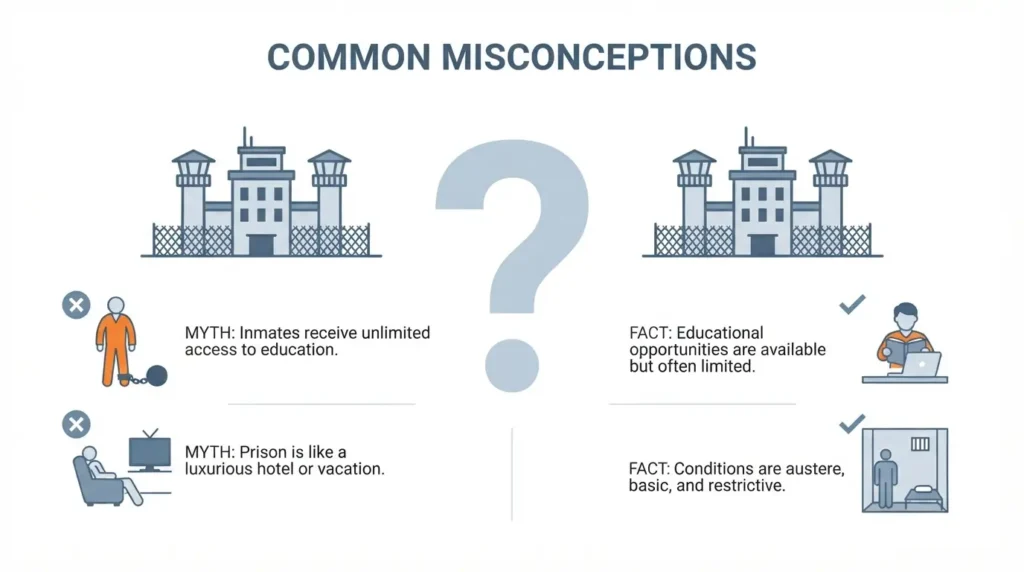
Several myths cause confusion between these terms.
Myth 1: Every Prison Is a Penitentiary
Reality: A penitentiary is generally considered a specific type of prison, not every prison.
Myth 2: All Penitentiaries Are Maximum Security
Reality: Many are high-security facilities, but terminology varies by country and correctional system.
Myth 3: Jail and Prison Mean the Same Thing
Reality: Jails typically hold individuals awaiting trial or serving short sentences, while prisons house convicted offenders for longer terms.
Myth 4: Only Murderers Go to Penitentiaries
Reality: Penitentiaries may house many types of serious offenders, including those convicted of armed robbery, drug trafficking, organized crime, and other major felonies.
Real-World Examples
Famous Penitentiaries
These institutions are widely recognized for their historical or security significance.
- United States Penitentiary, Leavenworth
- United States Penitentiary, Florence ADX (Supermax)
- Kingston Penitentiary (Canada)
Famous Prisons
Many prisons have become well known through history and popular culture.
- San Quentin State Prison
- Folsom State Prison
- HM Prison Belmarsh (United Kingdom)
These examples illustrate how the names “penitentiary” and “prison” are used differently across countries.
Legal Terminology Explained
Understanding related legal terms makes the distinction even clearer.
| Term | Meaning |
| Inmate | A person confined in a correctional facility. |
| Convict | Someone found guilty of a criminal offense. |
| Offender | A person who has violated criminal law. |
| Felony | A serious criminal offense, often punishable by imprisonment for more than one year. |
| Misdemeanor | A less serious criminal offense with shorter penalties. |
| Sentence | The punishment ordered by a court after conviction. |
| Parole | Conditional early release under supervision. |
| Probation | Community supervision instead of incarceration. |
| Correctional Facility | A general term for institutions that confine offenders. |
Penitentiary vs Prison Comparison Chart
| Feature | Penitentiary | Prison |
| Meaning | A specialized type of prison | A broad correctional facility |
| Purpose | Long-term incarceration of serious offenders | Housing convicted offenders |
| Security | Usually medium to maximum | Minimum to supermax |
| Typical Inmates | Serious or violent offenders | All types of offenders |
| Sentence Length | Usually longer | Short or long-term |
| Government | Often federal or state | Federal, state, or national |
| Rehabilitation | Extensive long-term programs | Programs vary by facility |
| Daily Life | More restrictive | Depends on security level |
| Examples | USP Leavenworth, ADX Florence | San Quentin, Folsom State Prison |
Which Term Should You Use?
Use “Penitentiary” When…
Use penitentiary when referring to a specific correctional institution designed for inmates serving long sentences or convicted of serious crimes. The term is common in legal writing, historical discussions, and references to certain federal or provincial facilities. If accuracy matters in a legal or criminal justice context, “penitentiary” is often the better choice.
Use “Prison” When…
Use prison when speaking generally about correctional institutions. It is the most widely recognized and understood term in everyday conversation, journalism, education, and international discussions. Since every penitentiary is a type of prison, “prison” is usually appropriate unless you need a more specific legal distinction.
Pros and Limitations
Penitentiary
Pros
- High level of security
- Comprehensive rehabilitation programs
- Better management of dangerous offenders
- Specialized facilities for long-term incarceration
Cons
- Higher operating costs
- More restrictive living conditions
- Limited freedom of movement
- Greater psychological challenges for inmates
Prison
Pros
- Covers multiple security levels
- Broad rehabilitation opportunities
- Flexible inmate placement
- Supports various offender categories
Cons
- Program quality varies by location
- Overcrowding in some facilities
- Resource limitations
- Different standards across jurisdictions
Frequently Asked Questions
Is every penitentiary a prison?
Yes. A penitentiary is generally considered a specific type of prison, but not every prison is classified as a penitentiary.
Is a penitentiary more secure than a prison?
Often yes. Many penitentiaries operate at medium or maximum security, although security levels depend on the correctional system.
What’s the difference between a jail and a penitentiary?
Jails usually hold people awaiting trial or serving short sentences, while penitentiaries house convicted offenders serving longer sentences for more serious crimes.
Why is it called a penitentiary?
The term comes from the word penitence, reflecting the original idea that offenders should reform through discipline, reflection, and rehabilitation.
Do federal inmates go to penitentiaries?
Many federal inmates convicted of serious offenses are assigned to federal penitentiaries, while others may serve time in different types of federal correctional institutions.
Are penitentiaries always maximum security?
No. Although many are high-security facilities, some operate at medium security depending on the correctional system.
Can inmates transfer between prisons?
Yes. Transfers may occur because of security reclassification, medical needs, court orders, behavioral changes, or population management.
Which countries use the term “penitentiary”?
The term is commonly used in countries such as the United States and Canada, while many other nations primarily use the broader term prison.
Role in the Criminal Justice System
Both penitentiaries and prisons play essential roles in maintaining public safety and enforcing criminal law.
They help:
- Protect communities from dangerous offenders
- Enforce court-ordered sentences
- Provide rehabilitation opportunities
- Reduce recidivism through education and treatment
- Prepare eligible inmates for successful reintegration into society
A balanced correctional system seeks to combine accountability with rehabilitation, benefiting both offenders and the wider community.
Final Words
A penitentiary is generally a specialized, higher-security type of prison designed for inmates serving long sentences for serious crimes. Prison is the broader term that covers correctional facilities of all security levels. Understanding the distinction helps you use the correct legal terminology in conversations, writing, and criminal justice discussions.
Conclusion
Although the terms penitentiary and prison are often used interchangeably, they are not always identical. A prison is any correctional facility that houses convicted offenders, while a penitentiary usually refers to a more specialized institution for serious offenders serving longer sentences, often under stricter security. The exact meaning can vary between countries and correctional systems, but the general distinction remains useful. Whether you’re studying criminal justice, reading legal news, or simply expanding your vocabulary, knowing when to use each term improves both accuracy and understanding.
Learn more about:
Difference Between Modernism and Postmodernism: guide 2026