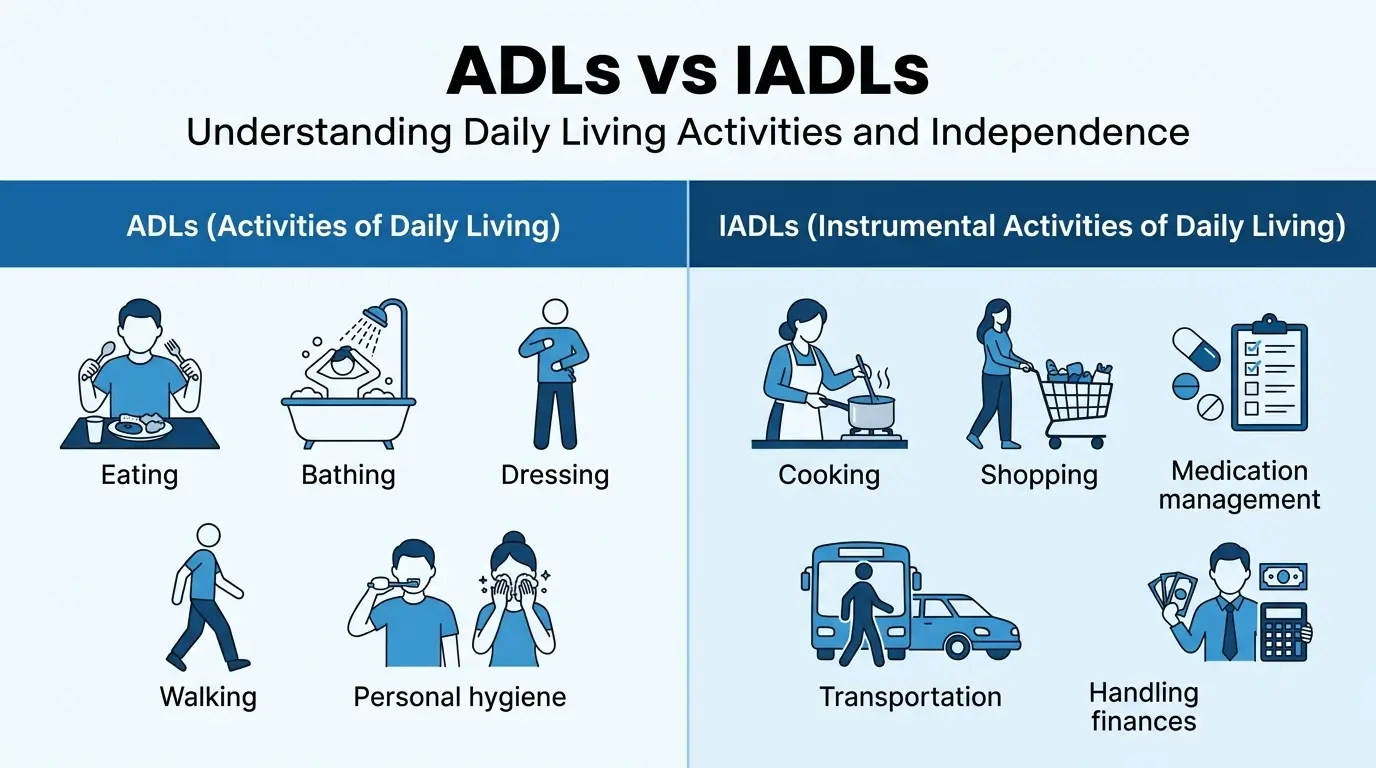
ADLs (Activities of Daily Living) are basic self-care tasks such as eating, bathing, dressing, toileting, and mobility. IADLs (Instrumental Activities of Daily Living) are more complex activities such as cooking, shopping, managing medications, transportation, and handling finances. The main difference is that ADLs measure basic personal independence, while IADLs measure a person’s ability to live independently within the community.
Imagine an elderly parent who can still eat, dress, and bathe without help but struggles to manage bills, shop for groceries, or remember medications. In healthcare, this distinction is very important. It is where the comparison of ADLs vs IADLs becomes useful.
Many people searching for ADLs vs IADLs are caregivers, healthcare students, occupational therapists, or family members caring for aging loved ones. Although both terms measure independence, they assess different aspects of daily life.
Understanding ADLs vs IADLs helps healthcare professionals evaluate a person’s functional abilities and determine the level of support they may need. Whether planning elderly care, rehabilitation, or long-term assistance, knowing the difference between ADLs and IADLs can lead to better decisions and improved quality of life.
ADLs vs IADLs at a Glance
| Feature | ADLs | IADLs |
| Best Known For | Basic self-care activities | Independent living activities |
| Complexity | Simple | More complex |
| Main Purpose | Personal survival and hygiene | Community and household functioning |
| Examples | Eating, bathing, dressing | Shopping, cooking, transportation |
| Importance | Basic independence | Advanced independence |
| Similarity | Both assess functional ability | Both assess functional ability |
What Is the Difference Between ADLs and IADLs?
The primary difference between ADLs and IADLs is the level of complexity involved.
ADLs refer to basic daily tasks necessary for personal care and survival. These activities are essential for maintaining health and hygiene.
IADLs involve more advanced skills required to live independently in society. These tasks often require planning, decision-making, memory, and organizational abilities.
Simply put, if ADLs help a person take care of themselves, IADLs help them manage their life.
Why Is This Difference Important?
Importance for Caregivers
Caregivers use ADLs and IADLs to determine how much assistance an individual needs. Understanding limitations helps create appropriate care plans.
Importance for Healthcare Professionals
Doctors, nurses, occupational therapists, and rehabilitation specialists rely on these assessments to evaluate patient functioning and recovery progress.
Importance for Elderly Care
Aging adults often lose IADL abilities before ADL abilities. Identifying these changes early can improve safety and independence.
Real-World Relevance
ADLs and IADLs influence decisions about assisted living, home care, rehabilitation services, and long-term care planning.
Pronunciation
| Word | US Pronunciation | UK Pronunciation |
| ADLs | AY-DEE-ELZ | AY-DEE-ELZ |
| IADLs | EYE-AY-DEE-ELZ | EYE-AY-DEE-ELZ |
Now that we understand the basics, let’s explore the detailed comparison between ADLs and IADLs.
ADLs vs IADLs – 10 Key Differences
Definition
ADLs
ADLs are basic self-care tasks necessary for daily survival.
Examples:
- Taking a shower independently.
- Feeding yourself during meals.
Real-world relevance:
Healthcare providers often assess ADLs when determining personal care needs.
IADLs
IADLs are more complex activities required for independent living.
Examples:
- Paying monthly bills.
- Scheduling medical appointments.
Real-world relevance:
IADLs help determine whether a person can safely live alone.
Purpose
ADLs
The primary purpose of ADLs is maintaining personal health and hygiene.
Examples:
- Brushing teeth.
- Using the toilet independently.
Real-world relevance:
Poor ADL performance may indicate a need for personal assistance.
IADLs
The purpose of IADLs is maintaining an independent lifestyle.
Examples:
- Managing household expenses.
- Shopping for groceries.
Real-world relevance:
Difficulties with IADLs often signal early functional decline.
Complexity
ADLs
ADLs involve simple physical actions.
Examples:
- Getting dressed.
- Walking to the bathroom.
Real-world relevance:
Most children learn ADLs early in life.
IADLs
IADLs require planning and cognitive skills.
Examples:
- Organizing medications.
- Managing a bank account.
Real-world relevance:
IADLs often reveal cognitive impairments before ADLs do.
Daily Function
ADLs
ADLs focus on personal functioning.
Examples:
- Eating meals.
- Grooming.
Real-world relevance:
Essential for basic survival.
IADLs
IADLs focus on household and community functioning.
Examples:
- Driving.
- Using public transportation.
Real-world relevance:
Support independent living.
Here is Part 2 of the article:
ADLs vs IADLs – 10 Key Differences (Continued)
Level of Independence
ADLs
ADLs measure a person’s ability to care for themselves physically.
Examples:
- Bathing without assistance.
- Dressing independently.
Real-world relevance:
Healthcare providers often use ADLs to determine eligibility for personal care services.
IADLs
IADLs measure a person’s ability to function independently within society.
Examples:
- Managing household finances.
- Planning transportation.
Real-world relevance:
IADLs indicate whether a person can safely live alone.
Examples of Tasks
ADLs
Tasks focus on personal care.
Examples:
- Eating meals.
- Using the toilet.
Real-world relevance:
These tasks are necessary for daily survival.
IADLs
Tasks focus on managing everyday life.
Examples:
- Grocery shopping.
- Preparing meals.
Real-world relevance:
These activities support independent living.
Healthcare Assessment
ADLs
ADLs are commonly evaluated during hospital admissions and long-term care assessments.
Examples:
- Mobility evaluations.
- Bathing assessments.
Real-world relevance:
They help determine the need for nursing assistance.
IADLs
IADLs assess cognitive and executive functioning.
Examples:
- Medication management.
- Financial planning.
Real-world relevance:
Useful for identifying early cognitive decline.
Care Planning
ADLs
ADL limitations often require hands-on caregiving.
Examples:
- Assistance with dressing.
- Help with bathing.
Real-world relevance:
Care plans focus on personal support services.
IADLs
IADL limitations often require supervision or assistance.
Examples:
- Help with transportation.
- Support with shopping.
Real-world relevance:
Care plans may focus on community resources.
Aging and Disability Impact
ADLs
ADL impairments usually occur later in aging or after significant disability.
Examples:
- Difficulty walking.
- Difficulty feeding oneself.
Real-world relevance:
Loss of ADLs often signals advanced care needs.
IADLs
IADL impairments often appear earlier.
Examples:
- Forgetting medications.
- Difficulty balancing finances.
Real-world relevance:
Can be an early warning sign of dementia or cognitive decline.
Importance in Long-Term Care
ADLs
ADLs strongly influence decisions about nursing care.
Examples:
- Home health assistance.
- Skilled nursing facilities.
Real-world relevance:
Critical for determining care intensity.
IADLs
IADLs help evaluate community living potential.
Examples:
- Assisted living suitability.
- Independent living assessments.
Real-world relevance:
Guide decisions about housing and support services.
Similarities Between ADLs and IADLs
- Both measure functional independence.
- Both are used in healthcare assessments.
- Both help create personalized care plans.
- Both support rehabilitation goals.
- Both are important in elderly care and disability management.
Common ADL Examples
Common Activities of Daily Living include:
- Eating
- Bathing
- Dressing
- Grooming
- Toileting
- Walking and transferring
- Personal hygiene
Common IADL Examples
Common Instrumental Activities of Daily Living include:
- Cooking meals
- Shopping
- Managing finances
- Taking medications correctly
- Housekeeping
- Using transportation
- Communication and phone use
ADLs and IADLs Assessment Tools
Katz Index of Independence in Activities of Daily Living
The Katz Index measures a person’s ability to perform six basic ADLs independently. It is widely used in hospitals, rehabilitation centers, and long-term care settings.
Lawton Instrumental Activities of Daily Living Scale
The Lawton Scale evaluates a person’s ability to perform complex daily tasks. It helps healthcare providers identify areas where support may be needed.
How Healthcare Providers Measure Independence
Healthcare professionals use interviews, observations, caregiver reports, and standardized assessments to evaluate functional ability.
Importance in Patient Evaluation
These tools help determine care needs, rehabilitation goals, discharge planning, and long-term support requirements.
ADLs vs IADLs in Aging Adults
As people age, they often experience changes in physical and cognitive abilities.
Common challenges include:
- Reduced mobility
- Memory problems
- Vision loss
- Balance issues
- Chronic illnesses
Many older adults lose IADL abilities before ADL abilities. Early recognition allows families to arrange support while preserving independence.
ADLs vs IADLs in Occupational Therapy
Occupational therapists use ADLs and IADLs to evaluate functional performance.
Role of Occupational Therapists
They help individuals regain independence after illness, injury, or disability.
Functional Assessments
Therapists observe how individuals perform everyday tasks and identify barriers.
Rehabilitation Planning
Treatment plans focus on improving daily functioning and safety.
Recovery and Independence Goals
The ultimate goal is to maximize independence and quality of life.
Why Do People Confuse ADLs and IADLs?
People often confuse ADLs and IADLs because both involve everyday activities.
Common reasons include:
- Similar terminology
- Both measure independence
- Both are used in healthcare
- Tasks may overlap in daily life
The key distinction is that ADLs are basic self-care activities, while IADLs are more complex independent living activities.
Difference and Similarity Table
| Feature | ADLs | IADLs |
| Meaning | Basic self-care tasks | Independent living tasks |
| Complexity | Lower | Higher |
| Physical Skills | Primary focus | Secondary focus |
| Cognitive Skills | Minimal | Significant |
| Examples | Eating, bathing | Shopping, finances |
| Assessment Tool | Katz Index | Lawton Scale |
| Care Needs | Personal assistance | Community support |
| Goal | Survival and self-care | Independent living |
Which Is More Important?
When ADLs Matter Most
ADLs become most important when evaluating a person’s ability to care for themselves safely. In hospitals, rehabilitation centers, and long-term care facilities, ADLs determine whether a person can manage essential daily functions. Without ADL independence, health and safety may be at risk.
When IADLs Matter Most
IADLs are most important when assessing independent living capabilities. These tasks help determine whether a person can successfully manage life in the community. Difficulties with IADLs often appear before basic self-care problems and can signal the need for additional support.
Pros and Limitations of Using ADLs and IADLs Assessments
ADLs Pros
- Easy to measure
- Widely accepted
- Important for care planning
ADLs Cons
- May not detect early cognitive decline
- Focuses mainly on physical functioning
IADLs Pros
- Detects subtle functional decline
- Evaluates real-world independence
IADLs Cons
- More subjective
- Can be influenced by lifestyle differences
Role in Healthcare and Elderly Care
ADLs and IADLs play a central role in:
- Geriatric care
- Rehabilitation
- Long-term care planning
- Assisted living decisions
- Independent living assessments
- Caregiver support programs
How Healthcare Professionals Use ADLs and IADLs
Healthcare professionals use these assessments to:
- Evaluate patient independence
- Monitor recovery progress
- Create treatment plans
- Recommend support services
- Determine care placement options
Frequently Asked Questions
What do ADLs stand for?
ADLs stand for Activities of Daily Living.
What do IADLs stand for?
IADLs stand for Instrumental Activities of Daily Living.
Which comes first, ADL loss or IADL loss?
IADL loss typically occurs before ADL loss.
Why are ADLs important?
They measure basic self-care abilities and independence.
Who uses ADL and IADL assessments?
Doctors, nurses, occupational therapists, caregivers, and rehabilitation specialists.
How Both Improve Quality of Life
ADLs and IADLs help people maintain independence, dignity, and safety. They guide healthcare planning, support aging in place, and improve overall well-being. Together, they provide a complete picture of a person’s functional abilities.
Final Words
ADLs and IADLs are both essential measures of independence. ADLs focus on basic self-care, while IADLs evaluate the more advanced skills needed for independent living.
Conclusion
Understanding ADLs vs IADLs is essential for caregivers, healthcare professionals, and families supporting older adults or individuals with disabilities. ADLs measure basic self-care tasks such as eating, bathing, and dressing, while IADLs assess more complex activities such as managing finances, shopping, and transportation.
Although both evaluate independence, they serve different purposes in healthcare and long-term care planning. By understanding these differences, families and professionals can make better decisions about support, rehabilitation, and independent living.
Whether assessing aging adults, planning care, or monitoring recovery, ADLs and IADLs remain valuable tools for promoting safety, dignity, and quality of life.
Learn more article:
Squat vs Deadlift: What’s the Real Difference? (guide 2026)
Krill vs Shrimp: Key Differences in Size, Habitat and Diet