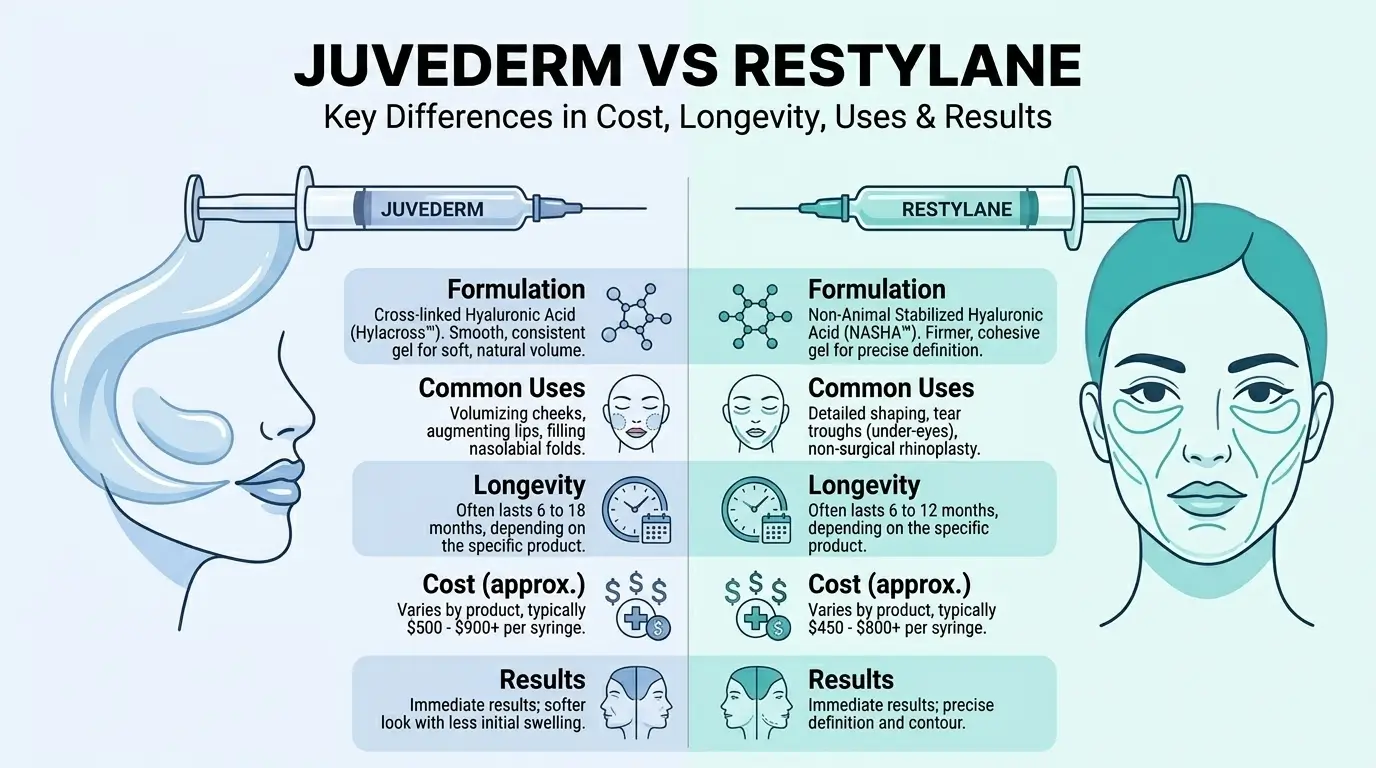
Juvederm and Restylane are both hyaluronic acid dermal fillers used to restore facial volume, smooth wrinkles, and enhance facial features. The main difference is their formulation and texture. Juvederm has a smoother gel consistency, while Restylane offers firmer structural support, making each suitable for different treatment goals and facial areas.
Imagine looking in the mirror and noticing that your smile lines seem deeper or your lips have lost some of their youthful fullness. Many people turn to dermal fillers as a non-surgical solution for facial rejuvenation. Among the most popular options are Juvederm and Restylane.
The Juvederm vs Restylane comparison is one of the most common topics in cosmetic dermatology because both fillers use hyaluronic acid and can produce natural-looking results. However, they differ in texture, longevity, treatment areas, and overall performance.
Understanding these differences can help patients choose the right filler for their aesthetic goals. Whether you’re considering lip enhancement, cheek augmentation, or wrinkle reduction, knowing how Juvederm and Restylane compare is essential before making a decision.
Juvederm vs Restylane at a Glance
| Feature | Juvederm | Restylane |
| Type | Hyaluronic acid filler | Hyaluronic acid filler |
| Texture | Smooth and soft | Slightly firmer and more granular |
| Best Known For | Lip enhancement and volume restoration | Precision correction and facial contouring |
| Duration | 6–24 months depending on product | 6–18 months depending on product |
| Common Areas | Lips, cheeks, nasolabial folds | Lips, under-eyes, cheeks, smile lines |
| FDA Approved | Yes | Yes |
What Is Juvederm?
Juvederm is a family of injectable fillers made from hyaluronic acid. It is designed to add volume, smooth wrinkles, and enhance facial contours. Popular products include Juvederm Voluma, Volbella, Vollure, and Ultra XC.
What Is Restylane?
Restylane is another hyaluronic acid filler brand used for facial rejuvenation. Its product line includes Restylane Lyft, Kysse, Refyne, Defyne, and Silk.
Main Difference
Juvederm generally provides a smoother and softer appearance, while Restylane offers greater structural support and precision.
Key Similarity
Both are FDA-approved hyaluronic acid fillers designed for non-surgical facial enhancement.
Best For Juvederm
- Fuller lips
- Cheek volume
- Smooth facial contours
- Long-lasting results
Best For Restylane
- Fine lines
- Under-eye hollows
- Natural facial shaping
- Precise contour correction
What Is the Difference Between Juvederm and Restylane?
The biggest difference between Juvederm and Restylane is the way their hyaluronic acid gel is formulated.
Juvederm uses a smoother gel technology that spreads evenly beneath the skin, creating soft and natural-looking volume. Restylane uses a firmer gel structure that stays more precisely where it is injected.
As a result, Juvederm is often chosen for larger-volume treatments, while Restylane is frequently selected for targeted corrections and delicate facial areas.
Why Is This Difference Important?
For Patients
Different fillers produce different cosmetic outcomes. Choosing the right one can improve satisfaction and longevity.
For Cosmetic Professionals
Proper filler selection allows practitioners to customize treatments based on facial anatomy and patient goals.
For Anti-Aging Treatments
The right filler can improve facial balance while maintaining a natural appearance.
Real-World Value
Understanding filler differences helps patients make informed decisions and avoid unrealistic expectations.
Pronunciation
| Word | US Pronunciation | UK Pronunciation |
| Juvederm | JOO-vuh-derm | JOO-vuh-derm |
| Restylane | RES-tih-lane | RES-tih-layn |
Before choosing between these fillers, it’s important to understand how they differ in practical use. The following comparison explores the ten most important distinctions.
Juvederm vs Restylane – 10 Key Differences
1. Definition
Juvederm
Juvederm is a collection of smooth hyaluronic acid dermal fillers designed for facial rejuvenation and volume restoration.
Examples:
- Juvederm Voluma
- Juvederm Ultra XC
Real-World Relevance:
Often selected for cheeks and lips where smooth volume is desired.
Restylane
Restylane is a family of hyaluronic acid fillers designed for precision correction and contouring.
Examples:
- Restylane Kysse
- Restylane Lyft
Real-World Relevance:
Commonly used in delicate facial areas requiring detailed correction.
2. Composition and Technology
Juvederm
Uses Vycross and Hylacross technologies to create a smooth gel texture.
Examples:
- Volbella
- Vollure
Real-World Relevance:
Provides a softer feel under the skin.
Restylane
Uses NASHA and XpresHAn technologies for structure and flexibility.
Examples:
- Refyne
- Defyne
Real-World Relevance:
Offers more controlled placement.
3. Texture
Juvederm
Smooth consistency.
Examples:
- Lip enhancement
- Cheek volumization
Real-World Relevance:
Produces a softer and fuller appearance.
Restylane
Slightly firmer consistency.
Examples:
- Under-eye correction
- Facial contouring
Real-World Relevance:
Allows precise sculpting.
4. Treatment Areas
Juvederm
Best for larger-volume areas.
Examples:
- Cheeks
- Lips
Real-World Relevance:
Excellent for restoring youthful fullness.
Restylane
Works well in detailed treatment zones.
Examples:
- Tear troughs
- Fine lines
Real-World Relevance:
Ideal for subtle refinements.
5. Longevity
Juvederm
Many formulations last 12–24 months.
Examples:
- Voluma
- Vollure
Real-World Relevance:
Fewer maintenance appointments.
Restylane
Typically lasts 6–18 months.
Examples:
- Kysse
- Lyft
Real-World Relevance:
May require touch-ups sooner.
6. Injection Experience
Juvederm
Juvederm products often contain lidocaine, a local anesthetic that helps reduce discomfort during treatment.
Examples:
- Lip filler procedures
- Cheek enhancement treatments
Real-World Relevance:
Many patients report a smoother injection experience with minimal discomfort.
Restylane
Most Restylane products also contain lidocaine, although the feel during injection may vary depending on the formulation.
Examples:
- Restylane Kysse
- Restylane Defyne
Real-World Relevance:
Comfort levels are generally similar to Juvederm when administered by an experienced injector.
7. Flexibility and Movement
Juvederm
Juvederm’s smooth gel allows it to move naturally with facial expressions.
Examples:
- Smiling
- Talking
Real-World Relevance:
Can create a softer and more youthful appearance.
Restylane
Certain Restylane products are designed to maintain flexibility while preserving structure.
Examples:
- Refyne
- Defyne
Real-World Relevance:
Provides natural movement without sacrificing support.
8. Precision
Juvederm
Best suited for adding volume over larger treatment areas.
Examples:
- Mid-face volume loss
- Cheek augmentation
Real-World Relevance:
Excellent for restoring youthful facial fullness.
Restylane
Known for precise placement and detailed contouring.
Examples:
- Lip borders
- Under-eye hollows
Real-World Relevance:
Often preferred for targeted corrections.
9. Cost
Juvederm
Generally ranges from $600–$1,200 per syringe depending on the product and provider.
Examples:
- Voluma
- Ultra XC
Real-World Relevance:
Longer-lasting results may reduce the need for frequent touch-ups.
Restylane
Usually costs between $500–$1,000 per syringe.
Examples:
- Lyft
- Kysse
Real-World Relevance:
May offer a slightly lower initial treatment cost.
10. Ideal Candidate
Juvederm
Best for patients seeking smooth volume enhancement and longer-lasting correction.
Examples:
- Fuller lips
- Enhanced cheeks
Real-World Relevance:
Suitable for individuals wanting noticeable but natural-looking results.
Restylane
Best for patients seeking precise correction and subtle contouring.
Examples:
- Under-eye rejuvenation
- Lip definition
Real-World Relevance:
Ideal for detailed facial refinement.
Similarities Between Juvederm and Restylane
- Both use hyaluronic acid as their primary ingredient.
- Both are FDA-approved dermal fillers.
- Both provide non-surgical facial rejuvenation.
- Both can enhance lips, cheeks, and facial contours.
- Both offer temporary yet natural-looking results.
- Both require treatment by qualified medical professionals.
Difference and Similarity Table
| Feature | Juvederm | Restylane |
| Main Ingredient | Hyaluronic Acid | Hyaluronic Acid |
| Texture | Smooth | Firmer |
| Longevity | 12–24 Months | 6–18 Months |
| Best For | Volume Enhancement | Precision Correction |
| Lips | Excellent | Excellent |
| Cheeks | Excellent | Very Good |
| Under-Eyes | Good | Excellent |
| Cost | Moderate to High | Moderate |
| Maintenance | Less Frequent | More Frequent |
| FDA Approved | Yes | Yes |
Cost Comparison
| Cost Factor | Juvederm | Restylane |
| Average Syringe Cost | $600–$1,200 | $500–$1,000 |
| Maintenance Frequency | Lower | Moderate |
| Long-Term Value | High | High |
| Touch-Up Requirement | Less Frequent | Slightly More Frequent |
Real-World Applications
Juvederm
Commonly used for:
- Lip enhancement
- Cheek augmentation
- Smile line correction
- Chin contouring
- Jawline enhancement
Restylane
Commonly used for:
- Under-eye correction
- Lip definition
- Facial contouring
- Fine line treatment
- Nasolabial folds
Common Mistakes and Misconceptions
“Juvederm and Restylane Are the Same”
While both contain hyaluronic acid, they differ in texture, formulation, and intended uses.
“One Is Always Better Than the Other”
The best filler depends on treatment goals, facial anatomy, and provider recommendations.
“Fillers Look Fake”
When properly injected, both fillers can produce natural-looking results.
“Results Are Permanent”
Neither filler is permanent. The body gradually breaks down the hyaluronic acid over time.
Pros and Cons
Juvederm Pros
- Smooth consistency
- Long-lasting results
- Excellent for volume restoration
- Popular for lip enhancement
Juvederm Cons
- May cost more
- Can attract more water in some areas
- Not always ideal for delicate corrections
Restylane Pros
- Precise placement
- Excellent structural support
- Great for under-eye treatment
- Natural contouring results
Restylane Cons
- Some products may not last as long
- Touch-ups may be needed sooner
- Slightly firmer feel in certain areas
Which Is Better?
When Juvederm Is Better
Juvederm is often the better choice for patients who want smoother, fuller, and longer-lasting volume enhancement. Its soft gel consistency makes it particularly effective for lip augmentation, cheek volumization, and reducing deeper facial folds. Many cosmetic providers recommend Juvederm for individuals seeking noticeable but natural-looking results with fewer maintenance appointments. Products like Voluma and Ultra XC are especially popular for restoring lost facial volume and creating youthful contours. If longevity and softness are your top priorities, Juvederm may be the ideal option.
When Restylane Is Better
Restylane is often preferred when precision and structural support are important. Its firmer consistency allows injectors to place the filler more accurately, making it an excellent choice for under-eye hollows, lip definition, and subtle contouring. Products such as Kysse, Refyne, and Defyne are designed to move naturally while maintaining support. If you want detailed facial shaping or treatment in delicate areas, Restylane may provide better results.
Expert Recommendations
For Beginners
If this is your first filler treatment, consult a qualified cosmetic dermatologist or injector who can evaluate your facial anatomy and recommend the most suitable option.
For Lip Enhancement
Both fillers work well, but Juvederm is often chosen for fuller lips, while Restylane Kysse is known for natural movement and definition.
For Cheek Volume
Juvederm Voluma is one of the most popular fillers for restoring cheek volume and facial structure.
For Under-Eye Hollows
Many providers prefer Restylane because of its precision and lower tendency to attract excess water in the tear trough area.
For Long-Term Value
Juvederm often lasts longer, which may reduce maintenance costs over time.
Frequently Asked Questions
Is Juvederm better than Restylane?
Neither filler is universally better. The best choice depends on your treatment goals, facial anatomy, and the area being treated.
Which filler lasts longer?
Many Juvederm products can last up to 24 months, while most Restylane products typically last between 6 and 18 months.
Is Restylane more natural-looking than Juvederm?
Both can produce natural results when injected correctly. Restylane is often favored for precise contouring, while Juvederm is known for smooth volume enhancement.
Which filler is best for lips?
Juvederm Ultra XC and Restylane Kysse are both popular lip fillers. The ideal choice depends on whether you want more fullness or more definition.
Can Juvederm and Restylane be dissolved?
Yes. Both are hyaluronic acid fillers and can usually be dissolved using hyaluronidase if necessary.
Which filler costs more?
Juvederm is often slightly more expensive, although prices vary by provider, location, and product type.
How Both Are Important
Cosmetic Value
Both fillers help restore lost facial volume and improve facial balance.
Anti-Aging Benefits
They reduce the appearance of wrinkles, folds, and age-related volume loss.
Non-Surgical Facial Rejuvenation
Both offer effective alternatives to invasive cosmetic surgery.
Patient Confidence
Many patients report improved self-confidence and satisfaction after treatment.
Final Words
Juvederm and Restylane are among the most trusted dermal fillers available today. While Juvederm generally excels in smooth volume restoration and longevity, Restylane often stands out for precision and structural support. The right choice depends on your individual goals, treatment area, and provider recommendations.
Conclusion
When comparing Juvederm vs Restylane, the most important distinction is how each filler is formulated and where it performs best. Juvederm offers a smoother gel texture that excels at creating soft, youthful volume in areas such as the lips and cheeks. Restylane provides greater precision and support, making it a popular choice for under-eye treatments, facial contouring, and detailed corrections.
Both fillers are FDA-approved, hyaluronic acid-based treatments with proven safety records and impressive results. Rather than asking which filler is universally better, the better question is which filler is best for your specific needs. Consulting an experienced cosmetic professional can help ensure the best outcome and the most natural-looking results.
Learn more related article:
Technician vs Mechanic: Key Differences, and Career Paths