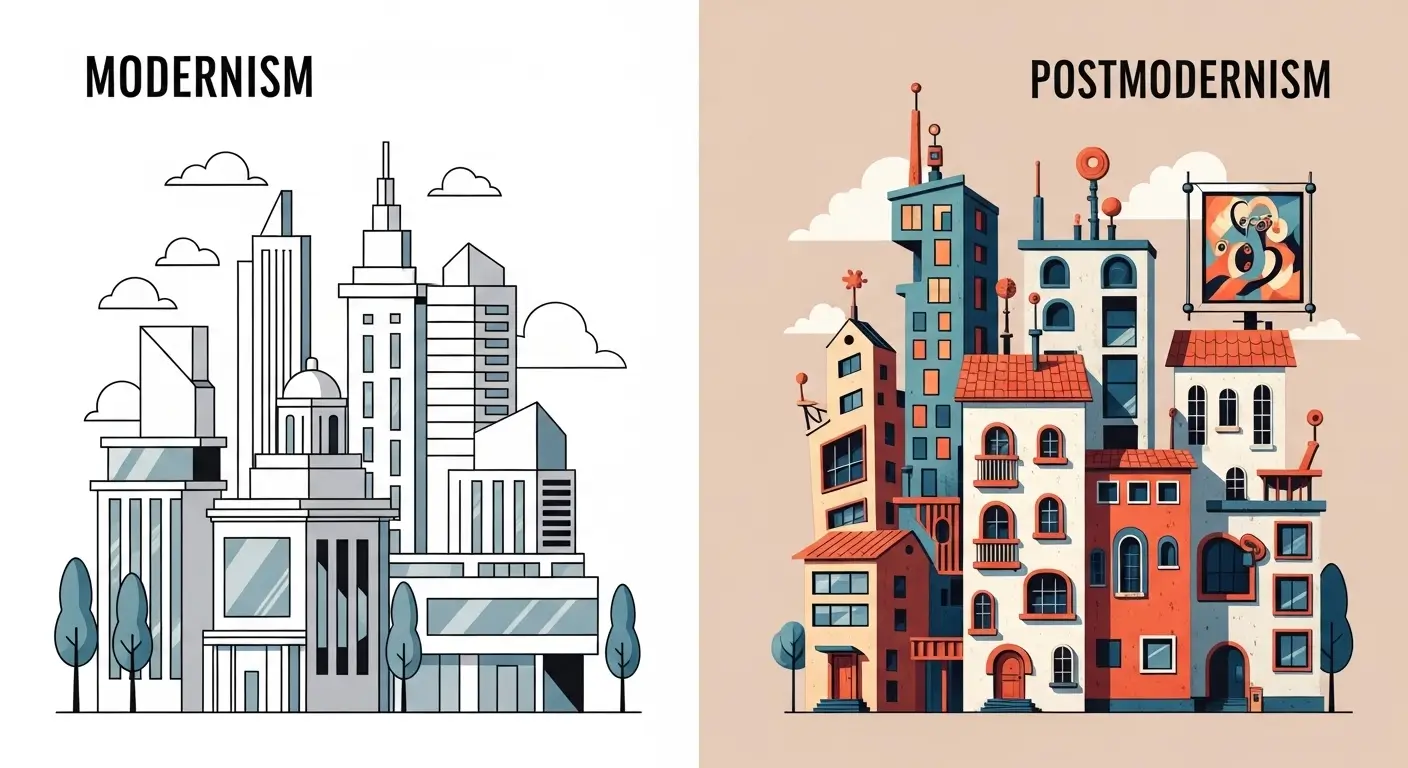
A few years ago, an architecture student visited two buildings in the same city. One was sleek, minimal, and functional—everything had a purpose.
The other was colorful, playful, and mixed styles in unexpected ways. When asked which one made more sense, the student smiled and said, “The first is modernism, the second is postmodernism.”
This simple real-world moment explains the difference between modernism and postmodernism. People often search for the difference between modernism and postmodernism because both terms appear similar yet represent very different ideas.
Understanding the difference between modernism and postmodernism helps students, writers, and thinkers interpret art, culture, and literature more clearly. In fact, the difference between modernism and postmodernism is not just academic—it reflects how society itself has evolved over time.
Key Difference Between the Both
Modernism focuses on order, logic, and universal truths, while postmodernism challenges these ideas by embracing complexity, diversity, and subjective interpretations.
Why Is Their Difference Important for Learners and Experts?
Understanding these concepts helps learners analyze literature, art, and philosophy with depth. For experts, it provides tools to interpret cultural shifts and societal changes. In society, these ideas influence architecture, media, education, and even everyday thinking—shaping how we see truth, identity, and creativity.
Pronunciation (US & UK)
- Modernism
- US: /ˈmɑː.dɚ.nɪ.zəm/
- UK: /ˈmɒd.ən.ɪ.zəm/
- Postmodernism
- US: /ˌpoʊstˈmɑː.dɚ.nɪ.zəm/
- UK: /ˌpəʊstˈmɒd.ən.ɪ.zəm/
Now, let’s explore their differences in detail to truly understand how they shape our thinking and creativity.
Difference Between Modernism and Postmodernism
1. View of Truth
- Modernism believes in one universal truth.
Example 1: Scientific laws are fixed and reliable.
Example 2: A novel has one clear meaning. - Postmodernism believes truth is subjective.
Example 1: Truth changes based on perspective.
Example 2: A story can have multiple meanings.
2. Approach to Structure
- Modernism values structure and order.
Example 1: Symmetrical buildings.
Example 2: Linear storytelling. - Postmodernism embraces chaos and fragmentation.
Example 1: Irregular architecture.
Example 2: Non-linear narratives.
3. Attitude Toward Tradition
- Modernism rejects tradition to create new forms.
Example 1: Breaking classical art rules.
Example 2: New writing styles. - Postmodernism mixes old and new styles.
Example 1: Combining classical and modern art.
Example 2: Parody of traditional stories.
4. Focus in Art and Literature
- Modernism focuses on originality.
Example 1: Unique artistic styles.
Example 2: Individual expression. - Postmodernism focuses on imitation and remixing.
Example 1: Referencing other works.
Example 2: Pastiche and parody.
5. Tone and Style
- Modernism is serious and formal.
Example 1: Deep philosophical themes.
Example 2: Structured writing tone. - Postmodernism is playful and ironic.
Example 1: Humor and satire.
Example 2: Breaking seriousness.
6. Role of the Author
- Modernism sees the author as authority.
Example 1: Author controls meaning.
Example 2: Fixed interpretation. - Postmodernism reduces author authority.
Example 1: Reader creates meaning.
Example 2: Open interpretation.
7. Use of Language
- Modernism uses clear and precise language.
Example 1: Direct communication.
Example 2: Logical arguments. - Postmodernism plays with language.
Example 1: Wordplay and ambiguity.
Example 2: Multiple meanings.
8. Reality Representation
- Modernism represents reality objectively.
Example 1: Realistic descriptions.
Example 2: Logical narratives. - Postmodernism questions reality itself.
Example 1: Blurred reality and fiction.
Example 2: Unreal or surreal elements.
9. Philosophy
- Modernism is based on rational thinking.
Example 1: Enlightenment ideas.
Example 2: Faith in progress. - Postmodernism questions rationality.
Example 1: Doubt in progress.
Example 2: Focus on uncertainty.
10. Cultural Perspective
- Modernism promotes universal culture.
Example 1: Global standards.
Example 2: Shared values. - Postmodernism celebrates diversity.
Example 1: Cultural differences.
Example 2: Local identities.
Nature and Behaviour
- Modernism: Organized, logical, serious, and focused on clarity and progress.
- Postmodernism: Flexible, playful, skeptical, and open to multiple interpretations.
Why Are People Confused?
People often confuse these terms because both deal with innovation and change. The shift between them is gradual, not sudden. Also, many modern works contain postmodern elements, making the boundary unclear.
Difference and Similarity Table
| Aspect | Modernism | Postmodernism | Similarity |
| Truth | Universal | Relative | Both explore meaning |
| Structure | Organized | Fragmented | Both innovate forms |
| Style | Serious | Playful | Both creative |
| Tradition | Rejects | Mixes | Both challenge norms |
| Interpretation | Fixed | Open | Both require analysis |
Which Is Better in What Situation?
Modernism is better when clarity, structure, and logical thinking are required. It suits academic writing, scientific research, and formal design where precision matters.
Postmodernism is better in creative fields where flexibility and experimentation are valued. It works well in media, storytelling, and art that aim to challenge norms and engage diverse perspectives.
Use in Metaphors and Similes
- Modernism: “His thinking was like a straight road—clear and direct.”
- Postmodernism: “Her ideas were like a maze—complex and full of surprises.”
Connotative Meanings
- Modernism
- Positive: Progress, clarity
- Negative: Rigidity
- Neutral: Structured thinking
Example: “His modernist approach brought order but limited creativity.”
- Postmodernism
- Positive: Creativity, freedom
- Negative: Confusion
- Neutral: Open interpretation
Example: “The postmodern design was exciting but hard to understand.”
Idioms or Proverbs (Related Usage)
- “Think outside the box” (Postmodernism)
Example: She used a postmodern approach to think outside the box. - “Stick to the basics” (Modernism)
Example: His modernist style showed he believed in sticking to the basics.
Works in Literature
- Modernism
- Ulysses – Novel, James Joyce, 1922
- The Waste Land – Poem, T.S. Eliot, 1922
- Postmodernism
- Gravity’s Rainbow – Novel, Thomas Pynchon, 1973
- Beloved – Novel, Toni Morrison, 1987
Movies Related to the Concepts
- Modernism
- Metropolis (1927, Germany)
- Citizen Kane (1941, USA)
- Postmodernism
- Pulp Fiction (1994, USA)
- The Matrix (1999, USA)
Frequently Asked Questions
1. What is the main difference between modernism and postmodernism?
Modernism seeks truth and order, while postmodernism questions truth and embraces complexity.
2. Which came first?
Modernism came first, followed by postmodernism.
3. Are they opposites?
Not completely—they are more like reactions to each other.
4. Where are they used?
In literature, art, architecture, and philosophy.
5. Why are they important?
They help us understand cultural and intellectual changes in society.
How Both Are Useful for Surroundings
Modernism helps create structured systems like cities, education, and science. Postmodernism encourages creativity, diversity, and innovation in culture and communication.
Final Words for Both
Modernism builds the foundation; postmodernism questions and reshapes it. Both are essential for balanced progress.
Conclusion
The difference between modernism and postmodernism reflects a shift from certainty to questioning, from structure to flexibility. While modernism focuses on order and universal truth, postmodernism opens the door to multiple perspectives and interpretations. Understanding both allows us to appreciate art, literature, and society in a deeper way. Rather than choosing one over the other, recognizing how they complement each other provides a more complete view of human creativity and thought.
Learn more article:
Difference Between Seamstress and Tailor: guide 2026