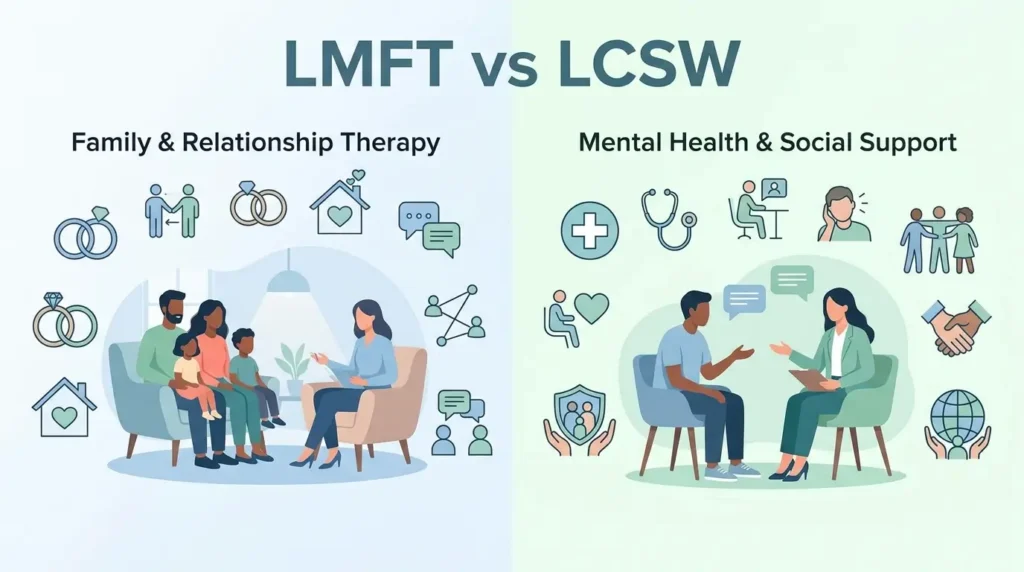
The main difference between LMFT and LCSW is that an LMFT (Licensed Marriage and Family Therapist) mainly focuses on relationships, couples, and family therapy, while an LCSW (Licensed Clinical Social Worker) focuses on mental health counseling, social services, and community support. LMFTs specialize in relationship dynamics, whereas LCSWs provide broader emotional and social care.
A couple once visited a mental health clinic because they were struggling with communication problems and emotional stress. The clinic offered appointments with both an LMFT and an LCSW, which left them confused about whom they should choose.
This situation explains why many people search for the difference between LMFT and LCSW. Both professionals work in mental health and counseling, but their training, focus, and treatment approaches are different.
Understanding the difference between LMFT and LCSW helps students choose the right career path and helps clients find the right mental health professional for their needs.
The difference between LMFT and LCSW is also important because both roles support emotional well-being, relationships, and social health in different ways.
Key Difference Between LMFT and LCSW
The main difference between LMFT and LCSW is that an LMFT focuses mainly on relationships, marriage, and family therapy, while an LCSW focuses on mental health counseling, social services, and community support.
Why Is Their Difference Important to Know?
Understanding the difference between LMFT and LCSW is important for learners, healthcare workers, and clients seeking therapy. Students entering mental health careers need to know which field matches their interests. Clients also benefit because choosing the right professional can improve therapy outcomes. In society, both professions play a major role in emotional wellness, family stability, and mental health awareness.
Pronunciation
| Word | US Pronunciation | UK Pronunciation |
| LMFT | /el-em-ef-tee/ | /el-em-ef-tee/ |
| LCSW | /el-see-es-double-u/ | /el-see-es-double-u/ |
Now that we understand the basics, let us explore the detailed difference between LMFT and LCSW to see how these mental health professions compare.
Difference Between LMFT and LCSW
1. Main Focus
LMFT
Focuses on relationships and family dynamics.
Example 1: Marriage counseling sessions.
Example 2: Family conflict therapy.
Real-world relevance: Helps improve personal relationships.
LCSW
Focuses on mental health and social support.
Example 1: Depression counseling.
Example 2: Community support services.
Real-world relevance: Helps individuals and communities.
2. Educational Background
LMFT
Studies marriage and family therapy programs.
Example 1: Relationship counseling training.
Example 2: Family systems education.
Real-world relevance: Specialized relationship expertise.
LCSW
Studies social work and mental health services.
Example 1: Clinical social work degree.
Example 2: Community care education.
Real-world relevance: Broader healthcare knowledge.
3. Treatment Style
LMFT
Uses relationship-centered therapy methods.
Example 1: Couples communication exercises.
Example 2: Parenting therapy sessions.
Real-world relevance: Improves family interactions.
LCSW
Uses therapy combined with social support.
Example 1: Mental health counseling.
Example 2: Crisis intervention services.
Real-world relevance: Addresses emotional and social needs.
4. Workplace Environment
LMFT
Often works in private therapy clinics.
Example 1: Couples therapy centers.
Example 2: Family counseling offices.
Real-world relevance: Common in relationship therapy settings.
LCSW
Works in hospitals, schools, and agencies.
Example 1: Mental health clinics.
Example 2: Social service organizations.
Real-world relevance: Supports public health systems.
5. Client Type
LMFT
Usually works with couples and families.
Example 1: Married partners.
Example 2: Parent-child relationships.
Real-world relevance: Supports healthy relationships.
LCSW
Works with individuals, groups, and communities.
Example 1: Anxiety patients.
Example 2: Social support cases.
Real-world relevance: Broad mental health support.
6. Community Involvement
LMFT
Less focused on community programs.
Example 1: Private therapy sessions.
Example 2: Relationship workshops.
Real-world relevance: Specialized counseling role.
LCSW
Strong involvement in community services.
Example 1: Social welfare programs.
Example 2: Crisis response support.
Real-world relevance: Helps vulnerable populations.
7. Therapy Goals
LMFT
Improves communication and relationships.
Example 1: Marriage conflict resolution.
Example 2: Family bonding support.
Real-world relevance: Strengthens family systems.
LCSW
Improves mental health and life stability.
Example 1: Emotional recovery counseling.
Example 2: Social adjustment support.
Real-world relevance: Enhances daily functioning.
8. Licensing Path
LMFT
Requires supervised therapy training.
Example 1: Family counseling internship.
Example 2: Relationship therapy exams.
Real-world relevance: Specialized licensing process.
LCSW
Requires supervised clinical social work hours.
Example 1: Hospital social work practice.
Example 2: Clinical mental health supervision.
Real-world relevance: Broad healthcare certification.
9. Professional Identity
LMFT
Identified mainly as relationship therapists.
Example 1: Marriage specialists.
Example 2: Family therapy experts.
Real-world relevance: Known for relational counseling.
LCSW
Identified as clinical social workers.
Example 1: Mental health providers.
Example 2: Social care professionals.
Real-world relevance: Connected with healthcare systems.
10. Career Flexibility
LMFT
Mostly focused on therapy practice.
Example 1: Private counseling offices.
Example 2: Relationship therapy programs.
Real-world relevance: Specialized career path.
LCSW
Has broader career opportunities.
Example 1: Schools and hospitals.
Example 2: Government agencies.
Real-world relevance: Wide professional scope.
Nature and Behaviour of Both
LMFT
LMFT professionals are relationship-focused, empathetic, and communication-oriented. Their work centers on helping couples and families understand each other better and solve emotional conflicts.
LCSW
LCSWs are community-focused, supportive, and problem-solving professionals. They combine therapy with social care to improve emotional health and life conditions.
Why People Are Confused About Their Use?
People often confuse LMFT and LCSW because both provide counseling and mental health therapy. They may also work in similar clinics and help people with emotional problems. However, their educational focus and treatment approaches are different.
Difference and Similarity Table
| Feature | LMFT | LCSW |
| Main Focus | Relationships and families | Mental health and social work |
| Workplace | Therapy clinics | Hospitals, schools, agencies |
| Client Type | Couples and families | Individuals and communities |
| Educational Path | Marriage and family therapy | Social work |
| Similarity | Both provide counseling and emotional support |
Which Is Better in What Situation?
LMFT
An LMFT is better when someone needs relationship or family counseling. Couples dealing with communication issues, parenting conflicts, or marriage stress often benefit from an LMFT because these professionals specialize in relationship dynamics and emotional connection within families.
LCSW
An LCSW is better when someone needs broader mental health or social support services. Individuals facing anxiety, depression, trauma, or social difficulties may benefit more from an LCSW because they combine counseling with healthcare and community resources.
Metaphors and Similes
- “The LMFT worked like a bridge connecting family members.”
- “The LCSW acted like a guide helping people through emotional storms.”
- “Their counseling support was strong like a family foundation.”
- “The therapist listened gently like a trusted friend.”
Connotative Meaning
LMFT
- Positive: Connection, healing, communication
Example: “LMFT therapy improved family understanding.” - Neutral: Relationship counseling profession
Example: “She works as an LMFT.”
LCSW
- Positive: Support, care, social healing
Example: “The LCSW helped the patient recover emotionally.” - Neutral: Clinical social work profession
Example: “He became a licensed LCSW.”
Idioms or Proverbs
- “Communication is the key.”
Example: LMFT therapy teaches that communication is the key to healthy relationships. - “A helping hand makes a difference.”
Example: LCSWs provide a helping hand during difficult times.
Works in Literature
- Family Therapy: Concepts and Methods — Psychology, Michael P. Nichols, 1984
- Social Work Practice — Educational, Louise C. Johnson, 1995
Movies Related to the Topic
- Marriage Story — 2019, USA
- Good Will Hunting — 1997, USA
Frequently Asked Questions
1. What is the main difference between LMFT and LCSW?
LMFT focuses on relationships and family therapy, while LCSW focuses on mental health and social support.
2. Can both provide therapy?
Yes. Both LMFTs and LCSWs provide counseling and therapy services.
3. Which is better for marriage counseling?
LMFT is usually better for marriage and relationship counseling.
4. Which profession works more in hospitals?
LCSWs commonly work in hospitals and healthcare systems.
5. Are both licensed professionals?
Yes. Both require education, supervision, and licensing exams.
How Both Are Useful for Society
Both LMFTs and LCSWs improve mental health and emotional well-being in society. They help individuals, couples, and families manage stress, relationships, trauma, and emotional challenges. Their work strengthens communities and supports healthier lives.
Final Words for Both
LMFT focuses on relationships and family healing, while LCSW combines mental health therapy with social and community support.
Conclusion
The difference between LMFT and LCSW mainly lies in their focus, training, and treatment approach. LMFT professionals specialize in relationships and family therapy, while LCSWs provide broader mental health and social support services. Understanding the difference between LMFT and LCSW helps people choose the right therapy professional for their needs and helps students select the best career path. Both professions are valuable because they improve emotional health, strengthen relationships, and support healthier communities.
Learn about related article:
Difference Between Sermorelin and Ipamorelin