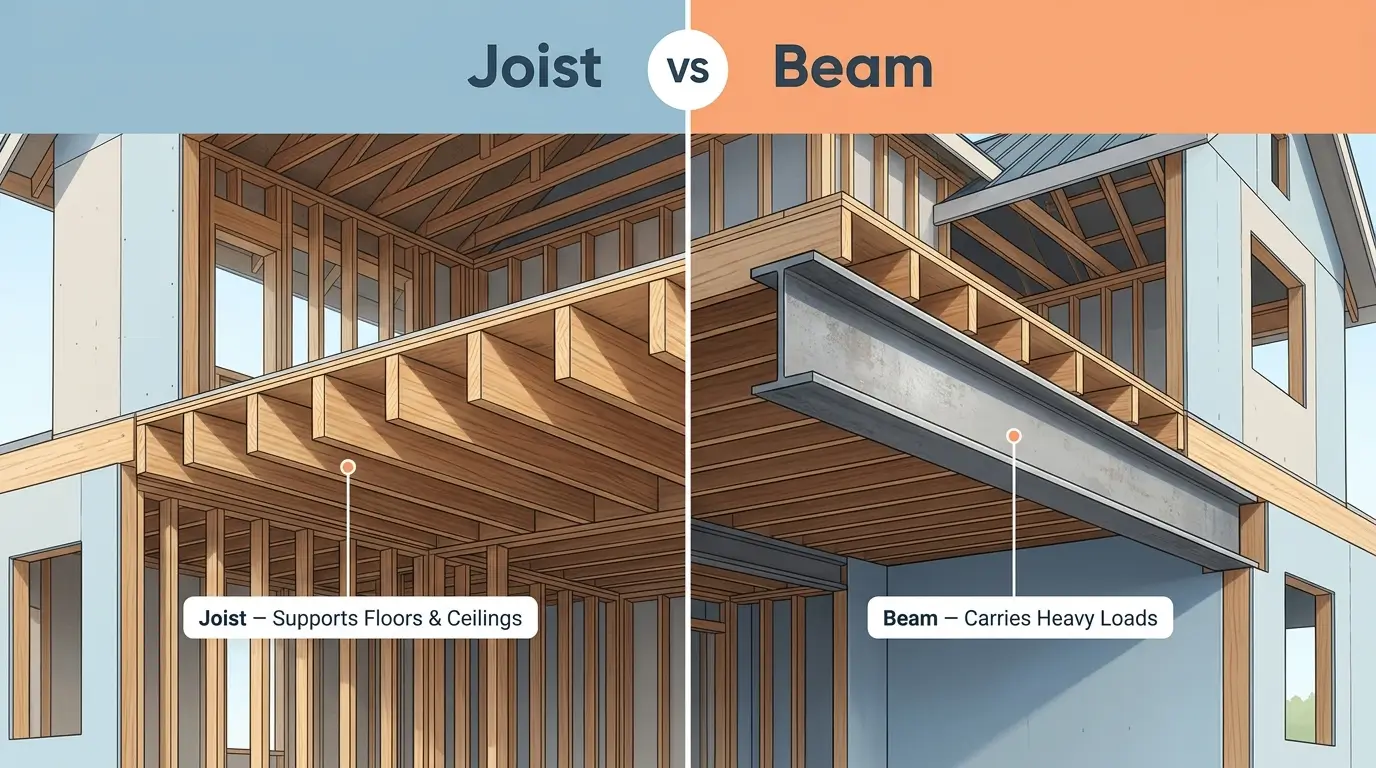
The main difference between joist and beam is that a joist is a smaller horizontal support used for floors and ceilings, while a beam is a larger structural support that carries heavier loads from joists, walls, or roofs. Joists distribute weight evenly across a surface, whereas beams transfer major structural loads to columns or foundations.
A family once decided to renovate their old house and noticed workers discussing joists and beams while building the new floor.
To the homeowners, both looked like long wooden supports, so they wondered about the difference between joist and beam. This confusion is common because both are important structural parts used in construction.
However, they perform different jobs in supporting buildings and distributing weight. Understanding the difference between joist and beam helps homeowners, students, engineers, and builders make better construction decisions.
The difference between joist and beam also improves safety because each component has a unique role in holding floors and ceilings together
. Learning the difference between joist and beam makes construction terms easier to understand and helps people communicate more confidently in building projects.
Key Difference Between Joist and Beam
The main difference between joist and beam is that a joist is a smaller horizontal support used to hold floors or ceilings, while a beam is a larger structural support designed to carry heavy loads from joists, walls, or roofs.
Why Is Their Difference Important to Know?
Understanding the difference between joist and beam is important for students, architects, engineers, and homeowners. Builders need this knowledge to create strong and safe structures. Homeowners also benefit because it helps them understand renovation plans and construction costs. In society, properly designed beams and joists improve building safety, durability, and stability in homes, schools, offices, and bridges.
Pronunciation
| Word | US Pronunciation | UK Pronunciation |
| Joist | /dʒɔɪst/ | /dʒɔɪst/ |
| Beam | /biːm/ | /biːm/ |
Now that we understand the basics, let us explore the detailed difference between joist and beam to see how both support construction structures differently.
Difference Between Joist and Beam
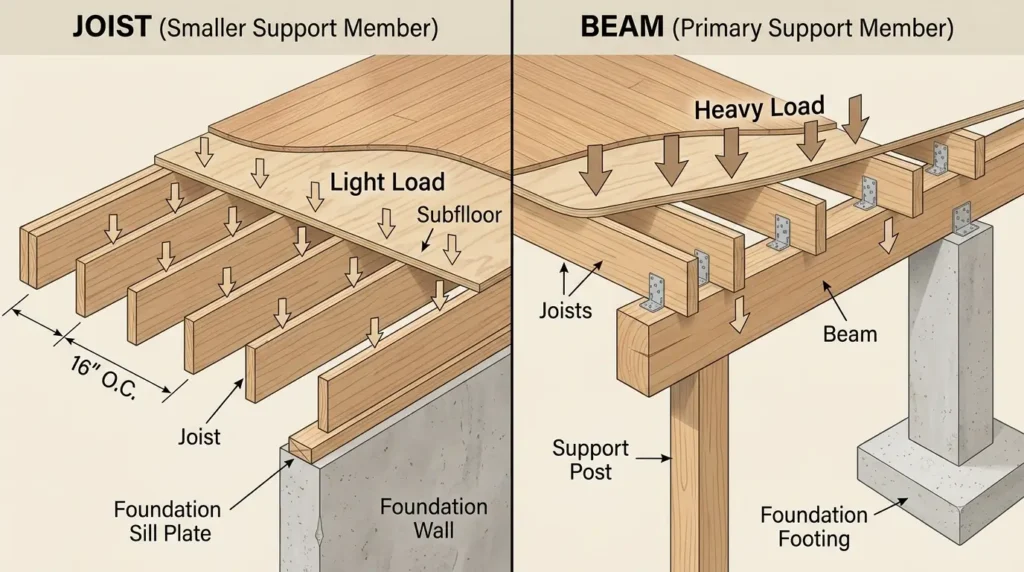
1. Main Function
Joist:
A joist supports floors or ceilings.
Example 1: Floor joists support wooden flooring.
Example 2: Ceiling joists hold ceiling panels.
Real-world relevance: Used in homes and offices.
Beam:
A beam carries heavy structural loads.
Example 1: Steel beams support bridges.
Example 2: Concrete beams hold roof weight.
Real-world relevance: Essential in large structures.
2. Size
Joist:
Usually smaller and lighter.
Example 1: Wooden joists in houses.
Example 2: Thin ceiling joists.
Real-world relevance: Easier to install in small buildings.
Beam:
Larger and stronger.
Example 1: Thick steel beams in skyscrapers.
Example 2: Heavy concrete beams in parking structures.
Real-world relevance: Designed for major support.
3. Load Capacity
Joist:
Carries lighter distributed loads.
Example 1: Furniture weight on floors.
Example 2: Ceiling materials.
Real-world relevance: Suitable for everyday residential use.
Beam:
Handles heavy concentrated loads.
Example 1: Roof structures.
Example 2: Multiple joists resting on one beam.
Real-world relevance: Prevents structural collapse.
4. Position in Structure
Joist:
Placed closely together horizontally.
Example 1: Floor joists under wooden flooring.
Example 2: Ceiling joists across rooms.
Real-world relevance: Creates even support.
Beam:
Placed beneath joists or walls.
Example 1: Main support beam in basement.
Example 2: Roof beam in halls.
Real-world relevance: Transfers weight downward.
5. Material Used
Joist:
Often made from wood or light steel.
Example 1: Pine wood joists.
Example 2: Engineered wood joists.
Real-world relevance: Common in residential homes.
Beam:
Made from steel, reinforced concrete, or heavy timber.
Example 1: Steel I-beams.
Example 2: Reinforced concrete beams.
Real-world relevance: Used in large buildings.
6. Spacing
Joist:
Installed with regular spacing.
Example 1: Joists every 16 inches.
Example 2: Ceiling joists placed evenly.
Real-world relevance: Provides balanced floor support.
Beam:
Installed farther apart.
Example 1: Main support beams in warehouses.
Example 2: Bridge support beams.
Real-world relevance: Supports large spans.
7. Structural Importance
Joist:
Supports surface structures.
Example 1: Holds floorboards.
Example 2: Supports ceiling drywall.
Real-world relevance: Important for interior support.
Beam:
Supports major building loads.
Example 1: Supports multiple floors.
Example 2: Carries wall loads.
Real-world relevance: Critical for structural integrity.
8. Shape and Design
Joist:
Usually narrow and repetitive.
Example 1: Wooden rectangular joists.
Example 2: Metal joists in ceilings.
Real-world relevance: Simplifies construction layout.
Beam:
Often thicker and specially engineered.
Example 1: I-shaped steel beams.
Example 2: Wide concrete beams.
Real-world relevance: Designed for strength.
9. Common Usage
Joist:
Common in floors and ceilings.
Example 1: Residential flooring systems.
Example 2: Attic ceiling support.
Real-world relevance: Found in most houses.
Beam:
Used in foundations, bridges, and roofs.
Example 1: Highway bridges.
Example 2: Commercial buildings.
Real-world relevance: Important for large-scale projects.
10. Cost
Joist:
Generally less expensive.
Example 1: Wooden joists in homes.
Example 2: Standard floor systems.
Real-world relevance: Budget-friendly for housing.
Beam:
Usually more costly due to strength requirements.
Example 1: Steel beam installation.
Example 2: Reinforced concrete beams.
Real-world relevance: Higher cost but stronger support.
Nature and Behaviour of Both
Joist
Joists behave as secondary support systems that evenly distribute lighter loads across floors and ceilings. They are practical, repetitive, and flexible for residential construction.
Beam
Beams act as primary structural supports that carry heavy loads and transfer them to columns or foundations. They are stronger, larger, and more critical in structural engineering.
Why People Are Confused About Their Use?
People often confuse joists and beams because both are horizontal supports used in construction. They can also look similar to non-experts. However, their load capacity, size, and structural purpose are very different.
Difference and Similarity Table
| Feature | Joist | Beam |
| Main Role | Supports floors and ceilings | Carries heavy structural loads |
| Size | Smaller | Larger |
| Load Capacity | Light to medium loads | Heavy loads |
| Placement | Closely spaced | Main support position |
| Material | Wood or light steel | Steel, concrete, timber |
| Similarity | Both support building structures |
Which Is Better in What Situation?
Joist
A joist is better for supporting floors and ceilings in residential buildings where evenly distributed lightweight support is needed. It works well in homes, apartments, and small offices because it provides stable flooring and ceiling systems without excessive cost. Builders use joists when they need multiple evenly spaced supports across a room.
Beam
A beam is better when a structure must handle heavy loads or large open spaces. It is ideal for bridges, commercial buildings, warehouses, and roofs that require strong structural support. Engineers choose beams when safety, strength, and load-bearing capacity are the top priorities.
Metaphors and Similes
- “The beam stood strong like the backbone of the building.”
- “The joists worked together like a team carrying equal weight.”
- “His leadership was solid like a steel beam.”
- “Their support system spread evenly like floor joists.”
Connotative Meaning
Joist
- Positive: Support, balance, stability
Example: “The joists created a stable foundation.” - Neutral: Construction component
Example: “Workers installed new joists.”
Beam
- Positive: Strength, power, reliability
Example: “The beam carried the entire structure safely.” - Neutral: Structural support element
Example: “Concrete beams were added to the design.”
Idioms or Proverbs
- “Built on a strong foundation.”
Example: A house with strong beams is built on a strong foundation. - “Support holds everything together.”
Example: Joists and beams prove that support holds everything together.
Works in Literature
- Building Construction Illustrated — Educational, Francis D. K. Ching, 1975
- Structures: Or Why Things Don’t Fall Down — Engineering, J. E. Gordon, 1978
Movies Related to the Topic
- Dream Big: Engineering Our World — 2017, USA
- Skyscraper — 2018, USA
Frequently Asked Questions
1. What is the main difference between joist and beam?
A joist supports floors or ceilings, while a beam carries heavier structural loads.
2. Is a beam stronger than a joist?
Yes. Beams are larger and designed for heavier loads.
3. Are joists and beams both horizontal?
Yes, both are usually horizontal structural supports.
4. Can a building have joists without beams?
Small structures sometimes can, but most buildings use beams for major support.
5. Which is more expensive?
Beams are usually more expensive because they carry heavier loads.
How Both Are Useful for Society
Joists and beams are essential in modern construction. They support homes, schools, hospitals, offices, and bridges. Without them, safe and durable buildings would not exist. Together, they improve public safety, infrastructure, and living conditions.
Final Words for Both
Joists provide balanced floor and ceiling support, while beams deliver the heavy structural strength that keeps buildings stable and secure.
Conclusion
The difference between joist and beam mainly lies in their strength, size, and structural role. Joists are smaller supports designed for floors and ceilings, while beams are larger components that carry heavy loads across a structure. Understanding the difference between joist and beam helps homeowners, builders, and students better understand construction systems and building safety. Both components work together to create strong and durable structures used in everyday life. Whether in homes, bridges, or skyscrapers, joists and beams remain essential parts of modern engineering and architecture.
Learn more related article:
Difference Between Witch and Warlock :(guide 2026)