On a bright morning, a teacher once asked students why ancient people worshipped the sun. One student mentioned Helios, while another spoke about Apollo.
Both names appeared connected to the sun, yet their roles in mythology were not exactly the same. This simple classroom moment shows why many people search for the difference between Helios and Apollo.
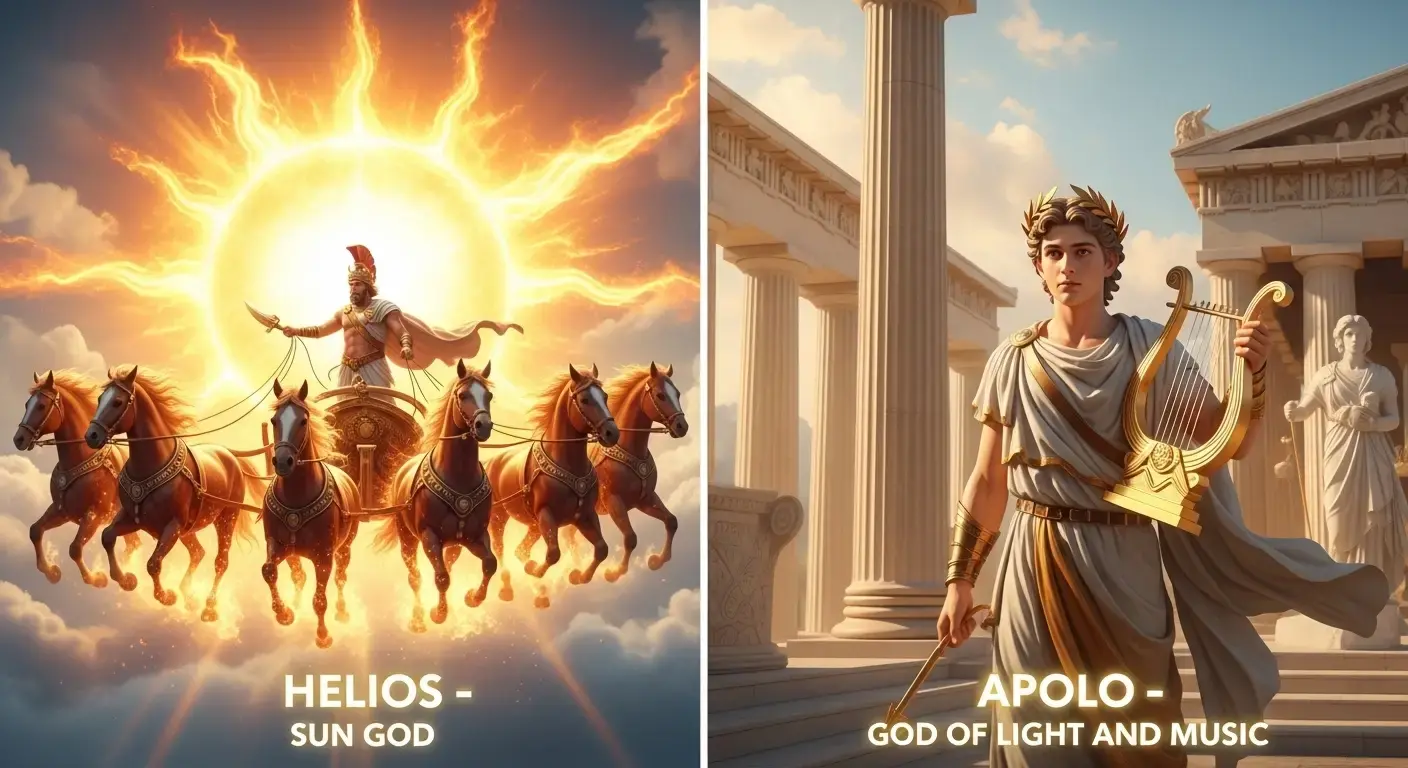
In Greek mythology, Helios is the original sun god who drives the sun chariot across the sky each day. Apollo, on the other hand, is a powerful Olympian god associated with light, music, prophecy, and later connected to the sun.
Understanding the difference between Helios and Apollo helps readers appreciate mythology, literature, and ancient culture. The difference between Helios and Apollo also explains how myths evolve over time and how different gods share similar symbols.
Key Difference Between Helios and Apollo
The main difference between Helios and Apollo is their original roles in Greek mythology. Helios is the personification of the sun itself, while Apollo is a multi-talented Olympian god who later became associated with sunlight and light.
Why Is Their Difference Important to Know?
Knowing the difference between Helios and Apollo helps students, historians, and mythology lovers understand ancient Greek beliefs. For learners, it clarifies myths and stories that appear in literature and art. For scholars and experts, the distinction shows how mythology developed over time. In society today, references to these gods appear in books, movies, and academic discussions, so understanding their difference adds cultural knowledge and historical awareness.
Pronunciation
| Name | US Pronunciation | UK Pronunciation |
| Helios | /ˈhiːliˌoʊs/ | /ˈhiːliɒs/ |
| Apollo | /əˈpɑːloʊ/ | /əˈpɒləʊ/ |
Linking Hook:
Now that we know the basic roles of these gods, let’s explore the detailed difference between Helios and Apollo to understand how they compare in mythology and culture.
1. Role in Greek Mythology
Helios: The original sun god who drives the sun chariot across the sky.
Example 1: In myths, Helios rises every morning in a golden chariot.
Example 2: Ancient Greeks believed Helios watched everything from the sky.
Apollo: A major Olympian god connected with music, prophecy, healing, and later sunlight.
Example 1: Apollo plays the lyre in many myths.
Example 2: He delivers prophecies through the Oracle of Delphi.
2. Status Among Gods
Helios: A Titan god belonging to the older generation of deities.
Example 1: Helios existed before many Olympian gods.
Example 2: He represents natural cosmic power.
Apollo: One of the twelve Olympian gods.
Example 1: Apollo lives on Mount Olympus.
Example 2: He is the son of Zeus and Leto.
3. Main Symbol
Helios: The shining sun chariot.
Example 1: Helios drives horses pulling the sun across the sky.
Example 2: His crown often appears as sun rays.
Apollo: The lyre and laurel wreath.
Example 1: Apollo is known as the god of music.
Example 2: Laurel leaves symbolize victory and poetry.
4. Domain and Powers
Helios: Controls sunlight and the daily movement of the sun.
Example 1: He watches the earth from above.
Example 2: His power represents daylight.
Apollo: Controls many areas including music, healing, prophecy, and light.
Example 1: Apollo heals diseases.
Example 2: He inspires poets and musicians.
5. Family Background
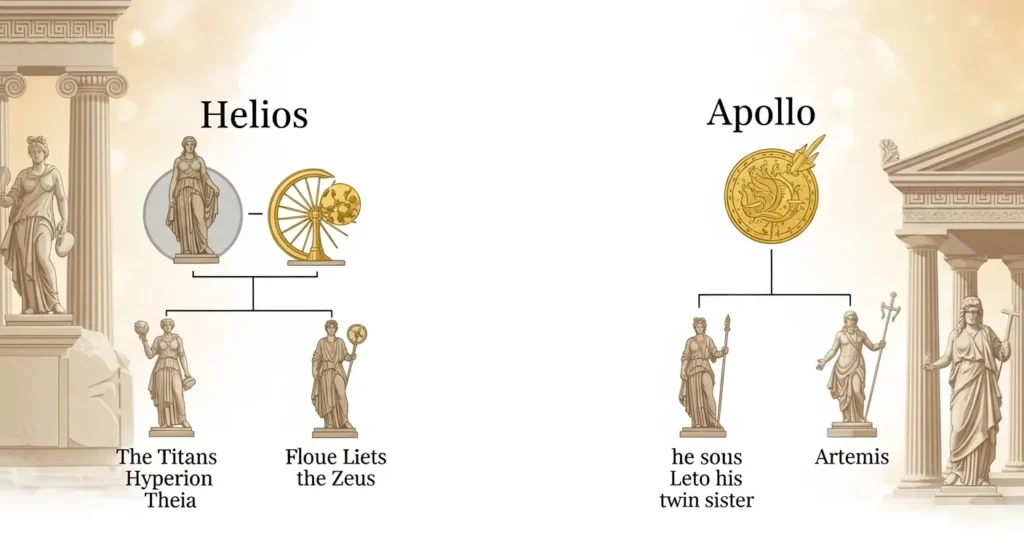
Helios: Son of the Titans Hyperion and Theia.
Example 1: His sisters are Selene (moon) and Eos (dawn).
Example 2: His family represents natural celestial forces.
Apollo: Son of Zeus and Leto.
Example 1: His twin sister is Artemis.
Example 2: He belongs to the Olympian generation.
6. Mythological Stories
Helios: Appears mainly in stories about the sun’s journey.
Example 1: Helios witnessed the kidnapping of Persephone.
Example 2: He warned about the cattle of the sun in Homer’s Odyssey.
Apollo: Appears in many myths across Greek literature.
Example 1: Apollo defeated the serpent Python.
Example 2: He guided heroes and prophets.
7. Cultural Influence
Helios: Symbolizes the physical sun.
Example 1: Statues often show Helios with radiant crowns.
Example 2: The Colossus of Rhodes represented Helios.
Apollo: Symbolizes art, beauty, and wisdom.
Example 1: Apollo inspired Greek poetry and music.
Example 2: Many temples were dedicated to him.
8. Personality
Helios: Calm and observant.
Example 1: He watches the world from above.
Example 2: He reveals hidden truths.
Apollo: Artistic and powerful.
Example 1: He rewards creativity.
Example 2: He punishes arrogance.
9. Historical Development
Helios: Worshipped mainly in early Greek religion.
Example 1: Ancient Greeks prayed to Helios for sunlight.
Example 2: Early myths focused on his daily journey.
Apollo: Became one of the most popular Greek gods.
Example 1: Temples to Apollo existed across Greece.
Example 2: His worship spread widely.
10. Representation in Art
Helios: Usually shown with a radiant sun crown.
Example 1: Ancient statues depict him with shining rays.
Example 2: Paintings show him riding a chariot.
Apollo: Shown as a youthful god with a lyre or bow.
Example 1: Sculptures present him as a symbol of beauty.
Example 2: Art often shows him guiding muses.
Nature and Behaviour of Both
Helios:
Helios represents stability and cosmic order. His daily journey across the sky symbolizes reliability and natural rhythm.
Apollo:
Apollo represents creativity, harmony, and intellectual power. His nature reflects beauty, balance, and artistic inspiration.
Why People Are Confused About Their Use
People often confuse Helios and Apollo because both are connected to sunlight. Over time, Greek myths started linking Apollo with the sun, which made their roles appear similar.
Table Showing Difference and Similarity
| Feature | Helios | Apollo |
| Role | Sun god | God of light, music, prophecy |
| Generation | Titan | Olympian |
| Symbol | Sun chariot | Lyre and laurel |
| Family | Hyperion and Theia | Zeus and Leto |
| Similarity | Both associated with light |
Which Is Better in What Situation?
Helios:
Helios is better when discussing the literal sun in mythology. He represents the physical movement of the sun and natural cosmic power.
Apollo:
Apollo is better when discussing art, music, prophecy, and intellectual light. He symbolizes creativity, culture, and divine inspiration.
Metaphors and Similes
- “His leadership was bright like Helios rising in the sky.”
- “Her talent shone like Apollo’s light in music.”
Connotative Meaning
Helios – Positive / Neutral
Represents clarity, visibility, and cosmic power.
Example: “Truth rose like Helios in the morning.”
Apollo – Positive
Represents beauty, intelligence, and creativity.
Example: “The artist performed with Apollo-like brilliance.”
Idioms or Proverbs (Creative Usage)
“Bright as Helios”
Example: Her smile was bright as Helios.
“Inspired by Apollo”
Example: The musician played as if inspired by Apollo.
Works in Literature
- The Iliad – Epic Poetry, Homer, 8th century BCE
- The Odyssey – Epic Poetry, Homer, 8th century BCE
- Metamorphoses – Mythological Poetry, Ovid, 8 CE
Movies Featuring These Mythological Figures
- Clash of the Titans (1981, USA/UK)
- Percy Jackson & the Olympians: The Lightning Thief (2010, USA)
Frequently Asked Questions
1. Are Helios and Apollo the same god?
No. Helios is the sun god, while Apollo is an Olympian god later associated with sunlight.
2. Who came first in mythology?
Helios existed earlier as a Titan deity.
3. Why is Apollo linked with the sun?
Later Greek traditions connected Apollo with sunlight and light.
4. Who drives the sun chariot?
Helios drives the sun chariot across the sky.
5. Which god represents music?
Apollo is the god of music and poetry.
How Both Are Useful for Surroundings
Both figures enrich culture, literature, and education. They help people understand ancient beliefs and inspire modern art, storytelling, and symbolism.
Final Words for Both
Helios represents the physical power of the sun, while Apollo represents artistic and intellectual light.
Conclusion
The difference between Helios and Apollo lies mainly in their mythological roles and origins. Helios is the ancient Titan who personifies the sun itself, guiding its daily journey across the sky. Apollo, in contrast, is a versatile Olympian god known for music, prophecy, healing, and later associations with sunlight. Understanding the difference between Helios and Apollo helps readers appreciate Greek mythology more deeply and recognize how ancient cultures interpreted natural forces and artistic inspiration. Both gods remain powerful symbols of light, knowledge, and creativity in literature and culture.
Learn more related article:
Difference Between Latte and Cortado: A Simple Coffee Guide